
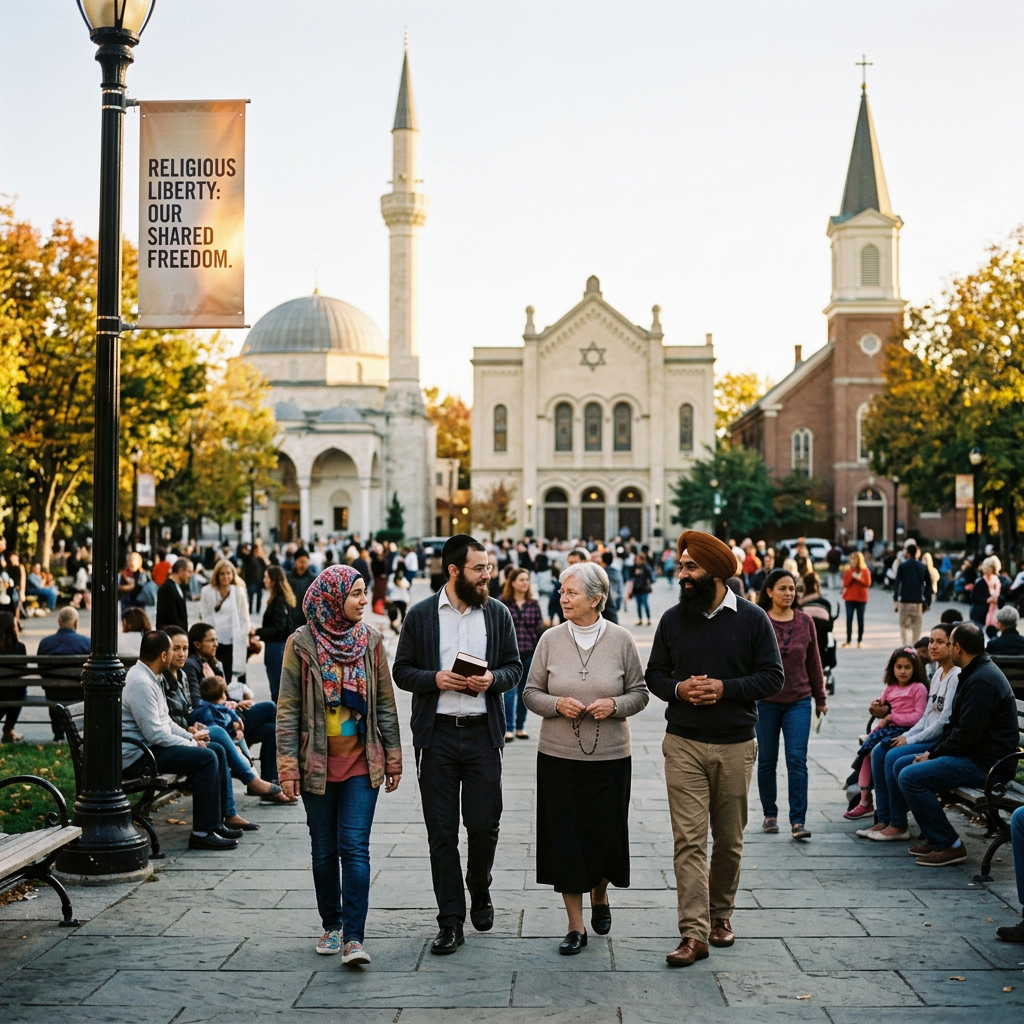
I call the image above an example of the utopia dream many across America share. I say this not because I care nothing about getting along with our neighbors. After all, Jesus commands it. No, I, too, wish we could all live together without strife, but we all know, or should know, that man’s sinful nature prevents that.
So what is Religious Liberty? Here is a simple definition I found online: Religious liberty is the fundamental right of individuals to hold, or not hold, religious beliefs and to practice their faith, or refrain from practicing, without government interference. This freedom protects both individual conscience and the public expression of religion, ensuring the state remains neutral.1
Do you agree with this definition? I can tell you I do not. The full or better definition from the same source is at the end of this post, and it states: without undue [government] interference. Subtle but an important difference. Are there limits to Religious Liberty? Yes. Are there times when the government should interfere in a person or group’s Religious Liberty? Yes.
I may be the only one, but I believe the government has a duty to protect its citizens. So if one group wants to exercise its liberty at another’s explicit harm, the government has a duty to interfere. If one religious group wants to exercise its liberties and that affects the public as a whole (as in the current situation in France), the government has a duty to interfere. Applied in reverse, no group has a fundamental right to exercise its religious liberty at anyone else’s expense.
What is clear in that definition and in the First Amendment to the U.S. Constitution is ensuring the state remains neutral. This little phrase has huge implications. It means the state, or government, can not favor one religion over another. The state can not interfere with the functions of a religious group (except as noted above), nor can it establish a state religion.
So does this mean the state must not be involved in religious activities at all? Of course not:
Congress shall make no law respecting an establishment of religion, or prohibiting the free exercise thereof; or abridging the freedom of speech, or of the press; or the right of the people peaceably to assemble, and to petition the Government for a redress of grievances.
Congress, meaning the Federal Government as a whole, cannot establish, prohibit, or abridge (lessen) citizens’ rights regarding religion and speech. Just as the government must not interfere with an individual’s exercise of their First Amendment rights, citizens must not abuse those rights.
As Christians, we have a dual responsibility. Jesus said we are to render unto Caesar (the government) what is due them and to obey those appointed over us. The Bible is equally clear that we must obey God’s Law above man’s and not use our liberty in Christ in a manner that does not glorify Him.
STUDY

The Limits of Religious Liberty
By: John Stonestreet and Andrew Carico
Religious Liberty is Good for Everyone for Many Reasons

The Meaning of Religious Liberty
What You Need to Know About Religious Freedom | The Heritage Foundation
Religious Liberty and the Fracturing of Civil Society by Andrew Walker

1Definition of religious liberty
Religious liberty is a fundamental right that protects an individual’s freedom to believe in, practice, and express their religious faith (or to hold no religious beliefs) without undue interference from the government. It also ensures that the government cannot establish an official religion, favor one religion over others, or compel individuals to participate in religious practices against their will. This right allows people to follow their conscience in matters of faith, provided their practices do not infringe upon the rights and safety of others.
Here are some examples illustrating religious liberty:
- Example 1: Individual Religious PracticeA university student from a particular faith requests a specific dietary accommodation in the dining hall, such as kosher or halal meals, to align with their religious dietary laws. The university, as a public or federally funded institution, generally provides these options.This illustrates religious liberty because the student is exercising their right to practice their religion through dietary choices. The university’s accommodation respects this right by allowing the student to adhere to their religious beliefs without undue burden.
- Example 2: Freedom from Government Establishment of ReligionA public school district decides to remove a large, permanent display of the Ten Commandments from the wall of its main administrative building after a complaint from a local resident.This demonstrates religious liberty by showing the government (in this case, a public school district) acting to avoid establishing or endorsing a particular religion. Displaying a specific religious text prominently in a government building could be seen as favoring one religion, which violates the principle of religious liberty that prevents government entanglement with religion.
- Example 3: Collective Religious ExpressionA small religious community seeks to purchase land and build a new house of worship in a residential area. The local zoning board must consider their application fairly, applying the same criteria as they would for any other community building, without discrimination based on the group’s religious affiliation.This highlights religious liberty by showing the freedom of a group to collectively practice their faith by establishing a dedicated space for worship and community activities. The zoning board’s obligation to treat their application without religious discrimination upholds the principle that religious groups have the right to organize and build their institutions.
Last updated: July 2026 · Part of LSD.Law’s Legal Dictionary
Discover more from Faithful Steward Ministries and FSM Women's Outreach
Subscribe to get the latest posts sent to your email.

