
OOPS, forgot to hit the publish button twice yesterday 🙃

.
“Deliver me out of the mire, and let me not sink.”
COMMENTS
I may be wrong (it happens now and then 😇🤣), but I think Christians are the least likely to admit to being overwhelmed. We have this distorted sense that once saved, everything should be easy and awesome. That is fantasy land, not real-world Christianity. I don’t care how many times you say I am blessed while greeting others or name and claim a smooth life; God is in control, and He is under no obligation to release us from the mire of daily life. We are here for His glory; He is not here for our pleasure.
But is that the way God expects us to live? Are we to trudge along and just put up with it, do nothing? I would argue no. The following quote reminds me that we are not an island in the midst of turmoil:
You can tell the size of your God by looking at the size of your worry list. The longer your list, the smaller your God.
Ron Rhodes, 1001 Unforgettable Quotes About God, Faith, and the Bible (Eugene, OR: Harvest House Publishers, 2011).
—Anonymous
Bible Truth Behind the Quote:
“Do not be anxious about anything, but in everything by prayer and supplication with thanksgiving let your requests be made known to God. And the peace of God, which surpasses all understanding, will guard your hearts and your minds in Christ Jesus” (Philippians 4:6-7).
So what do we do about the turmoil in our lives? Just suck it up, and that is it? The apostle Paul, in writing to the church at Thessalonica, exhorts them to pray without ceasing. The context is simple: we are to v.16 rejoice always, v.17 pray always and give thanks always, to the Lord. Note how there is no conditional clause applied that says this applies only when you are doing well. No, I would argue the opposite; it is most appropriate when we are down deep in the trenches of life’s battles.
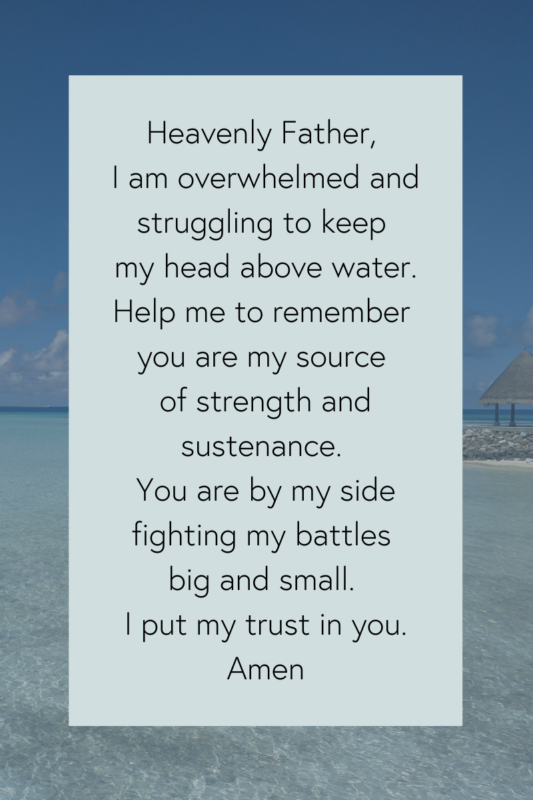
Yet how many times do we share our feelings with others in the church or our Pastor? We have enough trouble communicating basic stuff effectively with our spouses and coworkers, let alone sharing our deepest concerns with others. Is it Biblical to share our worries with others? I would assert absolutely. Read Romans 12:15, Galatians 6:2, 1 Thessalonians 5:11, and James 5:1, and see if you do not agree.
In today’s sermon, Spurgeon speaks of a specific kind of mire: persecution. But his points apply to anyone overwhelmed by any of life’s daily grind.
STUDY
ŌVERWHELM´, v. t. To overspread or crush beneath something violent and weighty, that covers or encompasses the whole; as, to overwhelm with waves. 2. To immerse and bear down; in a figurative sense; as, to be overwhelmed with cares, afflictions, or business. To overlook gloomily. Shak. To put over. [Not used.] O´VERWHELM, n. The act of overwhelming. Young. ŌVERWHELM´ING, ppr. Crushing with weight or numbers. ŌVERWHELM´INGLY, adv. In a manner to overwhelm.
Noah Webster, Noah Webster’s First Edition of An American Dictionary of the English Language. (Anaheim, CA: Foundation for American Christian Education, 2006).
The word “overwhelm” encompasses multiple dimensions of impact: it can mean to submerge or bury completely, to flood someone with emotional intensity, or to defeat through superior force.12 Historically, the term described both physical submersion—such as being engulfed by waves—and metaphorical situations where one becomes immersed in abstract burdens like cares or responsibilities.3
Contemporary usage extends beyond these definitions into the psychological and existential realm. Modern life generates overwhelming circumstances that range from professional crises like job loss to personal traumas including grief, health emergencies, and financial strain.4 What distinguishes these experiences is not merely their severity but their capacity to dominate one’s mental and emotional landscape. When circumstances command constant attention, they create a state of being overwhelmed.4
The distinction between being overwhelmed and overcoming it hinges on perspective. The fundamental choice lies between surrendering to overwhelming conditions or actively working to transcend them.4 Shifting focus away from difficult circumstances toward larger purposes—particularly spiritual ones—can catalyze meaningful change in how one experiences adversity.4 This reframing doesn’t deny the reality of hardship; rather, it repositions one’s relationship to difficulty, transforming passive victimization into active agency. The word “overwhelm” thus captures both a condition one can experience and a threshold one can choose to cross.
- 1COLLINS ENGLISH DICTIONARY. [See here.]
- 2Catherine Soanes and Angus Stevenson, eds., in Concise Oxford English Dictionary (Oxford: Oxford University Press, 2004). [See here, here.]
- 3Noah Webster, in Noah Webster’s First Edition of An American Dictionary of the English Language. (Anaheim, CA: Foundation for American Christian Education, 2006). [See here, here.]
- 4Perry Noble, The Perry Noble Collection: Unleash! / Overwhelmed (Carol Stream, IL: Tyndale Momentum, 2016). [See here, here, here, here.]
LOGOS AI SUMMARY
Ver. 14. Deliver me out of the mire, and let me not sink, &c.] In which he was sinking, ver. 2 and accordingly he was delivered out of it, Psal. 40:2. even out of all the mire of sin, the sins of his people that were upon him, from which he was justified when raised from the dead; and so will appear without sin, when he comes a second time: let me be delivered from them that hate me, and out of the deep waters; these phrases design the same, even the enemies of Christ; such that hated him, compared to deep waters: these are the floods of the ungodly, and the many waters out of which he was drawn and delivered, Psal. 18:4, 16, 17.
John Gill, An Exposition of the Old Testament, vol. 3, The Baptist Commentary Series (London: Mathews and Leigh, 1810), 811.
Ver. 14. Deliver me from the mire, that I may not sink. The Psalmist repeats the same similitude which he had used before, but in a different manner. He had previously said that he was sunk in the mire, and now he prays that he may not sink in it. In short, he now prays that those things may not now befall him which he had formerly complained of as having befallen him. But it is very easy to reconcile this diversity of statement; for in the opening of the psalm he spake according to his actual feeling and experience; but now, looking to the issue, although living in the midst of death, he cherishes the hope of deliverance. This is expressed still more clearly in the last clause of the 15th verse, where he prays, Let not the pit close its mouth upon me; which is as if he had said, Let not the great multitude and weight of my afflictions overwhelm me, and let not sorrow swallow me up.
John Calvin and James Anderson, Commentary on the Book of Psalms, vol. 3 (Bellingham, WA: Logos Bible Software, 2010), 61–62.
What history shaped Psalm 69:14?
Psalm 69 – The King’s Sufferings and Joy
This is one of the three most frequently quoted psalms in the New Testament, the others being Psalms 22 and 110. Besides the direct quotations (see John 2:17; 15:25; Acts 1:16, 20; Romans 11:9–10; 15:3) there are striking parallels between David’s situation and that experienced by our Lord (compare Psalm 69:12, 21 with Matthew 27:29, 34, 48; John 19:28–29). In addition, echoes from the psalm of God’s wrath being poured out (verse 24) and of names being blotted out of the book of life (verse 28) are found in Revelation 16:1 and 21:27.
As the Second Book draws to a close we may wonder why the three following psalms (Psalms 69–71) return to the theme of suffering that characterised earlier psalms in the collection. There has been a rising crescendo of universal praise to the God of Israel in the immediately preceding psalms (Psalms 65–68) and Psalm 72 will bring the collection to a close with all nations acknowledging the king of David’s line. Why spoil this thread by introducing once more pleas for deliverance from the enemy’s cruel threats? It is a reminder to us that the end is not yet (Mark. 13:7–13). The Messiah suffers for his people (1 Corinthians 15:3) and with his people (Acts 9:5). Like the pain a woman in labour suffers while giving birth, so the glory of Messiah’s kingdom comes through trials and tribulation.
Besides the familiar heading ‘To the Chief Musician’ this psalm ‘of David’ (see Acts 1:16, 20; Romans 11:9), like Psalm 45, was ‘Set to “The Lilies” ’. As Calvin observed there are close resemblances between this psalm and Psalm 22. It also bears a number of resemblances to Psalm 40 which is interesting in view of the fact that the following psalm (Psalm 70) is almost identical with Psalm 40:13–17. David is a type of Christ but he also speaks for all God’s people in their sufferings.
As in Psalm 22 the psalm divides into two uneven sections, with the longer section (verses 1–29) alternating between prayer and lament and the shorter one (verses 30–35) given over to praise and trust. There is a striking correspondence within the first section between verses 1–12 and 13–29 (similar to what we find in Psalm 22:1–11 and 12–21) reinforcing the intensity of the distress and cries for help. Interestingly, it is the call for divine vengeance in verses 22–28 that finds no parallel in the initial twelve verses.
Philip Eveson, The Book of Psalms: From Suffering to Glory, vol. 1, Welwyn Commentary Series (Welwyn Garden City, UK: EP, 2014–2015), 419–420.
SERMON
The Believer Sinking in the Mire
Metropolitan Tabernacle, Newington
Discover more from Faithful Steward Ministries and FSM Women's Outreach
Subscribe to get the latest posts sent to your email.

