
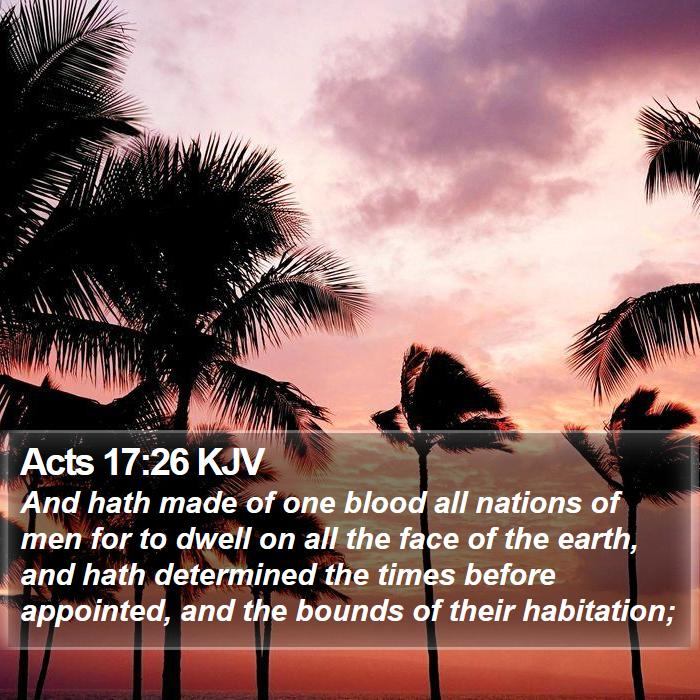
Today, we are back on one of my favorite topics, Sovereignty, and specifically the Sovereignty of God. The main text I chose (see list of 45 possibilities below) describes God in three ways:
- Creator – made of one blood…
- Constant – determined the times before…
- Control – appointed the bounds…
Only someone who has Divine Sovereignty (see definition below) could meet the qualifications for all three of these. Only the God of the Bible has ever made that claim and, more importantly, fulfilled these qualities and more.
So why do I and many others so frequently write and speak on this subject? As I have stated many times, if God is not the Sovereign Ruler of the Universe, why should I or would I worship him? I/we write because so many continue to chase after and worship false gods, while the God of the Bible stands before them.
STUDY
SŎVEREIGN, a. suv´eran. [We retain this barbarous orthography from the Norman souvereign. The true spelling would be suveran, from the L. supernus, superus; Fr. souverain; It. sovrano; Sp. Port. soberano.]
- Supreme in power; possessing supreme dominion; as a sovereign prince. God is the sovereign ruler of the universe.
- Supreme; superior to all others; chief. God is the sovereign good of all who love and obey him.
- Supremely efficacious; superior to all others; predominant; effectual; as a sovereign remedy.
- Supreme; pertaining to the first magistrate of a nation; as sovereign authority.
SŎVEREIGN, n. suv´eran. A supreme lord or ruler; one who possesses the highest authority without control. Some earthly princes, kings and emperors are sovereigns in their dominions. - A supreme magistrate; a king.
- A gold coin of England, value 20s. or $4.44.
SŎVEREIGNĪZE, v. i. suv´eranize. To exercise supreme authority. [Not in use.] Herbert.
SŎVEREIGNLY, adv. suv´eranly. Supremely; in the highest degree.
He was sovereignly lovely in himself. [Little used.] Boyle.
SŎVEREIGNTY, n. suv´eranty. Supreme power; supremacy; the possession of the highest power, or of uncontrollable power. Absolute sovereignty belongs to God only.
Noah Webster, Noah Webster’s First Edition of An American Dictionary of the English Language. (Anaheim, CA: Foundation for American Christian Education, 2006).
sovereignty of God. God’s authority and power to accomplish his will as the supreme Ruler of all things. God expresses his sovereignty through his *decrees and actions, which are planned in complete independence from anything outside himself and enacted throughout *redemptive history. The Reformed tradition recognizes God’s sovereignty over all creation and particularly in his acts of *predestination, *effectual calling, *justification and *glorification of his people. This sovereignty is linked paradoxically and inseparably with human responsibility in a way that resists merely mechanical determinism, although Reformed theologians differ on the nature of human *free will. God’s sovereignty serves as a source of great comfort to Christians, whose hope rests in a God who controls all things for the good of his people and creation.
Kelly M. Kapic and Wesley Vander Lugt, Pocket Dictionary of the Reformed Tradition, The IVP Pocket Reference Series (Downers Grove, IL: IVP Academic, 2013), 112–113.
Acts Chapter 17
Paul at Thessalonica
1–9
The noble conduct of the Bereans
10–15
Paul at Athens
16–21
He preaches there
22–31
The scornful conduct of the Athenians
32–34
Verses 1–9
The drift and scope of Paul’s preaching and arguing, was to prove that Jesus is the Christ. He must needs suffer for us, because he could not otherwise purchase our redemption for us; and he must needs have risen again, because he could not otherwise apply the redemption to us. We are to preach concerning Jesus that he is Christ; therefore we may hope to be saved by him, and are bound to be ruled by him. The unbelieving Jews were angry, because the apostles preached to the Gentiles, that they might be saved. How strange it is, that men should grudge others the privileges they will not themselves accept! Neither rulers nor people need be troubled at the increase of real Christians, even though turbulent spirits should make religion the pretext for evil designs. Of such let us beware, from such let us withdraw, that we may show a desire to act aright in society, while we claim our right to worship God according to our consciences.
Verses 10–15
The Jews in Berea applied seriously to the study of the word preached unto them. They not only heard Paul preach on the sabbath, but daily searched the Scriptures, and compared what they read with the facts related to them. The doctrine of Christ does not fear inquiry; advocates for his cause desire no more than that people will fully and fairly examine whether things are so or not. Those are truly noble, and likely to be more and more so, who make the Scriptures their rule, and consult them accordingly. May all the hearers of the gospel become like those of Berea, receiving the word with readiness of mind, and searching the Scriptures daily, whether the things preached to them are so.
Verses 16–21
Athens was then famed for polite learning, philosophy, and the fine arts; but none are more childish and superstitious, more impious, or more credulous, than some persons, deemed eminent for learning and ability. It was wholly given to idolatry. The zealous advocate for the cause of Christ will be ready to plead for it in all companies, as occasion offers. Most of these learned men took no notice of Paul; but some, whose principles were the most directly contrary to Christianity, made remarks upon him. The apostle ever dwelt upon two points, which are indeed the principal doctrines of Christianity, Christ and a future state; Christ our way, and heaven our end. They looked on this as very different from the knowledge for many ages taught and professed at Athens; they desire to know more of it, but only because it was new and strange. They led him to the place where judges sat who inquired into such matters. They asked about Paul’s doctrine, not because it was good, but because it was new. Great talkers are always busy-bodies. They spend their time in nothing else, and a very uncomfortable account they have to give of their time who thus spend it. Time is precious, and we are concerned to employ it well, because eternity depends upon it, but much is wasted in unprofitable conversation.
Verses 22–31
Here we have a sermon to heathens, who worshipped false gods, and were without the true God in the world; and to them the scope of the discourse was different from what the apostle preached to the Jews. In the latter case, his business was to lead his hearers by prophecies and miracles to the knowledge of the Redeemer, and faith in him; in the former, it was to lead them, by the common works of providence, to know the Creator, and worship Him. The apostle spoke of an altar he had seen, with the inscription, “TO THE UNKNOWN GOD.” This fact is stated by many writers. After multiplying their idols to the utmost, some at Athens thought there was another god of whom they had no knowledge. And are there not many now called Christians, who are zealous in their devotions, yet the great object of their worship is to them an unknown God? Observe what glorious things Paul here says of that God whom he served, and would have them to serve. The Lord had long borne with idolatry, but the times of this ignorance were now ending, and by his servants he now commanded all men every where to repent of their idolatry. Each sect of the learned men would feel themselves powerfully affected by the apostle’s discourse, which tended to show the emptiness or falsity of their doctrines.
Verses 32–34
The apostle was treated with more outward civility at Athens than in some other places; but none more despised his doctrine, or treated it with more indifference. Of all subjects, that which deserves the most attention gains the least. But those who scorn, will have to bear the consequences, and the word will never be useless. Some will be found, who cleave to the Lord, and listen to his faithful servants. Considering the judgement to come, and Christ as our Judge, should urge all to repent of sin, and turn to Him. Whatever matter is used, all discourses must lead to Him, and show his authority; our salvation, and resurrection, come from and by Him.
Matthew Henry and Thomas Scott, Matthew Henry’s Concise Commentary (Oak Harbor, WA: Logos Research Systems, 1997), Ac 17:1–32.
v.26 And hath made of one blood all nations of men for to dwell on all the face of the earth, and hath determined the times before appointed, and the bounds of their habitation;
Hath made of one blood: 1. To teach all charity and compassion towards one another, being so nearly allied to one another. 2. As also to admire God more in that variety that appears in men’s shapes and voices, but especially in the dispositions of their minds; whenas they all come from one stock and stem. Hath determined the times, &c.: the apostle asserts the providence of God against these Athenian philosophers, that nothing comes by chance, or a fatuitous concourse of atoms; but that God is in every thing, though men know it not, or rather will not consider it, Job 7:1; 14:5, 14. This doctrine was preached by Moses, who tells the people, that God is their life, and the length of their days, that they might love him, and obey his voice, and cleave unto him, Deut. 30:20.
Matthew Poole, Annotations upon the Holy Bible, vol. 3 (New York: Robert Carter and Brothers, 1853), 442–443.
Ver. 26. And hath made of one blood, &c.] That is, of one man’s blood; the Vulgate Latin version reads, of one; and the Arabic version of De Dieu reads, of one man; of Adam, the first parent of all mankind, and who had the blood of all men in his veins: hence the Jews say, “the first man was דמו של אולﬦ, the blood of the world;” and this by propagation has been derived from him, and communicated to all mankind. They also say, that “the reason why man was created alone (or there was but one man created) was, on account of families, that they might not be stirred up one against another;” that is, strive and contend with one another about pre-eminence: and they add, “that the righteous might not say we are the sons of the righteous, and ye are the sons of the wicked.” And it is a certain truth that follows upon this, that no man has any reason to vaunt over another, and boast of his blood and family; and as little reason have any to have any dependence upon their being the children of believers, or to distinguish themselves from others, and reject them as the children of unbelievers, when all belong to one family, and are of one man’s blood, whether Adam or Noah: of whom are all nations of men, for to dwell on all the face of the earth; for from Adam sprung a race of men, which multiplied on the face of the earth, and peopled the world before the flood; these being destroyed by the flood, and Noah and his family saved, his descendants were scattered all over the earth, and re-peopled it: and this is the original of all the nations of men, and of all the inhabitants of the earth; and stands opposed to the fabulous accounts of the Heathens, which the apostle might have in his view, that men at first grew up out of the earth, or after the flood were formed of stones, which Deucalion and Prometheus threw over their heads; and particularly the Athenians boasted that they sprung out of the earth, which Diogenes ridiculed as common with mice and worms. But the apostle ascribes all to one blood: and hath determined the times before appointed; how long the world he has made shall continue; and the several distinct periods, ages, and generations, in which such and such men should live, such and such nations should exist, and such monarchies should be in being, as the Assyrian, Persian, Grecian, and Roman, and how long they should subsist; as also the several seasons of the year, as seed-time and harvest, cold and heat, summer and winter, and day and night; and which are so bounded, and kept so distinct in their revolutions, as not to interfere with, and encroach upon each other; and likewise the several years, months, and days of every man’s life; see Job 7:1 and 14:5 to which may be added, the times of the law and Gospel; the time of Christ’s birth and death; the time of the conversion of particular persons; and all their times of desertion, temptation, affliction, and comfort; the times of the church’s sufferings, both under Rome Pagan and Rome Papal; of the holy city being trodden under foot, of the witnesses prophesying in sackcloth, and of their being killed, and their bodies lying unburied, and of their resurrection and ascension to heaven, Rev. 2:10 and 12:6 and 11:2, 3, 9, 11, 12 the time of antichrist’s reign and ruin, ch. 13:5 and of Christ’s personal coming, and the day of judgment, 1 Tim. 6:15; Acts 17:31 and of his reign on earth for a thousand years, Rev. 20:4, 5, 6. All these are appointed times, and determined by the Creator and Governor of the world: and the bounds of their habitation; where men shall dwell, and how long they shall continue there; the age or distinct period of time, in which every man was, or is to come into the world, is fixed and determined by God; nor can, nor does any one come into the world sooner or later than that time; and also the particular country, city, town, and spot of ground where he shall dwell; and the term of time how long he shall dwell there, and then remove to another place, or be removed by death. And to this agrees the Ethiopic version, which renders the whole thus, and hath appointed his times, and his years, how long they shall dwell; see Deut. 32:8 to which the apostle seems to refer.
John Gill, An Exposition of the New Testament, vol. 2, The Baptist Commentary Series (London: Mathews and Leigh, 1809), 310–311.
Bible Verses About God’s Sovereignty – KJV
MAIN ARTICLES
The myth of “Mother Nature” by A.W. Pink
Psalm 135:6, “The Lord does whatever pleases Him, in the heavens and on the earth, in the seas and all their depths.”
Psalm 147:16-18, “He sends the snow like white wool; He scatters frost upon the ground like ashes. He hurls the hail like stones. Who can stand against His freezing cold? Then, at His command, it all melts. He sends His winds, and the ice thaws.”
Psalm 148:8, “Fire and hail, snow and clouds, wind and weather obey Him.” (Cont.)

God’s Faithfulness to His Covenant Promises

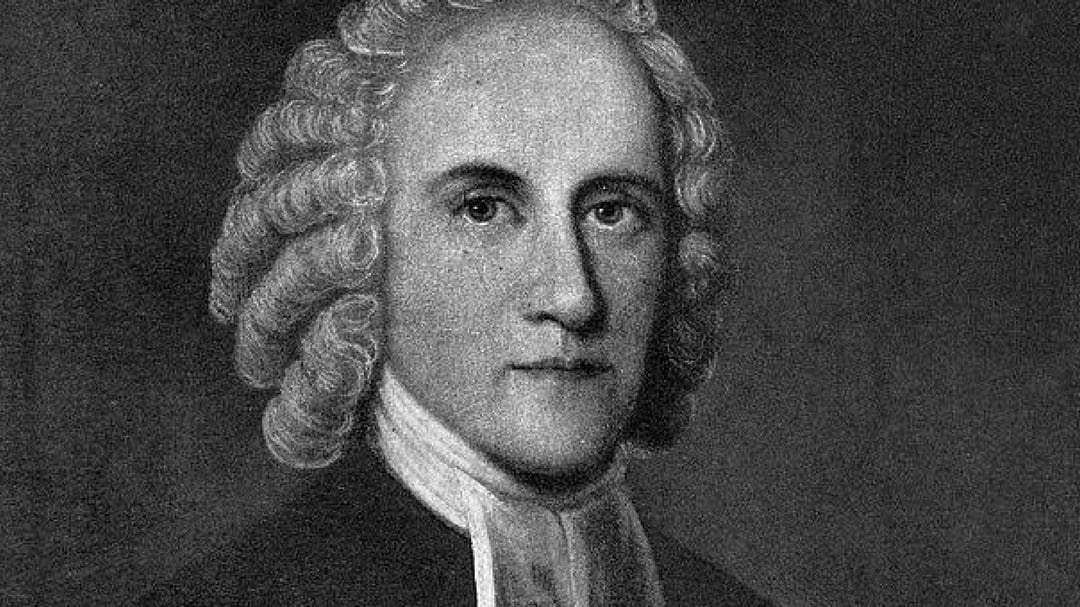
Jonathan Edwards and the Necessity of Divine Sovereignty
-Justin Feland
Within church history, the doctrine of God’s sovereignty represents a continental divide between denominations and theologians. Indeed, few Christians have gone untouched by this discussion in one way or another.
Jonathan Edwards was no exception.
Discover more from Faithful Steward Ministries and FSM Women's Outreach
Subscribe to get the latest posts sent to your email.

