
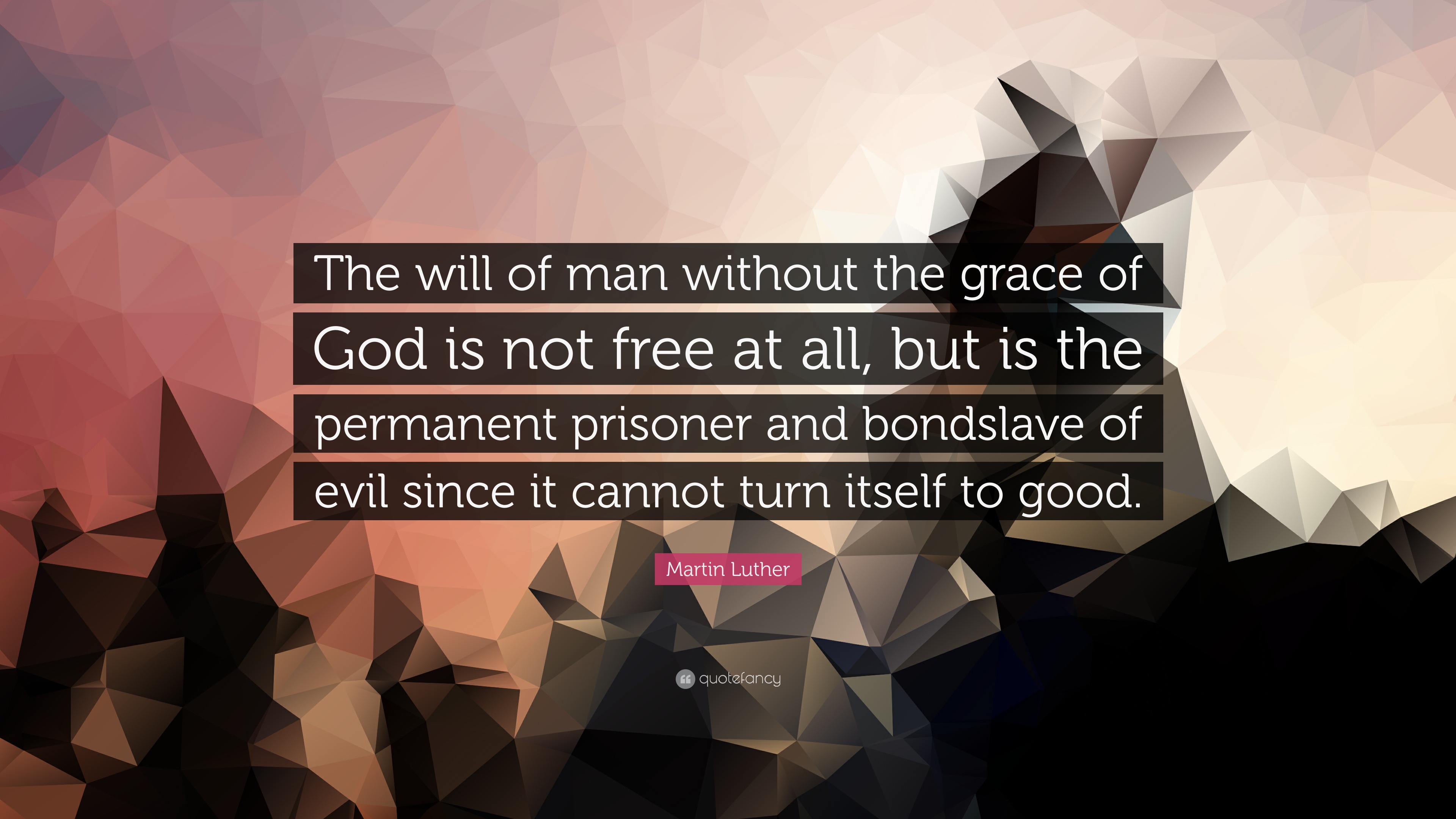
The idea for this post came about after reading a post on LinkedIn. The subject matter was Free Will and this statement caught my eye: God gave us free will so that we can either love Him or reject Him, but the decision is on us. That statement and many responses affirmed that the writers’ theology seems to be that they are in total control of their lives. Maybe it is just me, but I remember my life before Christ, and I certainly had no control then. I certainly do not want to be in total control now. I NEED the Holy Spirit to guide me every step of the way.
The debate over man’s ability to come to the Grave of Salvation freely and independently has raged for centuries. The two major views on this are:
Man’s Will1
The free will of man versus God’s sovereign will is linked to many points in the Calvinism vs. Arminianism debate.
Calvinism/Reformed: All men are totally depraved, and this depravity extends to the entire person, including the will. Except for God’s irresistible grace, men are entirely incapable of responding to God on their own.
Arminianism: Because prevenient grace is given to all men by the Holy Spirit, and this grace extends to the entire person, all people have free will.
For me, three things really changed my thinking on the subject:
- I was doing an in-depth study of John 3. I came to John 3:19 (AMP); This is the judgment [that is, the cause for indictment, the test by which people are judged, the basis for the sentence]: the Light has come into the world, and people loved the [c]darkness rather than the Light, for their deeds were evil, that was me before Christ in a nutshell. Go to Christ on my own; no way I was having too much fun as a sinner.
- The second thing that happened simultaneously was that I read a little book by John MacArthur. It plainly laid out the biblical evidence that God was sovereign and, as such, that man could not do good apart from God’s influence.; Why One Way.
- Finally, after finishing the first two, I was given a copy of Jonathan Edwards’s sermon, Sinners in the Hands of an Angry God. It is hard to explain the profound impact this had on me. Reading Puritan writings can be cumbersome, filled with words long since retired from daily conversation. Yet this sermon’s words seemed to jump at me, convict me, and demand action from me.
As always, I hope these resources and today’s sermon you be a Berean and be approved by God.
STUDY
Free will. The belief that human behavior is self-caused. The idea of free will assumes that there are no external causes sufficient to explain why a person acts as he or she does. Actions, according to free-will theory, are ultimately chosen, even if the person choosing knows that the chosen action may bring about undesirable consequences
Stanley Grenz, David Guretzki, and Cherith Fee Nordling, Pocket Dictionary of Theological Terms (Downers Grove, IL: InterVarsity Press, 1999), 54.
Free will. The ability, allegedly present in every human person, to act on the basis of one’s own rational choice; the ability to choose without constraint or compulsion from among options. The idea of free will is contrasted with determinism, i.e., the outlook that asserts that an external agent or force determines all human choices. The assertion that each human is endowed with free will is a widely held ethical assumption. As a principle of ethics, it suggests that moral actions are not random events, but originate from the volition (will) and perhaps the character of the moral agent. Some ethicists argue that free will forms a necessary basis for moral responsibility.
Stanley J. Grenz and Jay T. Smith, Pocket Dictionary of Ethics, The IVP Pocket Reference Series (Downers Grove, IL: InterVarsity Press, 2003), 44.
Free will. Following *Augustinianism, the Reformed tradition maintains that God created human beings as free moral agents, fully capable of responding to God, but that the fall severely distorted the human will, resulting in a form of enslavement to *sin. Because of *original sin, the will cannot positively respond to God except by God’s sovereign *grace, which does not negate human responsibility but restores natural freedom. All the leading Protestant Reformers shared a version of this Augustinian position, which *Luther famously defended in On the Bondage of the Will (1525) against the perceived *Pelagianism of *Erasmus. The Reformed view was developed more fully in distinction from *Arminian and Wesleyan perspectives on “libertarian” free will, the view that the will is free only if it is “able to do otherwise,” that is, other than determined by God’s will. Theologians such as Jonathan Edwards (The Freedom of the Will, 1754) and others accentuated the compatibility (compatibilism) of human responsibility and divine *sovereignty in conjunction with the *doctrines of grace.
Kelly M. Kapic and Wesley Vander Lugt, Pocket Dictionary of the Reformed Tradition, The IVP Pocket Reference Series (Downers Grove, IL: IVP Academic, 2013), 53.
Sermon
by C. H. Spurgeon
“You will not come to Me — that you might have life.” John 5:40
Discover more from Faithful Steward Ministries and FSM Women's Outreach
Subscribe to get the latest posts sent to your email.

