

Society today is all about the money. Many of y’all remember the movie Jerry Maguire, where Coba Gooding Jr. tells his sports agent played by Tom Cruise to stop making excuses and just “Show me the Money.”
Unfortunately, many “Christians” or those calling themselves such, are caught up in the need for material gain. They have been convinced by false teachers that God promises individual prosperity to those who are “faithful.”
CONTEXT
Chapter – Christ miraculously feedeth four thousand persons, 1–9. He refuseth the Pharisees a sign, 10–13. He warneth his disciples against the leaven of the Pharisees and of Herod, and explaineth his meaning, 14–21. He giveth a blind man sight, 22–26. The people’s opinions, and Peter’s confession, of him, 27–30. He foreshoweth his own death, and rebuketh Peter for dissuading him from it, 31–33. He showeth his followers that they must deny themselves, and not be ashamed of him and his gospel, 34–38.
Matthew Poole, Annotations upon the Holy Bible, vol. 3 (New York: Robert Carter and Brothers, 1853), 163.
Chapter 8:34–9:1 Humility and Sacrifice
Not only will Jesus suffer, but so will His followers. To announce this new concept, Jesus calls the crowd to hear, along with His disciples.
To deny oneself (8:34) is not a call to asceticism, self-rejection, or self-hatred. Rather, it is to replace the desires of self with the will of God, to set aside all personal rights and live for the glory of God and the mission of extending His kingdom.
Denial of self might indeed involve taking up a cross, which would have had a much more severe implication in the first century. Many of Jesus’ early followers literally died by crucifixion. Today the phrase is more symbolic, though it should never be cheapened by use in reference to minor irritations or common burdens.
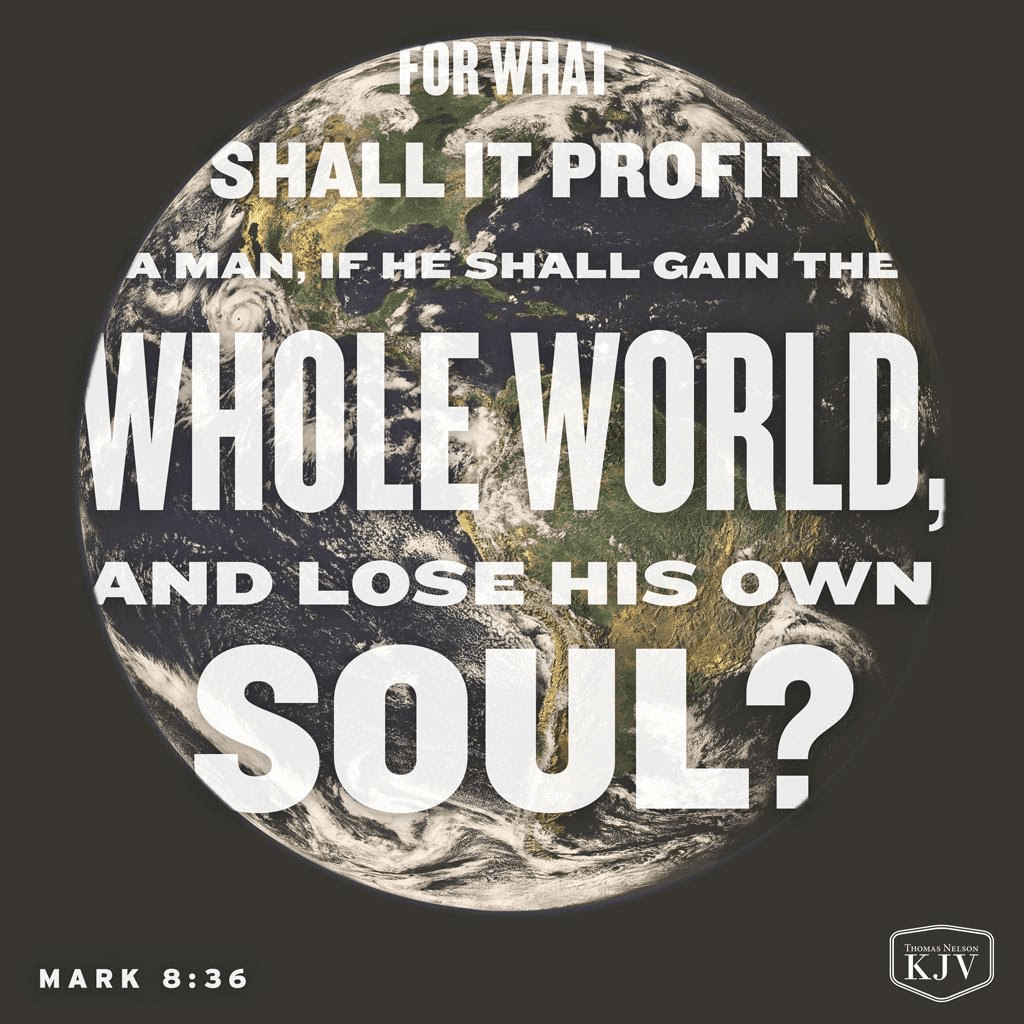
Jesus challenges His listeners to think of long-term effects of their daily choices (8:34–37). Everyone either lives for self or lives for God. While living for self will have certain benefits, none come close to eternal life with a loving God.
Living for Jesus includes speaking up for Him, even when persecuted by a wicked and adulterous generation (8:38). But on the positive side, Jesus makes a promise to “some who are standing here” (9:1 NIV). What does Jesus mean that some will “not taste death before they see the kingdom of God come with power” (NIV)? The answer comes in the next section of Mark (9:2–13).
Mark Strauss, ed., Matthew & Mark, vol. 8, Layman’s Bible Commentary (Barbour Publishing, 2008), 176–177.
I think it is obvious, but it could just be me that Jesus emphasizes that Spiritual Wealth always trumps Material Wealth. Yet as noted above even many “believers” can be found chasing the not-so-mighty dollar 💵. I can not find a prohibition against wealth in the Bible, in fact, many Biblical characters are known to have great wealth (Abraham, Job, etc..). Yet if we examine every one of these incidents we find God providing the wealth to those who did not chase after it.
STUDY
THE HEALTH, WEALTH, AND PROSPERITY GOSPEL
Some television preachers talk about God as if He’s aching to get you a new car, if only you’d have a little more faith (and if only you’d donate a little seed money to that preacher’s “ministry”). God is certainly permitted to provide new cars for His children. Every car owned by a Christian is, in a real sense, a gift from God. And God cares about our needs, even for transportation. But making sure we have sufficient stuff is not the top item on God’s agenda for His children. What we need is “holiness without which no one will see the Lord” (Heb. 12:14). And a new car isn’t going to get us to that destination. Like all things worth having, holiness is going to take some suffering. Promises of health, wealth, and prosperity are not a gospel because they’re not truly good news.
Mark Ward, Biblical Worldview: Creation, Fall, Redemption, ed. Mark L. Ward Jr. and Dennis Cone (Greenville, SC: BJU Press, 2016), 162.
prosperity gospel A presentation of the Christian gospel by contemporary preachers with the message that adherence to the gospel and following Christ brings earthly prosperity and success. God wants you to be successful.
Donald K. McKim, The Westminster Dictionary of Theological Terms, Second Edition, Revised and Expanded. (Louisville, KY: Westminster John Knox Press, 2014), 254.
What does the Bible say about the prosperity gospel?
In the prosperity gospel, also known as the “Word of Faith,” the believer is told to use God, whereas the truth of biblical Christianity is just the opposite—God uses the believer. Word of Faith or prosperity theology sees the Holy Spirit as a power to be put to use for whatever the believer wills. The Bible teaches that the Holy Spirit is a Person who enables the believer to do God’s will. The prosperity gospel movement closely resembles some of the destructive greed sects that infiltrated the early church. Paul and the other apostles were not accommodating to or conciliatory with the false teachers who propagated such heresy. They identified them as dangerous false teachers and urged Christians to avoid them.
Paul warned Timothy about such men in 1 Timothy 6:5, 9–11. These men of “corrupt mind” supposed godliness was a means of gain and their desire for riches was a trap that brought about them “into ruin and destruction” (v. 9). The pursuit of wealth is a dangerous path for Christians and one which God warns about: “For the love of money is a root of all kinds of evil. Some people, eager for money, have wandered from the faith and pierced themselves with many griefs” (v. 10). If riches were a reasonable goal for the godly, Jesus would have pursued it. But He did not, preferring instead to have no place to lay His head (Matthew 8:20) and teaching His disciples to do the same. It should also be remembered that the only disciple concerned with wealth was Judas.
Paul said covetousness is idolatry (Ephesians 5:5) and instructed the Ephesians to avoid anyone who brought a message of immorality or covetousness (Ephesians 5:6–7). Prosperity teaching prohibits God from working on His own, meaning that God is not Lord of all because He cannot work until we release Him to do so. Faith, according to the Word of Faith doctrine, is not submissive trust in God; faith is a formula by which we manipulate the spiritual laws that prosperity teachers believe govern the universe. As the name “Word of Faith” implies, this movement teaches that faith is a matter of what we say more than who we trust or what truths we embrace and affirm in our hearts.
A favorite term in the Word of Faith movement is “positive confession.” This refers to the teaching that words themselves have creative power. What you say, Word of Faith teachers claim, determines everything that happens to you. Your confessions, especially the favors you demand of God, must all be stated positively and without wavering. Then God is required to answer (as though man could require anything of God!). Thus, God’s ability to bless us supposedly hangs on our faith. James 4:13–16 clearly contradicts this teaching: “Now listen, you who say, ‘Today or tomorrow we will go to this or that city, spend a year there, carry on business and make money.’ Why, you do not even know what will happen tomorrow. What is your life? You are a mist that appears for a little while and then vanishes.” Far from speaking things into existence in the future, we do not even know what tomorrow will bring or even whether we will be alive.
Instead of stressing the importance of wealth, the Bible warns against pursuing it. Believers, especially leaders in the church (1 Timothy 3:3), are to be free from the love of money (Hebrews 13:5). The love of money leads to all kinds of evil (1 Timothy 6:10). Jesus warned, “Watch out! Be on your guard against all kinds of greed; a man’s life does not consist in the abundance of his possessions” (Luke 12:15). In sharp contrast to the Word of Faith emphasis on gaining money and possessions in this life, Jesus said, “Do not store up for yourselves treasures on earth, where moth and rust destroy, and where thieves break in and steal” (Matthew 6:19). The irreconcilable contradictions between prosperity teaching and the gospel of our Lord Jesus Christ is best summed up in the words of Jesus in Matthew 6:24, “You cannot serve both God and money.”
Got Questions Ministries, Got Questions? Bible Questions Answered (Bellingham, WA: Logos Bible Software, 2002–2013).
SERMON
The New Park Street Pulpit 1
Volume 21, NO. 92
MARK 8:38
A SERMON DELIVERED ON SABBATH MORNING, JULY 6, 1856
BY THE REV. C. H. SPURGEON AT EXETER HALL, STRAND
Discover more from Faithful Steward Ministries and FSM Women's Outreach
Subscribe to get the latest posts sent to your email.
 Faithful Steward Ministries and FSM Women's Outreach