

In this chapter is an account of David’s review of his army, preparing it for battle with Absalom, and those with him, ver. 1–5 and of the defeat and flight of the rebels, ver. 6, 7, 8 and of the death of Absalom, and the manner of it, and of his burial, ver. 9–18 and of the news of it brought to David by different persons, ver. 19–32 and of his great grief and sorrow on that account, ver. 33.
John Gill, An Exposition of the Old Testament, vol. 2, The Baptist Commentary Series (London: Mathews and Leigh, 1810), 639.

The Battle of Ephraim, David Retakes the Throne
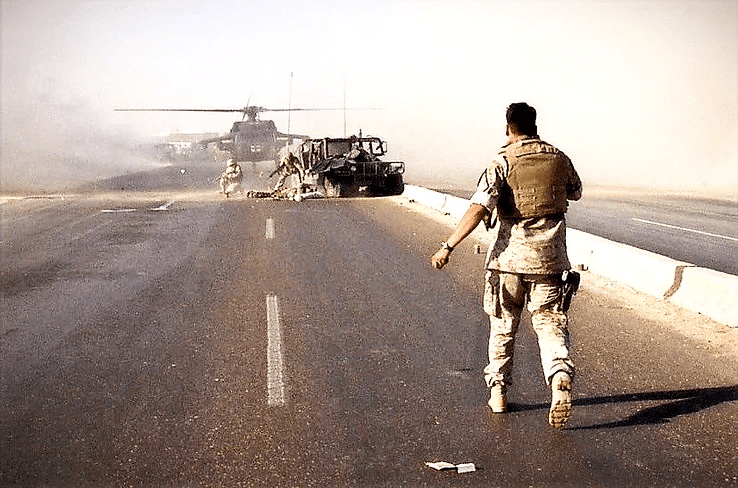
2 Sa 18:1–17 records a battle with Israelite supporters of David set against Israelite supporters of Absalom. The former fought under Abishai, David, Ittai, and Joab and mustered Israelite supporters of David. The latter fought under Absalom. The battle took place on an indeterminate date in the forest of Ephraim. The victors of the battle were Israelite supporters of David. 20,000 men were killed in battle. Joab and his armor-bearers killed Absalom, and the Israelites fled.
Related
• Civil War
• Absalom Is Defeated and Killed
• Spear
• Sword
Jessica Parks, All the Battles in the Bible, Faithlife Biblical and Theological Lists (Bellingham, WA: Faithlife, 2021), 2 Sa 18:1–17.
18:1 To prepare for battle, David counted and reviewed his fighting forces. captains of thousands: Although only a small contingent of troops left Jerusalem with David, other loyal followers soon rallied to his cause.
18:2 David divided his men into three companies—a frequent military tactic in ancient times (Judg. 7:16; 1 Sam. 11:11). Abishai, the oldest son of David’s sister Zeruiah (1 Chr. 2:16), was noted for his brave but impetuous spirit (3:30; 16:9; 1 Sam. 26:6–9). Joab, the younger brother of Abishai, had become commander of David’s army as a result of his heroic leadership in the capture of Jerusalem (1 Chr. 11:4–6). Little is known of Ittai except that he was strongly committed to serving David and the Lord (15:19–22).
18:3, 4 You shall not go out: Although David wanted to accompany his men into battle (v. 2), he was persuaded not to go, both for his own protection and for the safety of Mahanaim (17:27). you are worth ten thousand of us: The Hebrew text underlying this phrase is somewhat cryptic. It may be a comparative statement, as in our translation, saying that David is worth more than the army (compare Ruth 4:15). The phrasing could also be read as an exaggerative flourish: “(David need not go because) now there are ten thousand like us.”
Earl D. Radmacher, Ronald Barclay Allen, and H. Wayne House, Nelson’s New Illustrated Bible Commentary (Nashville: T. Nelson Publishers, 1999), 416.
DEVOTIONAL
OTHER NEWS / RESOURCES
2 US Navy sailors charged with providing military information to China
EXCLUSIVE: Leaders Of 13 Conservative Groups Demand States Abandon American Library Association
U.S., allies work to deter Korean War II
10 things you didn’t know about the Coast Guard
The USA’s Turn toward Communism
The Government Can’t Be Your Friend
The swamp sends up a weather balloon about bringing back the military draft


Help spread Agent Orange Awareness by purchasing a shirt today!
You may print the order form -or- order directly from our website at the link below.
Orders placed online or with the form reflect shipping costs.
Shirts may be purchased at MNVM for $15 each.
Questions, please call us directly at (573) 547-2035.

Discover more from Faithful Steward Ministries and FSM Women's Outreach
Subscribe to get the latest posts sent to your email.
 Faithful Steward Ministries and FSM Women's Outreach