
SCRIPTURE
COMMENTARY/STUDY
Some believe that when we speak of Common Salvation, we mean Salvation that is universal, that it is freely offered to all mankind. One of the main texts for this position is Titus 2:11. The twisted understanding of this comes mostly from the fact that, for the past 48 years, readers of the NIV have been misled by a very poor translation: For the grace of God has appeared that offers salvation to all people. While the trusty KJV, ESV, AMP, CSB, and every other well-researched modern translation reads similar to (AMP) For the [remarkable, undeserved] grace of God that brings salvation has appeared to all men. I hope you can see the difference. The NIV states that God universally offers salvation to everyone. The NIV changes the entire context of God’s plan of Salvation, commonly called the Order of Salvation (Ordo Salutis). Is this Biblical? NO! But do not believe me, do your own research. Titus 2:11 teaches the universal revelation of God’s salvation, not the universal offer of it.
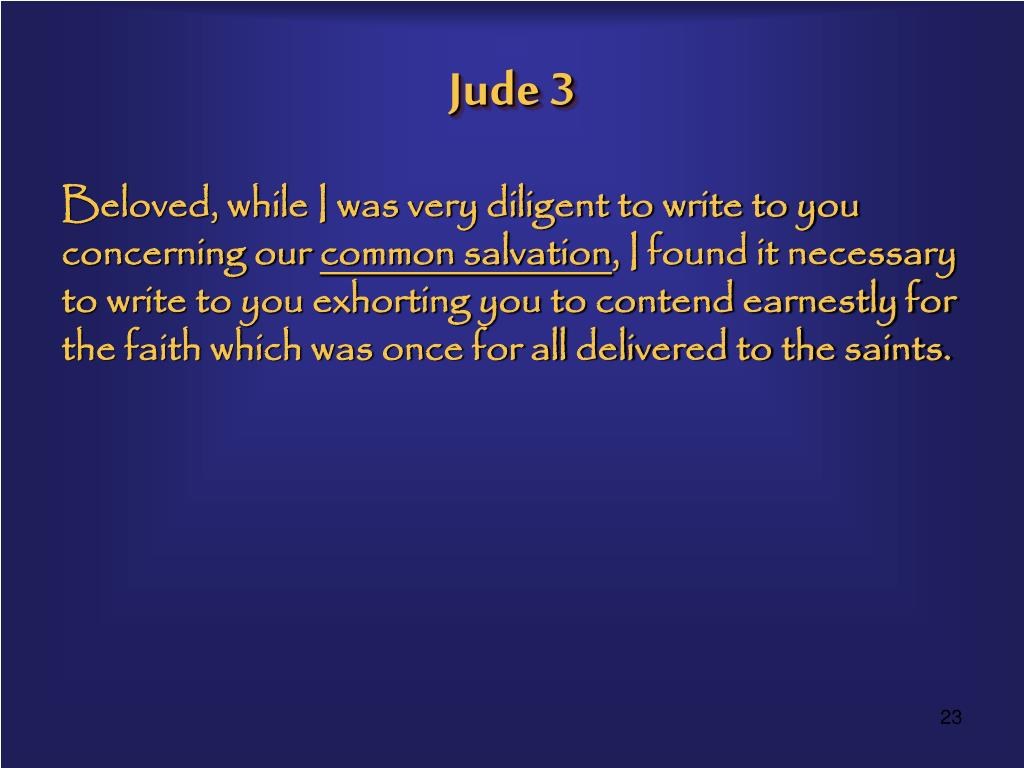
The “common salvation” refers to salvation as the shared possession of all believers[1]—a redemptive reality that transcends human differences. Jude addresses a diverse early Christian community separated by nationality, race, culture, and outlook, yet unites them through this shared salvation[2]. The term emphasizes universality rather than exclusivity: salvation is called “common” not because it is cheap, but because it originates from God’s love, is offered to all classes, and belongs to everyone[3].
Jude had originally intended to write a comprehensive letter about this common salvation, but the crisis posed by ungodly individuals infiltrating the church compelled him to shift his focus[4]. Rather than developing a treatise on salvation itself, he felt constrained by the Holy Spirit to write instead about apostasy and warn his readers of that danger[3]. This contextual shift reveals something crucial: the “common salvation” wasn’t merely an abstract doctrine but a living reality under threat.
The common salvation represents the single remedy for humanity’s spiritual condition, and all who possess it do so through exercising the common faith[2]. This salvation operates uniformly across all believers—there is no variation in how redemption functions based on a person’s background or status. By invoking this phrase, Jude grounds his urgent appeal to defend Christian doctrine in the foundational truth that all believers share an identical, irreplaceable inheritance in Christ.
[1] William C. Neece, The Book of Jude (James L. Fleming, 2005). [See here.]
[2] Alexander Maclaren, “The Common Salvation,” in The Beatitudes and Other Sermons (London: Alexander and Shepheard, 1896), 231–232.
[3] James Smith and Robert Lee, Handfuls on Purpose for Christian Workers and Bible Students, Series I–XIII (Grand Rapids, MI: William B. Eerdmans Publishing Company, 1971), 25.
[4] Alfred Plummer, “The General Epistles of St. James and St. Jude,” in The Expositor’s Bible: Ephesians to Revelation, ed. W. Robertson Nicoll, Expositor’s Bible (Hartford, CT: S.S. Scranton Co., 1903), 646.
AI-generated summary LOGOS software.
3 I was making every effort to write to you These godly men, though they wrote under divine inspiration, still stirred themselves up that they might be in a right condition of mind and heart. Even though the pen does not write by itself, still it is well that it is not corroded, lest it not answer to the hand that uses it; so Jude says, “I was making every effort to write to you.” All the diligence of Jude by itself could not have written this epistle. Still, while depending upon divine guidance, he was no mere passive agent but he gave all diligence to the accomplishment of his task.
Concerning our common salvation – Present salvation is enjoyed by the followers of Christ; otherwise there could be among them no “common salvation.” Those who are sanctified by God the Father, and preserved in Jesus Christ, and called, are saved. In the church of God salvation is this day the privilege of all believers. It is not a matter of the future alone, a blessing to be sought for on a dying bed and reached in heaven, but it is a blessing for this world and this present time. The very word used here—“our common salvation”—shows that Jude did not regard it as a hidden treasure put away from human reach throughout this mortal life. How could it have been common in such a case? He did not regard it as a distant attainment to be reached after 20, 30, or 40 years of holy living, but as a thing to be tasted and handled and received as soon as faith enters the soul. How else could it be common?
As salvation is not a future benefit only, so it is not a benefit reserved for a few of the more saintly people among believers. It is supposed by some that you cannot know whether you are saved until you are at the moment of death, or that if any do know it it must be a few eminent teachers or specially holy persons who have lived a very religious life and consequently know that they are saved. It is to be confessed that the more holy and godly our life the brighter our evidence of salvation becomes, but still the blessing itself is common to all the children of God. Those whose faith is feeble, and whose spiritual life is weak, are still saved in the Lord.
Salvation from sin, leading upward to perfection and heaven, is called in the text “the common salvation.” It is, then, the salvation of all God’s people—the salvation about which all true Christians are agreed. Notwithstanding all you hear about our divisions into sects, the church is really one. The nearer we come to him who is the salvation of God, the more plainly we see that among the children of God the basis of agreement is far wider than the ground of division.
Charles Spurgeon, Spurgeon Commentary: Jude, ed. Elliot Ritzema, Spurgeon Commentary Series (Bellingham, WA: Lexham Press, 2014), Jud 3.
Ver. 3. Beloved, when I gave all diligence to write unto you, &c.] The apostle calls the persons he writes unto beloved; as they were of God, and by him and other saints; and he signifies his diligence in writing to them: and the subject of his writing was, of the common salvation; which designs either the Gospel, sometimes called salvation, in opposition to the law, which is a ministration of condemnation; and because it is a declaration of salvation, and a means of it; and may be said to be common, because preached to all, Jews and Gentiles: or Jesus Christ the Saviour himself, who is also sometimes called salvation, because he was called and appointed to it, and undertook it, and is become the author of it; and may be said to be a common Saviour, not of all men, but of all his people; of his whole body, the church, and every member of it, and of all sorts of men, in all nations: or else that spiritual and eternal salvation wrought out by him, which is common, not to all men, for all are not saved with it, but to all the elect of God, and true believers in Christ; the love of God is common to them all alike; the choice of them to eternal salvation is the same; the covenant of grace, the blessings and promises of it, are equally shared by them; and they are bought with the same price of Christ’s blood, and are justified by the same righteousness, and are regenerated, sanctified, and called by the same grace, and shall possess the same glory: there is but one way of salvation, and that is not confined to any nation, family, community, or sect among men. The Alexandrian copy and two of Beza’s, and the Syriac version, read, our common salvation; and two other of Beza’s copies and the Vulgate Latin version read, your common salvation; the sense is the same: it was needful for me to write unto you, and exhort you, that ye should earnestly contend for the faith which was once delivered unto the saints; by the faith is meant the doctrine of faith, in which sense it is used whenever faith is said to be preached, obeyed, departed, or erred from, or denied, or made shipwreck of, or when exhortations are made to stand fast, and continue in it, or to strive and contend for it, as here; and which is sometimes called the word of faith, the faith of the Gospel, the mystery of faith, or most holy faith, the common faith, and, as here, faith only; and designs the whole scheme of evangelical truths to be believed; such as the doctrine of the Trinity, the deity and sonship of Christ, the divinity and personality of the Spirit; what regards the state and condition of man by nature, as the doctrines of the imputation of Adam’s sin to his posterity, the corruption of nature, and the impotence of men to that which is good; what concerns the acts of grace in the Father, Son, and Spirit, towards, and upon the sons of men; as the doctrines of everlasting love, eternal election, the covenant of grace, particular redemption, justification by the imputed righteousness of Christ, pardon and reconciliation by his blood, regeneration and sanctification by the grace of the spirit, final perseverance, the resurrection of the dead, and the future glory of the saints with Christ. This is said to be delivered to the saints: it was delivered by God the father to Christ as Mediator, and by him to his apostles, who may more especially be meant by the saints, or holy men; who were chosen to be holy, and to whom Christ was made sanctification, and who were sanctified by the spirit of God; and this faith, being a most holy faith, is fit for holy men, and only proper to be delivered to them, and preached by them; and by them it was delivered to the churches, both by word and writing; and this delivery of it supposes that it is not an invention of men, that it is of God, and a gift of his, and given in trust in order to be kept, held forth, and held fast; and it was but once delivered, in opposition to the sundry times and divers manners in which the mind of God was formerly made known; and designs the uniformity, perfection, and continuance of the doctrine of faith; there is no alteration to be made in it, or addition to it; no new revelations are to be expected, it has been delivered all at once: and therefore should be earnestly contended for; for could it be lost, another could not be had; and the whole of it is to be contended for; not only the fundamentals, but the lesser matters of faith; and not things essential only, but also what are circumstantial to faith and religion; every truth, ordinance, and duty, and particularly the purity of faith, and its consistency: and this contention includes a care and solicitude for it, to have it, own it, and hold it fast, and adorn it; and for the preservation of it, and for the spread of it, and that it might be transmitted to posterity: and it denotes a conflict, a combat, or a fighting for it, a striving even to an agony: the persons to be contended with on account of it, are such who deny, or depreciate any of the Persons in the Godhead, the assertors of the purity and power of human nature, and the deniers of sovereign, efficacious, and persevering grace: the persons who are to contend with them are all the saints in general, to whom it is delivered; which they may do by bearing an experimental testimony to it, by praying for the continuance and success of it, by standing fast in one spirit in it, and by dying for it; and particularly the ministers of the Gospel, by preaching it boldly, openly, fully, and faithfully, by disputing for it, and writing in the defence of it, and by laying down their lives, when called for: the manner in which this is to be done, is earnestly, heartily, in good earnest, and without deceit, zealously, and constantly.
John Gill, An Exposition of the New Testament, vol. 3, The Baptist Commentary Series (London: Mathews and Leigh, 1809), 670–671.
What does “common salvation” refer to (Jude 1:3)? – Got Questions Ministries
Our common salvation by Paul Mizzi
SERMON
Note the highlighted area. Advice and warning to all of us who desire to preach and teach (in any form) the Gospel.
Discover more from Faithful Steward Ministries and FSM Women's Outreach
Subscribe to get the latest posts sent to your email.
 Faithful Steward Ministries and FSM Women's Outreach