

INTRODUCTION
Defining Christianity
CHRISTIANITY The beliefs, practices, and socio-cultural expressions of the Jesus community and the wider Christian religion and culture. The key phenomenon of Christianity emerged from the early beginnings of the Jesus movement to the subsequent formation of Eastern and Western Christendom and its broader impacts on society and culture.
This article discusses key characteristics and defining features of Christianity from the first century to the early third century, including the teaching and healing activity of Jesus Christ, the significance of his death and resurrection, the parting of ways with Judaism, and some distinctively Christian beliefs and practices.
Tomas Bokedal and John D. Barry, “Christianity,” ed. John D. Barry et al., The Lexham Bible Dictionary (Bellingham, WA: Lexham Press, 2016).
Defining Nominal Christianity
Literal Definition: Nominal Christianity refers to individuals or groups who identify as Christian but do not actively practice or live out the teachings of Christianity. The word “nominal” means “in name only.” So nominal Christians are those who bear the name “Christian” but do not wholeheartedly devote themselves to the Christian faith.
What is nominal Christianity?
Outside of arcane discussions in medieval philosophy, nominalism is the possession of a baseless name, title, or description. A nominal presidency, for example, is one in which the president is nothing more than a figurehead. A nominal vacation is one in which the vacationers must still work. Nominalism has to do with empty formalities, things so-called, and meaningless labels.
Nominalism exists in religious circles. Nominal Christians are church-goers or otherwise religious people whose “faith” does not go beyond being identified with a church, Christian group, or denomination. They are Christians in name only; Christ has no bearing in their lives. Nominal Christians may attend church and Christian functions, and they self-identify as “Christians,” but it is just a label. They view religion primarily as a social construct, and they do not allow it to require much of them in terms of morality or responsibility. Nominalists take a minimalist approach to their faith… continued at source
You may wonder why, with a title like “LORDSHIP OF CHRIST,” I would start by writing about “nominal Christians.” The simple answer is that this is a classic example of folks who fail the LORDSHIP OF CHRIST test. We have all met these great pretenders, church on Sunday morning, faithfully, it is the rest of the week that provides us the clue that they are dead, James 2:14-26.
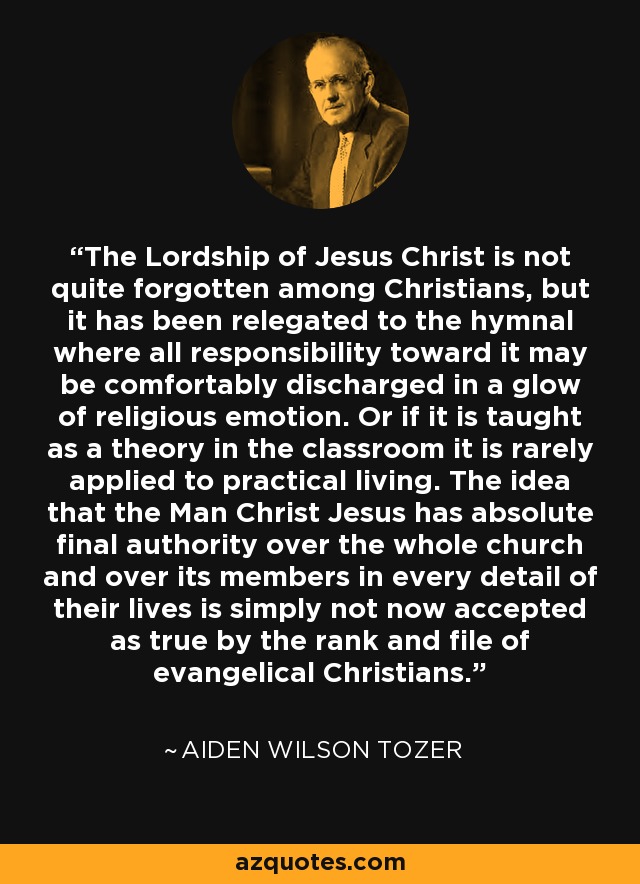
To be clear, I am not trying to say or imply that I or anyone I know is perfect, without sin, a great Christian if you will. Yet I am confident that the “works” James speaks of are evident in all true Christians. This ONLY happens when we put Christ first (LORDSHIP) in our lives. As A.W. Tozer notes in the quote above Christ has absolute authority and it rubs man the wrong way that he in not in control.
DEVOTIONAL

.
SERMONS
Discover more from Faithful Steward Ministries and FSM Women's Outreach
Subscribe to get the latest posts sent to your email.
 Faithful Steward Ministries and FSM Women's Outreach