
(Delayed this posting due to internet issues again and adapted it for Soldier Saturday)
Few “theologians” I know would associate Reformation Day with Military Service but bear with me I think I can make the case. ROMANS 13:1 says Let every soul be subject unto the higher powers. For there is no power but of God: the powers that be are ordained of God.
Up until the day Martin Luther nailed his 95 Thesis to the door of Wittenburg Castle he had been a dutiful follower, a soldier in the army of the Catholic Church. Yet as a theologian, Luther came to realize that many of the practices of the Catholic church were wrong. He like the Apostle Peter before him (Acts 5:29) understood he must Obey God’s commands, not man-made practices or ordinances that go against God’s decrees.
This is true for service members also, many think that lower-ranking members of the armed forces are nothing more than lost sheep led around and given orders that must be obeyed regardless of the results. These young patriots have a choice, follow blindly and damn the consequences or report the actions of those breaking the UCMJ and defend the oath they took at Enlistment.
Servicemembers who stand up for the Constitution and UCMJ are apologists. Luther became an Apologist, a soldier for the Word of God.
Many today who associate with Reformed, Calvinistic, or Covenant Theology are looked upon by modern evangelicals as something from outer space. Nothing could be further from the truth. Most consider the terms synonymous with each other and have as the foundation of their belief Sola Scriptura. That is what we celebrate today because the actions of one Catholic monk at a church in Wittenberg, Saxony-Anhalt, Germany in 1517 have had such a lasting impact upon how man looks at Holy Scripture. So today we celebrate not the man or men of the Reformation, but God and His Glory for giving us the insight to see the Truth in His Word.
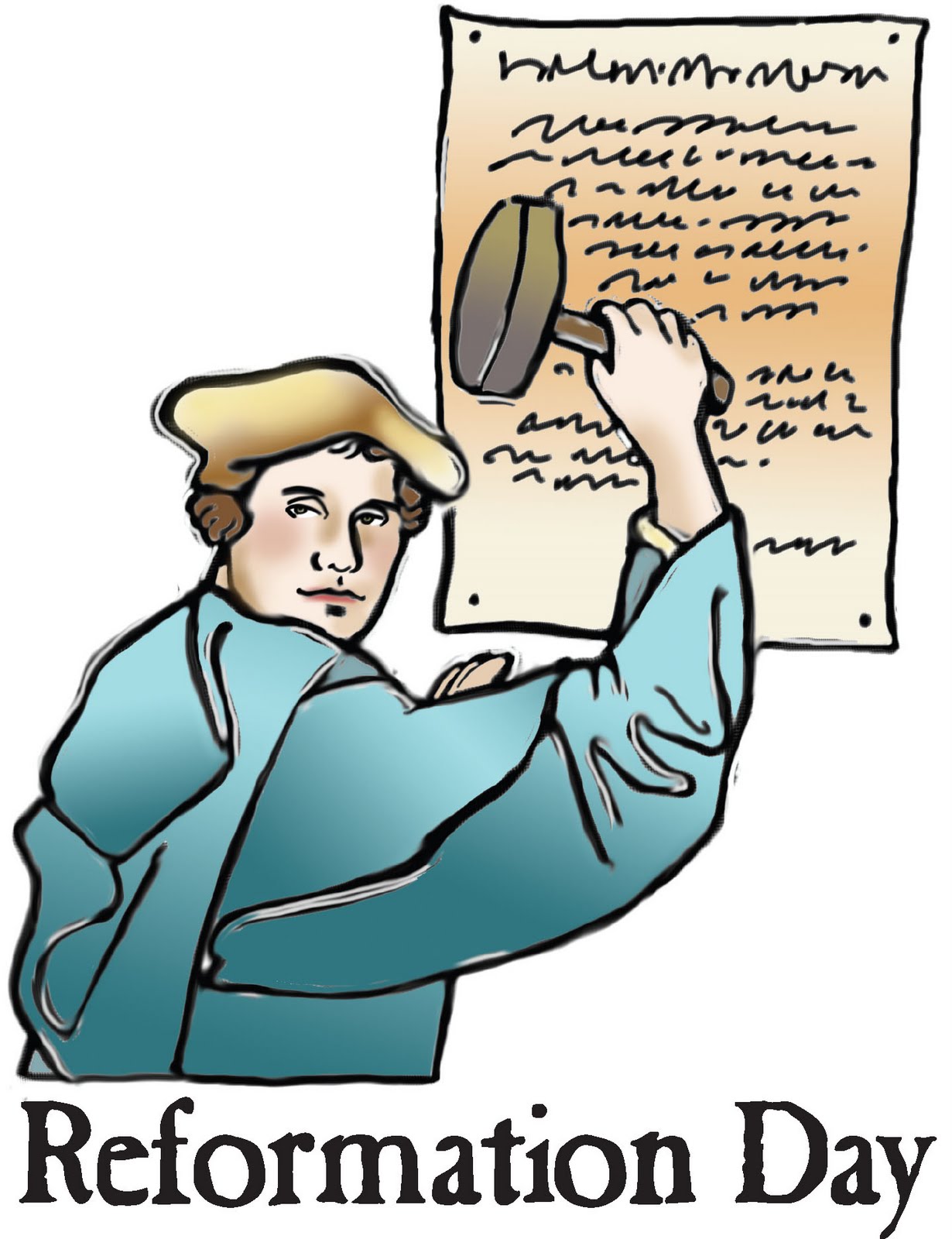
31 OCTOBER 1517
It must be noted that Luther did not set out to break away from the Catholic church in Rome, he set out to Reform the church and remind it of what the Word of God, Holy Scripture said. He was defending the faith.
Reformation, Protestant. A movement of theological protest and political, social and ecclesiological reform in sixteenth-century Europe. Although the beginning of the Reformation is often identified with the posting of Martin *Luther’s *Ninety-Five Theses in Wittenburg, reform was fermenting simultaneously in many places throughout the Holy Roman Empire. Many reform-minded individuals, such as John *Wyclif and Jan *Hus, and several movements, including Hussites, Lollards and Waldensians, preceded Luther in challenging doctrines and practices of the Roman Catholic Church. But conditions were ideal in the early sixteenth century for a more widespread reform; contributing factors included the growing corruption in the Roman Catholic Church, the influence of northern Renaissance *humanism, *Gutenburg’s invention of the printing press and rapid socio-economic changes. This unified reform, often encouraged and fostered by political leaders (cf. *magisterial Reformation), includes central ecclesial figures such as Luther, *Zwingli and *Calvin. The *radical Reformation, which includes *Anabaptists, is distinguished from the mainstream Reformation by its more extreme stance toward civil *government and by its doctrinal differences with the magisterial Reformers.
As the Reformation progressed, divisions emerged not only between magisterial and radical groups but also between *Lutheranism, *Anglicanism and the Reformed tradition. While Lutheranism spread through some parts of Germany and Scandinavia and Anglicanism arose within England and parts of Ireland, the Reformed tradition took hold throughout Bohemia, Hungary, Scotland and the Low Countries (present-day Netherlands and Belgium), in some parts of Germany, and among the *Huguenots in France. Therefore, while it is accurate to speak of the emergence of *Protestantism, this movement was not a unified whole, and it is equally important to recognize the unique character of the *Dutch, *English, *German, *Hungarian, *Irish, *Scandinavian, *Scottish and *Swiss Reformations. While reform resulted in state-supported churches in some areas, in other places reform was either successfully controlled by the *Counter-Reformation, or Protestant groups flourished under the auspices of secular authority. Because the Reformation was thoroughly enmeshed in socio-political realities, however, the ongoing turbulence of the period was not settled until the Peace of Westphalia, which ended the Thirty Years’ War (1618–1648) between Protestants and the Holy Roman Empire. Indeed the contemporary configuration of European nation-states arose out of this conflict, and the dominant Christian tradition in each nation reflects the results of the Reformation.Kelly M. Kapic and Wesley Vander Lugt, Pocket Dictionary of the Reformed Tradition, The IVP Pocket Reference Series (Downers Grove, IL: IVP Academic, 2013), 95–96.
Three Reasons to Celebrate Reformation Day
Luther & Protestant Reformation’s Political Repercussions on America’s Founding
What Is Reformation Day All About? – Ligonier Ministries
FREE DOCUMENTARY Luther: The Life and Legacy of the German Reformer
What is Reformation Day? – GotQuestions.Org
The Greatest Reformer You’ve Never Heard Of
.
.

Veterans Crisis Line: 988 and press 1, Chat, or Text 838255
2023 Veterans Day Free Meals, Discounts and More
FREE Admission, Discounted Stores and Entertainment for Veterans Day (and Beyond)
What Roles Can Veterans Play In Their Community
Just War Doctrine, Israel, and Hamas
Thoughts About Potentially Limited Warfare in the Middle East
Senate confirms 1st female leader of Navy, new Air Force top general and Marine Corps 2nd-in-command
Why Did America Fight the Korean War?
What Roles Can Veterans Play In Their Community
Managing Depression Depression Treatment Restores Hope
Discover more from Faithful Steward Ministries and FSM Women's Outreach
Subscribe to get the latest posts sent to your email.
 Faithful Steward Ministries and FSM Women's Outreach