
We have a saying in Disaster Relief scenarios “Sempre Gumby, Always Flexible.” Was this what Paul was saying in our main text today? Is he saying we should be “completely flexible” when dealing with “All Men?” As a stand-alone verse, one could (without any study) make that assumption. We must note that Paul was writing to the Church at Corinth. He was addressing believers, not worldly men.
Unfortunately, many in modern evangelical circles, have taken this phrase and applied it to our text to the extreme. Instead of following the CONTEXT of Scripture, they twist it by saying that I might, by all means, save some, as justification for being more worldly, sacrificing doctrine and truth to obtain that goal.
CONTEXT:
OVERVIEW: Having established that Christian freedom with respect to neutral or indifferent matters must be accommodated to the consciences of weaker believers, Paul now illustrates in 1 Corinthians 9 how he applied this principle in the conduct of his own ministry among the Corinthians. Drawing on Paul’s example, Reformation commentators describe at length the nature and priorities of the pastoral office. Protestant interpreters insist that the substance of faithful Christian ministry is found in proclaiming the gospel of Jesus Christ—not in performing ceremonies or reciting Masses. True Christian pastors diligently seek lost people through the ministry of the Word; they adapt their sermons to the capacity of ordinary people; they hold indifferent ceremonies loosely so as to win men and women to the truth; they perform their pastoral duties with spiritual zeal and diligence to the very end. All commentators agree that ministers should receive adequate (neither too much nor too little) financial remuneration from their churches in return for their ministry labors. However, Protestant and Catholic interpreters draw very different conclusions as to Paul’s meaning by the phrase adelphēn gynaika in 1 Corinthians 9:5 (“sister as a wife” or “sister as a woman”). For Protestant church leaders, this verse provides clear testimony that many of the original apostles had wives who accompanied them on their missionary journeys; consequently, in their view, the Roman Catholic Church perpetuates a great fraud in prohibiting marriage to bishops and priests.
Scott M. Manetsch, Timothy George, and David W. McNutt, eds., 1 Corinthians: New Testament, vol. IXa, Reformation Commentary on Scripture (Downers Grove, IL: IVP Academic, 2017), 174–175.
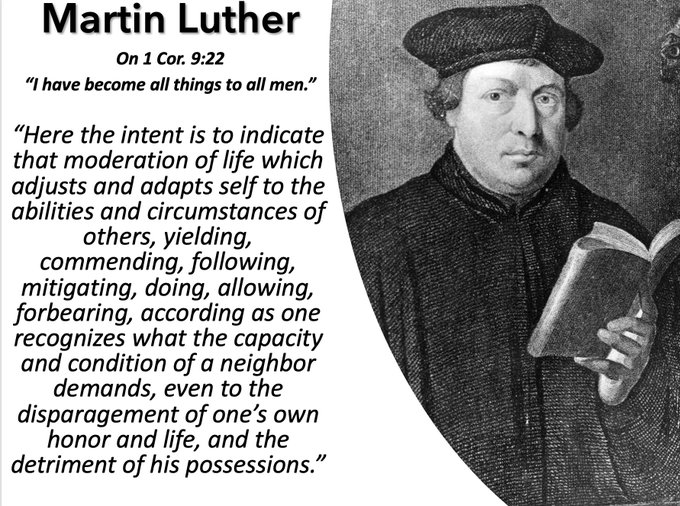
Ver. 22. To the weak became I as weak, &c.] That is, to weak Christians, who were weak in faith, and had not such clear knowledge of Gospel liberty, and therefore scrupled the eating of some sorts of meat, and particularly meats offered to idols; and the apostle so far consulted the peace and edification of these weak brethren, and so far complied with them, and became as one of them, that, rather than offend them, he determined to eat no meat while the world stood: that I might gain the weak; promote their edification and welfare, who otherwise might be stumbled, be in danger of falling from, and laid under a temptation to desert the faith of the Gospel: I am made all things to all men; which is to be understood, as in all the other instances of his being so, not in cases and things criminal and sinful, contrary to the moral law, and the dictates of his own conscience, subversive of the Gospel of Christ, and of the order and discipline of it, but in cases and things of an indifferent nature: that I might by all means save some; that is, that he might be the means of saving some of Jews and Gentiles, and of all sorts of men; by preaching the Gospel of salvation to them, and by directing them to Christ, the only Saviour of lost sinners; thus he explains what he means by so often saying that he migh gain them.
John Gill, An Exposition of the New Testament, vol. 2, The Baptist Commentary Series (London: Mathews and Leigh, 1809), 666.
Paul was no chameleon, changing colors to adapt to different environments. His message in all contexts was the same, but his manner of communication differed according to the understandings of his audience.
Paul W. Barnett, “1 Corinthians,” in CSB Apologetics Study Bible, ed. Ted Cabal (Nashville, TN: Holman Bible Publishers, 2017), 1437.
STUDY
Evaluating Cultural Relativism
In attempting to evaluate cultural relativism, we should acknowledge that we could indeed learn many things from other cultures. We should never fall into the belief that our culture has all the answers. No culture has a complete monopoly on the truth. Likewise, Christians must guard against the assumption that their Christian perspective on their cultural experiences should be normative for every other culture.
However, as we have already seen, the central weakness of cultural relativism is its unwillingness to evaluate another culture. This may seem satisfactory when we talk about language, customs, even forms of worship. But this non-judgmental mindset breaks down when confronted by real evils such as slavery or genocide. The Holocaust, for example, cannot be merely explained away as an appropriate cultural response for Nazi Germany.
Cultural relativism faces other philosophical problems. For example, it is insufficient to say that morals originated in the world and that they are constantly changing. Cultural relativists need to answer how value originated out of non-value. How did the first value arise?
Fundamental to cultural relativism is a belief that values change. But if the value that values change is itself unchanging, then this theory claims an unchanging value that all values change and evolve. The position is self-contradictory.
Another important concern is conflict. If there are no absolute values that exist trans-culturally or externally to the group, how are different cultures to get along when values collide? How are we to handle these conflicts?
Moreover, is there ever a place for courageous individuals to challenge the cultural norm and fight against social evil? Cultural relativism seems to leave no place for social reformers. The abolition movement, the suffrage movement, and the civil rights movement are all examples of social movements that ran counter to the social circumstances of the culture. Abolishing slavery and providing rights to citizens are good things even if they were opposed by many people within society.
The Bible provides a true standard by which to judge attitudes and actions. Biblical standards can be used to judge individual sin as well as corporate sin institutionalized within a culture.
By contrast, culture cannot be used to judge right and wrong. A changing culture cannot provide a fixed standard for morality. Only God’s character, revealed in the Bible provides a reliable measure for morality.
Cultural Relativism – Kerby Anderson, May 27, 2004
Christianity and Culture by Jerry Solomon
In the World but Unlike the World by John MacArthur
The World in the Church: A Distracted World, a Distracted Church? Web Page by Garry Williams
Becoming All Things to All Men to Save Some, John Piper – Scripture: 1 Corinthians 9:19–23
The following two articles can be found on: Beyond Culture Wars, MAY/JUN 1993
- Beyond Culture Wars – Michael S. Horton, ©1993, 1999 Alliance of Confessing Evangelicals
- Are You Prepared To Give A Defense? A Crash Course In Evidential Apologetics Rod Rosenbladt, ©1993, 1999 Alliance of Confessing Evangelicals
Discover more from Faithful Steward Ministries and FSM Women's Outreach
Subscribe to get the latest posts sent to your email.
 Faithful Steward Ministries and FSM Women's Outreach