
.
CONTEXT
IN this and the two following chapters Job makes answer to Zophar’s discourse in the former; who having represented him as an ignorant man, he resents it, and begins his defence with a biting sarcasm on him and his friends, as being self-conceited, and having an high opinion of their own wisdom, as if none had any but themselves, ver. 1, 2 and puts in his claim for a share with them, as being not at all inferior to them, ver. 3 and then refutes their notions, that it always goes well with good men, and ill with bad men; whereas the reverse is the truth, ver. 4–6 and which they might learn from the brute creatures; or he sends them to them, to observe to them, that the best things they had knowledge of concerning God and his providence, and of his wisdom therein, were common notions that every one had, and might be learned from beasts, birds, and fishes; particularly, that all things in the whole universe are made by God, and sustained by him, and are under his direction, and at his disposal, ver. 7–10 and such things might as easily be searched, examined, and judged of, as sounds are tried by the ear, and food by the mouth, ver. 11 and seeing it is usual among men, at least it may be expected that men in years should have a considerable share of wisdom and knowledge, it might be strongly inferred from thence, without any difficulty, that the most perfect and consummate wisdom was in God, ver. 12, 13. whence he passes on to discourse most admirably and excellently of the wisdom and power of God in the dispensations of his providence, in a variety of instances; which shews his knowledge of his perfections, ways, and works, was not inferior to that of his friends, ver. 14–25.
John Gill, An Exposition of the Old Testament, vol. 3, The Baptist Commentary Series (London: Mathews and Leigh, 1810), 286.
.
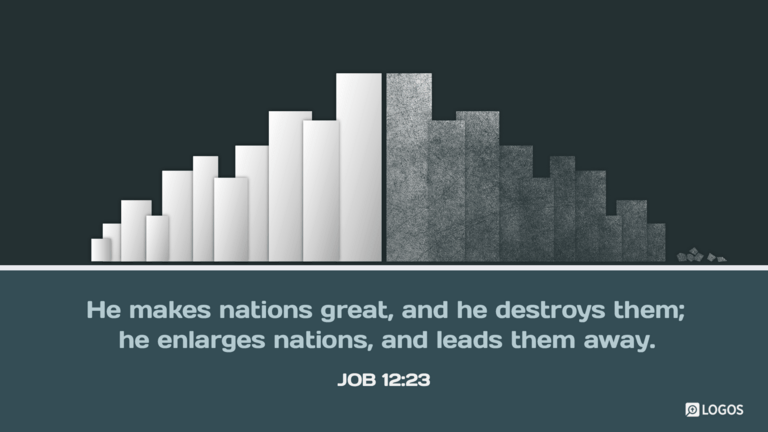
Verse 23 He {m} increaseth the nations, and destroyeth them: he enlargeth the nation straiteneth them [again]. (m) In this discourse of God’s wonderful works, Job shows that whatever is done in this world both in the order and change of things, is by God’s will and appointment, in which he declares that he thinks well of God, and is able to set forth his power in words as they that reasoned against him were.
Geneva Bible: Notes, vol. 1 (Geneva: Rovland Hall, 1560), 226.
The Devine Supremacy Illustrated
R. Green, Job 12:11-25, Does not the ear try words? and the mouth taste his meat?
Bildad appeals to “the ancients.” Job replies, “I also know their teaching.” But there is a wisdom higher than that of the ancients. Wisdom – unfailing wisdom – is a Divine attribute. From the earthly to the heavenly wisdom Job turns. He speaks of a higher and a mightier One – One “with whom is strength and wisdom,” by which he rules. The supremacy of that Divine rule he illustrates from a very wide field of survey. He points to the evidences of the Divine almightiness…
SERMON
by Milburn Cockrell
Discover more from Faithful Steward Ministries and FSM Women's Outreach
Subscribe to get the latest posts sent to your email.

