
Are you willing to go wherever God calls you?
.
CHAPTER 8 CONTENTS
The history of the Shunammite, which was in part given before is prosecuted yet further in this chapter. Her land is restored to her. Here is also a short relation concerning Hazael, the Syrian. This chapter also contains an account of Jehoram’s wicked regin, and of Ahaziah his succesor in the kingdom.
1–2. It should seem that this famine soon succeeded the siege of the enemy, which the foregoing chapter relates. A fruitful land the Lord makes barren for the wickedness of them that dwell therein. Psm. 107:34., That this famine was peculiar to Israel, seems evident from the prophet’s commanding the Shunammite to seek for sustenance elsewhere. But Reader! how delightful is it to see the Lord providing for his secret ones when lie brings his judgments upon others. Never doth the Lord more strikingly manifest himself than when he hides them.
Robert Hawker, Poor Man’s Old Testament Commentary: 1 Kings–Esther, vol. 3 (Bellingham, WA: Logos Bible Software, 2013), 200..
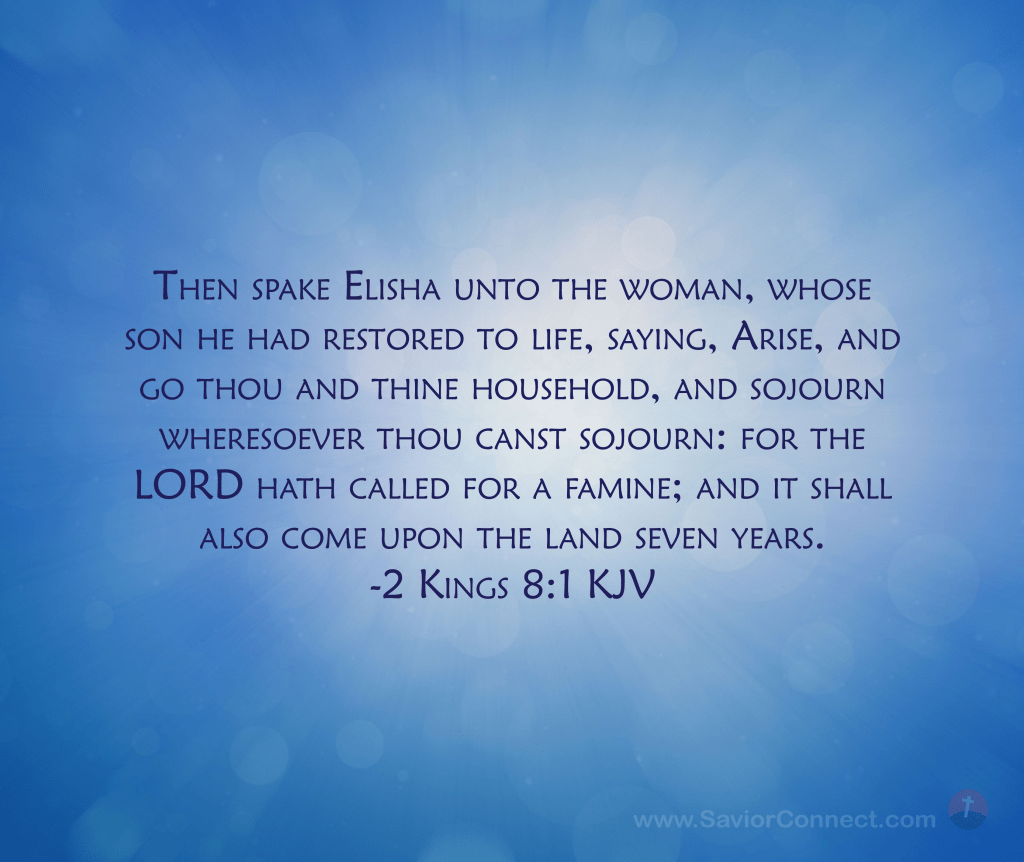
John D. Barry and Rebecca Kruyswijk, Connect the Testaments: A One-Year Daily Devotional with Bible Reading Plan (Bellingham, WA: Lexham Press, 2012).Ver. 1. Then spake Elisha unto the woman (whose son he had restored to life), &c.] His hostess at Shunem, ch. 4:8. &c. the following he said to her, not after the famine in Samaria, but before it, as some circumstances shew: saying, arise, and go thou and thine household, and sojourn wheresoever thou canst sojourn; with the greatest safety to her person and property, and with the least danger to her moral and religious character: for the Lord hath called for a famine, and it shall also come upon the land seven years; which Jarchi says was the famine that was in the days of Joel; it was, undoubtedly, on account of the idolatry of Israel, and was double the time of that in the days of Elijah.
Ver. 2. And the woman arose, and did after the saying of the man of God, &c.] Whose words she had reason to believe; she having a son given to her according to his word, and this restored to life, when dead, through his intercession: and she went with her household, and sojourned in the land of the Philistines; which was not far from her native place, and where there was plenty of food, and she could have as free an exercise of her religion as in the idolatrous kingdom of Israel.DEVOTION
November 21: Walk Like the Shunammite
2 Kings 8:1–9:29, Mark 16:1–20, Proverbs 6:28–35Trust is a fickle matter. What does it take for us to trust another person—especially with our livelihood? Our decision to trust someone can usually be determined by whether we see God in that person.
When the Shunammite woman must decide whether to trust Elisha, it is a simple choice. God has already worked in her life through Elisha—giving her a son and then resurrecting him—so she understands that what he says is from Yahweh. When Elisha says to her, “Get up and go, you and your household, and dwell as an alien wherever you can, for Yahweh has called for a famine, and it will come to the land for seven years,” she trusts him (2 Kgs 8:1). She goes to Philistia (2 Kgs 8:2).
Would we do the same—leave everything and go to a foreign land at one godly person’s word? What does it take for us to trust someone with our lives? What does it take for us to trust God with our lives?
We will probably never encounter the decision the Shunammite woman had to make, but contemplating our answer reveals where we stand with God and others. It’s tempting to answer with a quick, “Of course,” but that would be to ignore the magnitude of her decision, and thus deny the seriousness of what God really asks of us—complete obedience, no matter what, to any degree necessary. Think about that for a moment: any degree necessary (compare Mark 8:34–38).
Are we really willing to acknowledge the gravity of what Jesus did in His death and resurrection (Mark 16:1–10)? Are we willing to live our lives as He intends? Are we willing to go to any place, to trust the word of God completely, to allow God to speak to us directly and through others, and to live passionately for Christ despite the cost?Are you willing to go wherever God calls you?
JOHN D. BARRY
John Gill, An Exposition of the Old Testament, vol. 2, The Baptist Commentary Series (London: Mathews and Leigh, 1810), 795.
Discover more from Faithful Steward Ministries and FSM Women's Outreach
Subscribe to get the latest posts sent to your email.
 Faithful Steward Ministries and FSM Women's Outreach