
COMMENT
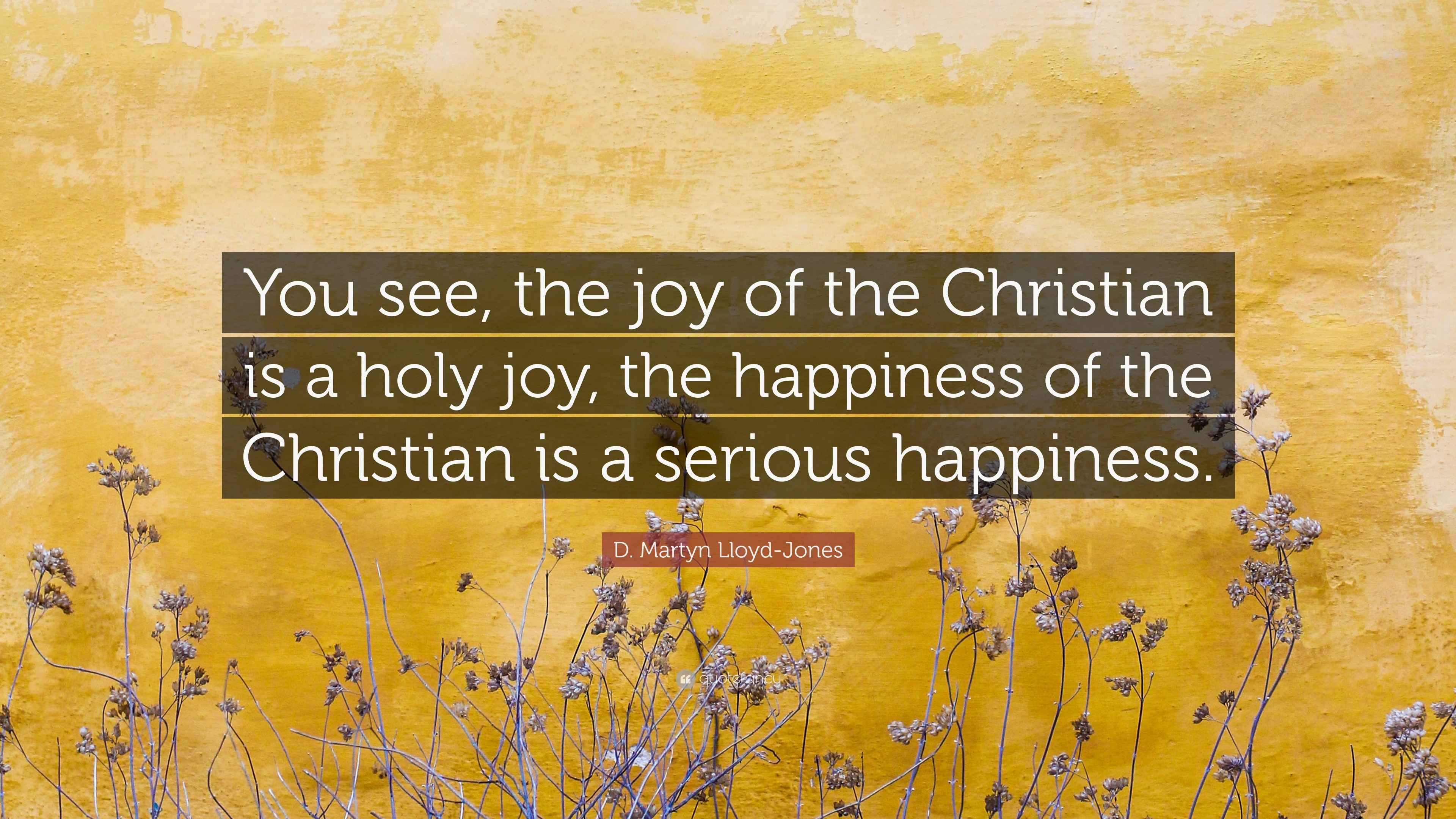
What is “Christian Joy” and how does one obtain it, are questions that have been asked repeatedly throughout the history of the church. I think, even more so, in the last 60-70 years. The Western world has become increasingly self-obsessed, more what’s in it for me. Pulpits have preached a message of love, pushing an emotional response to the “good news,” with little to no doctrinal foundation. The following quote is from some 800 years ago, and it announces the connection well:
No one can live without delight, and that is why a man deprived of spiritual joy goes over to carnal pleasure. —Thomas Aquinas (1225-1274), Italian philosopher, theologian
Bible Truth Behind the Quote: “The joy of the LORD is your strength” (Nehemiah 8:10).
Ron Rhodes, 1001 Unforgettable Quotes About God, Faith, and the Bible (Eugene, OR: Harvest House Publishers, 2011).
Man will always seek pleasure, even if that pleasure is against all their ethics, laws, or morals. Of course, Christians understand that everything in these pursuits is useless, for no one can have true “joy” apart from God. I am so convinced of this that it was the foundation for my thesis:
Abstract– Everyone seeks a joy-filled life. Believers and non-believers alike do not wake up in the morning and declare, I want to have a miserable day. Even our sinful nature inherently craves something greater that cannot be fulfilled by our own volition. The Bible lays out the route to a joy-filled life, and nowhere is that more evident than in the opening verses of the Apostle John’s first Epistle.
1 That which was from the beginning, which we have heard, which we have seen with our eyes, which we have looked upon, and our hands have handled, of the Word of life;
2 (For the life was manifested, and we have seen it, and bear witness, and shew unto you that eternal life, which was with the Father, and was manifested unto us;)
3 That which we have seen and heard declare we unto you, that ye also may have fellowship with us: and truly our fellowship is with the Father, and with his Son Jesus Christ.
4 And these things write we unto you, that your joy may be full.
True joy comes when we have fellowship with “us”, like-minded believers, and “truly,” with the Father and His Son. If you want your cup to overflow with joy, that is the path you must take.

RELATED RESOURCES
Topical Bible: The Role of Joy in Christian Life
Joy in Life’s Hard Times by C H Spurgeon
1 John “The Joy of the Lord” by Robert S Candlish
Christian Joy by Thomas Watson
STUDY
How Does Christian Joy Differ From Worldly Happiness?
Worldly happiness functions as an emotion dependent on favorable circumstances1, whereas Christian joy operates at a deeper level than emotion1. The fundamental distinction lies in their origins: happiness stems from external conditions—wealth, status, pleasure, or achievement—that create pleasant feelings from outside the soul2, while joy originates from within the soul itself, flowing outward from its inner virtues and harmony2.
This difference becomes evident in how each responds to adversity. Happiness typically depends on present circumstances, whereas Christian joy can persist at all times1. Paul encouraged believers to “rejoice in the Lord always” while imprisoned, and James instructed Christians to “count it all joy when you fall into various trials”1—instructions that would make no sense if joy required pleasant conditions. Joy functions as a gift of God, an aspect of His grace1, and it develops through fellowship with God, meditation on His Word, worship, and prayer1.
A crucial clarification emerges from the search results: both joy and happiness are circumstantial, but the question is which circumstances shape our emotional dispositions3. Living in joy means choosing to orient oneself around Christ’s resurrection as one’s fundamental emotional disposition3. This doesn’t demand constant cheerfulness; Christians appropriately experience anger, mourning, and fear in response to a broken world, yet refuse to dwell there3.
Christian joy differs from worldly joy in its permanence—steady as a fixed star rather than fleeting as lightning, like shells undisturbed in ocean depths despite surface turbulence, with a holy calm originating from Christ4. This stability makes Christian joy accessible regardless of external fortune, rooted instead in one’s relationship with God.
AI generated responce, LOGOS Software 01/23/2026
- 1Wilfred Graves and Ph D. Wilfred Graves Jr., In Pursuit of Wholeness: Experiencing God’s Salvation for the Total Person (Shippensburg, PA: Destiny Image, 2011). [See here, here, here, here, here, here.]
- 2Joseph S. Exell, The Biblical Illustrator (Acts): Or Anecdotes, Similes, Emblems, Illustrations; Expository, Scientific, Geographical, Historical, and Homiletic, Gathered from a Wide Range of Home and Foreign Literature, on the Verses of the Bible (Oak Harbor, WA: Logos Research Systems, Inc., 1997), 721.
- 3Gordon T. Smith, The Voice of Jesus: Discernment, Prayer and the Witness of the Spirit (Downers Grove, IL: IVP Formatio, 2015). [See here, here, here, here.]
- 4Joseph S. Exell, The Biblical Illustrator: Galatians (New York; Chicago;
JOY – State of delight and well-being that results from knowing and serving God. A number of Greek and Hebrew words are used to convey the ideas of joy and rejoicing. We have the same situation in English with such nearly synonymous words as joy, happiness, pleasure, delight, gladness, merriment, felicity, and enjoyment. The words “joy” and “rejoice” are the words used most often to translate the Hebrew and Greek words into English. Joy is found over 150 times in the Bible. If such words as “joyous” and “joyful” are included, the number comes to over 200. The verb “rejoice” appears well over 200 times.
Joy is the fruit of a right relation with God. It is not something people can create by their own efforts. The Bible distinguishes joy from pleasure. The Greek word for pleasure is the word from which we get our word “hedonism,” the philosophy of self-centered pleasure seeking. Paul referred to false teachers as “lovers of pleasure rather than lovers of God” (2 Tim. 3:4 HCSB).
The Bible warns that self-indulgent pleasure seeking does not lead to happiness and fulfillment. Ecclesiastes 2:1–11 records the sad testimony of one who sought to build his life on pleasure seeking. The search left him empty and disillusioned. Proverbs 14:13 offers insight into this way of life, “Even in laughter a heart may be sad” (HCSB). Cares, riches, and pleasures rob people of the possibility of fruitful living (Luke 8:14). Pleasure seeking often enslaves people in a vicious cycle of addiction (Titus 3:3). The self-indulgent person, according to 1 Tim. 5:6, is dead while seeming still to be alive.
Many people think that God is the great killjoy. Nothing could be a bigger lie. God Himself knows joy, and He wants His people to know joy. Psalm 104:31 speaks of God Himself rejoicing in His creative works. Isaiah 65:18 speaks of God rejoicing over His redeemed people who will be to Him “a joy.”
Extract from- Robert J. Dean, “Joy,” in Holman Illustrated Bible Dictionary, ed. Chad Brand et al. (Nashville, TN: Holman Bible Publishers, 2003), 956–957.
JOY (שִׂמְחָה, simchah; χαρά, chara). Closely related to gladness and happiness, although joy is more a state of being than an emotion; a result of choice. One of the fruits of the spirit (Gal 5:22–23). Having joy is part of the experience of being a Christian.
Biblical Relevance
In the Old Testament, joy is closely related to victory over one’s enemies. For example, in 1 Sam 18:6 when David returned from killing the Philistine, he was met with joy and dancing. It is also associated with religious acts and feasts, including sacrifices in Psa 27:6 and the Feast of Unleavened Bread (2 Chr 30; Ezra 6).
“Joy” also occurs frequently in songs of praise, most frequently in the book of Psalms (1 Chr 16; Pss 20; 33; 47). The prophets speak of joy, both its being taken away on account of exile (Ezek 24:25; Joel 1:12) and of the joy that will return when the people are restored (Isa 35:10; Jer 31:13).
In the New Testament, “joy” is still used for victory, as shown by the disciples returning with joy since even the evil spirits listened to them (Luke 10:17). However, the victory focuses more on salvation (Luke 15:7)—the presence of Christ, the bridegroom, gives reason for joy (John 3:29). In the New Testament letters, joy is a desired attribute of Christians. Paul expressed frequently the joy he had regarding the salvation of those he was writing to and prayed that they might be full of joy.
Etymology
A significant number of words in the Bible have been translated as “joy.” The most common are:
• The Hebrew שִׂמְחָה (simchah)—meaning “joy,” “mirth,” or “gladness” along with the closely related verbal adjective שָׂמֵחַ (sameach).
• The Greek χαρά (chara)—meaning “joy” or “gladness” and the closely related verbal form, χαίρω (chairō), meaning “to rejoice or be glad.”
Other words commonly used for “joy” are:
• Hebrew חֶדְוָה (chedwah), meaning “joy” and “gladness”; its verbal form, חָדָה (chadah).
• Hebrew רִנָּה (rinnah), translated as “ringing cry of supplication or joy or praise”; the closely related Hebrew verb, רָנַן (ranan), translated as “giving a ring out or shout out for joy” (except in the hithpolel).
• Hebrew verb, גִּיל (gil), meaning “rejoicing” or “exceedingly glad” in the noun form and “to rejoice, be glad” when used as a noun (גִּילָה, gilah, in the less frequently found feminine variation).
• Hebrew שָׂשׂוֹן (sason), meaning “gladness”, “joy” or “exultation”; the closely related verbal form, שׂוּשׂ (sus), “to exult or display joy.”
• Greek ἀγαλλίασις (agalliasis), meaning “extreme joy” and the closely related verbal form, ἀγαλλιάω (agalliaō), meaning “to rejoice”.
• Greek εὐφραίνω (euphrainō), meaning “to gladden or be joyful”; the less common noun form εὐφροσύνη (euphrosynē), meaning “joy” or “gladness.”
Development
Emotions in the Old Testament were generally connected to various body parts—the heart could have emotions and thoughts, while the gut or liver were also of importance for emotions. Smith explains, “Israelites associated emotions with the internal organs where the emotions were perceived to be felt physically” (Smith, “Israelite Emotion,” 431). While anger is often associated with a burning of the nostrils, the heart is the center for joy. However, joy does not remain in the heart, but is part of a movement towards appropriate action, explaining the relevance of joy in religious activities (Smith, “Israelite Emotion,” 435–36).
In the New Testament, Paul emphasized the place that joy was to have in the lives of Christians. Although he used the general form of Greek letters at the time, he adapted them to suit his needs—in particular, he used joy as an important element, especially in the beginning and ending of his letters. White argues that whereas ancient Greek letters had an element in the greeting where the writer would elaborate on their relationship with the recipient, Paul adapted the form of the letter to include a “joy expression” (White, “Introductory Formula,” 95–97).
Cultural Relevance
Joy is one of the fruits of the Spirit; it is expected of Christians because it is the natural result of having received salvation. The joy comes on account of what Christ has done, irrelevant of whatever other circumstances are happening in one’s life.
Bibliography
Mullins, Terence Y. “Formulas in New Testament Epistles.” Journal of Biblical Literature 91 (1972): 380–90.
Smith, Mark S. “The Heart and Innards in Israelite Emotional Expressions: Notes from Anthropology and Psychobiology.” Journal of Biblical Literature 117.3 (1998): 427–36.
White, John L. “Introductory Formulae in the Body of the Pauline Letter.” Journal of Biblical Literature 90 (1971): 91–97.
Brenda Heyink, “Joy,” in The Lexham Bible Dictionary, ed. John D. Barry et al. (Bellingham, WA: Lexham Press, 2016).
Discover more from Faithful Steward Ministries and FSM Women's Outreach
Subscribe to get the latest posts sent to your email.

