
CONTEXT
This chapter consists of exhortations, in general, to a holy life; and, in particular, to obedience to superiors. It begins with an exhortation to lay aside various vices, which were unbecoming regenerate persons, ver. 1 and, agreeably to their character, as new-born babes, to express a desire after the Gospel, which is commended from its nature, being comparable to milk; and from its quality, being reasonable, sincere, and unmixed; and from the end and usefulness of it, a spiritual growth; and the argument engaging to such a desire is the experience they had of the grace of Christ in it, ver. 2, 3 whose excellency is declared, under the metaphor of a stone, said to be living, to be chosen of God, and precious to him, though rejected by men; to whom the saints are encouraged to come, as lively stones built up, a spiritual house, for the exercise of the holy office of the priesthood, by offering up spiritual sacrifices acceptable to God through Christ, ver. 4, 5 and that Christ is such a precious stone, is proved from Isa. 28:16 and not only to God, but to all them that believe; though to them that believe not, he is the stone of rejection, stumbling, and offence; to stumble at which, and the doctrine of it, through disobedience, they were of old appointed by God, ver. 6, 7, 8 but the character of the persons the apostle writes to was very different, quite the reverse, being chosen and called, and manifestly the people of God, and sharing in his grace and mercy, ver. 9, 10 and these he exhorts, suitable to their state and condition, to abstain from sin, as an enemy to their souls, and to live an honest life and conversation among the Gentiles, that they, instead of speaking evil of them, might, by beholding their good works, glorify God, ver. 11, 12. And particularly he exhorts them to obedience to civil magistrates, both superior and inferior; partly from the author of them, they being of the Lord; and partly from the usefulness of them to punish wicked men, and to encourage good men; and also from its being the will of God, by such obedience, to silence the cavils of foolish men, ver. 13, 14, 15. And whereas it might be objected, that they were made free by Christ, and therefore should not be the servants of men; it is granted, that they were free; but then it is denied, that they should use their liberty for a cloak of maliciousness: and besides, it should be observed, that they were the servants of God, and therefore ought to do what he enjoined them; and, among other things, yield obedience to civil magistrates, ver. 16. And to this purpose are various exhortations in ver. 17 and another particular one is added, which is to servants, to be subject to their masters, and fear them, whether they be good or bad, ver. 18 and then he comforts such that had bad masters, and encourages them to bear the injuries they received from them patiently; because so to do was grateful to God, and acceptable in his sight; and because they were called unto it by him; and because of the example Christ had left them in suffering for them, ver. 19, 20, 21. And this is further urged from the character of Christ, who was without sin, and yet suffered, and from his conduct, who, when reviled, made no return, but left his cause with God, ver. 22, 23 which leads on the apostle to take notice of the nature of Christ’s sufferings in his body on the cross, and the ends of them, which were expiation of sin, healing diseases, and holiness of life, as a consequent thereof, ver. 24 previous to which is conversion, which is illustrated by the former state and condition men are in, being as sheep going astray; and by their present one, being returned to Christ, the Shepherd and Bishop of souls, ver. 25.
John Gill, An Exposition of the New Testament, vol. 3, The Baptist Commentary Series (London: Mathews and Leigh, 1809), 541.
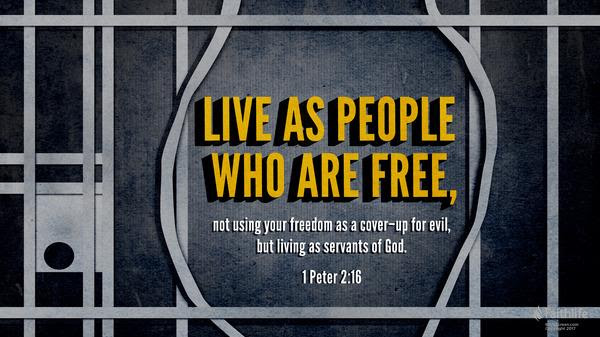
Ver. 16. As free, &c.] These converted Jews might value themselves on their freedom, partly as the descendants of Abraham, and so free-born, and not to be brought into bondage to other people; and chiefly because of their liberty which they had in and by Christ Jesus. The apostle allows that they were freemen, that they were Christ’s freemen, were free from sin, its damning and domineering power, and from the curses and condemnation of the law, and had freedom of access to God, and a right to all the privileges and immunities of the house of God; but then they were not free to sin, and to live in the contempt of the laws of God and men, to despise government, speak evil of dignities, and break in upon the rules of civil society: and not using your liberty as a cloak of maliciousness; under a pretence of Christian liberty, to hurt the persons, properties, and estates of men, without looking upon themselves accountable for their conduct to their superiors: some think the apostle alludes to the ancient custom of servants, who, when they were made free, walked with a cap, or covering on their heads, in token of it: it follows, but as the servants of God; for they that are free are the servants of God and Christ, and shew themselves to be so by submitting to and obeying those that are under them, and ordained by them; and which is no ways inconsistent with, and contrary to their Christian liberty, which never was designed to thwart and subvert the principles of natural religion, laws of a moral nature, or the rules of civil government; some instances of which are next mentioned.
John Gill, An Exposition of the New Testament, vol. 3, The Baptist Commentary Series (London: Mathews and Leigh, 1809), 550.
SERMONS
I liked them all, so you get a three for today 😇
https://learn.ligonier.org/sermons/be-honorable-sojourners-amidst-gentiles
https://www.desiringgod.org/messages/a-sojourn-on-earth-in-confident-fear
https://www.ligonier.org/learn/series/sojourners-and-exiles-the-message-of-first-peter
Discover more from Faithful Steward Ministries and FSM Women's Outreach
Subscribe to get the latest posts sent to your email.
 Faithful Steward Ministries and FSM Women's Outreach
Such rich, convicting truth. We are free, yet called to serve. Grace and Peace to you….
LikeLike
Yes, we are free but only in Christ. We can act freely but only as Christ would. That is why Paul most often referred to himself as a “bondservant or slave.” He meant it as a positive not the negative we associate such words today.
LikeLiked by 1 person
Amen 🙏
LikeLike