
CONTEXT
CHAPTER 4
THIS chapter is of the same nature and carrieth on the same design with that foregoing. That contained an exhortation unto faith, obedience, and perseverance, enforced by an instance in the pernicious event or punishment which befell them who were guilty of sin contrary unto those duties. And this was done by the exposition and application of a prophetical testimony, suggesting an example of God’s dealing with unbelievers formerly. Now, whereas in the words of the psalmist there is not only a moral example proposed unto us, but a prophecy also is interwoven therein concerning the rest of God in Christ by the gospel, and our duty thereon, the apostle proceeds to expound, improve, and confirm his exhortation from the scope, design, and words of that prophecy. Wherefore, in the beginning of this chapter he resumes his exhortation, in an immediate coherence with and dependence upon what he had before discoursed. Hence some think that the first verse of this chapter is unduly cut off and separated from that foregoing, whereunto it doth belong; yea, some, as we intimated before, that this discourse of the apostle doth immediately succeed unto the 14th verse of the preceding chapter, that which ensueth being a digression to be included in a parenthesis. But, as was said, the words of the psalmist containing a representation of a moral example from things past in the church, and a prophetical description of the future state and condition of the church, the apostle having made use of the former or moral example, in the preceding discourses, arguings, expostulations, and exhortations, here entereth upon the exposition and improvement of the latter, or the words of the psalmist, with reference unto their prophetical prospect towards the times of the gospel, and the instruction which was laid up for the use of those times in the example that he had insisted on. Herein,—
- He proposeth the duty which he aimeth to press upon those Hebrews, as that which is required in the words of the psalmist, from the example represented in them; with an especial enforcement of it, from the consideration of the sin and punishment of them whose example is proposed, which followeth thereon, verses 1, 2.
- He vindicates the foundation of his exhortation, by showing that the “rest” which the psalmist speaks of, and which he persuades them to endeavour an entrance into, and to take heed that they fail not, or come not short of, was yet remaining to be enjoyed, verse 3; as being neither the rest of God from the works of creation, with the sabbatical rest which ensued thereon, verses 4–6; nor yet the rest of Canaan, which Joshua brought the people into, verses 7, 8; but a spiritual rest, which remained for believers to enjoy, verses 8–10.
- Hence he resumes his exhortation with respect unto his explication and vindication of the prophetical testimony by him produced, verse 11.
- This he again strengtheneth by a double argument or consideration:—(1.) In a way of caution, by proposing unto them the nature of the word of God wherein they were concerned, verses 12, 13. (2.) In a way of encouragement from the priesthood of Christ, whereby this rest was procured for believers; and therein makes a transition to the declaration and exposition of that priesthood, with the effects and consequents of it, in the six ensuing chapters.
John Owen, An Exposition of the Epistle to the Hebrews, ed. W. H. Goold, vol. 21, Works of John Owen (Edinburgh: Johnstone and Hunter, 1854), 197–198.
4:1–13 ENTERING GOD’S REST
Therefore, while the promise of entering his rest still stands, let us fear lest any of you should seem to have failed to reach it. 2For good news came to us just as to them, but the message they heard did not benefit them, because they were not united by faith with those who listened. 3For we who have believed enter that rest, as he has said,
“As I swore in my wrath,
‘They shall not enter my rest,’ ”
although his works were finished from the foundation of the world.4 For he has somewhere spoken of the seventh day in this way: “And God rested on the seventh day from all his works.” 5And again in this passage he said,
“They shall not enter my rest.”
6Since therefore it remains for some to enter it, and those who formerly received the good news failed to enter because of disobedience, 7again he appoints a certain day, “Today,” saying through David so long afterward, in the words already quoted,
“Today, if you hear his voice, do not harden your hearts.”
8For if Joshua had given them rest, God would not have spoken of another day later on. 9So then, there remains a Sabbath rest for the people of God, 10for whoever has entered God’s rest has also rested from his works as God did from his.
11Let us therefore strive to enter that rest, so that no one may fall by the same sort of disobedience. 12For the word of God is living and active, sharper than any two-edged sword, piercing to the division of soul and of spirit, of joints and of marrow, and discerning the thoughts and intentions of the heart. 13And no creature is hidden from his sight, but all are naked and exposed to the eyes of him to whom we must give account.
Overview: The commentators reflect at length on the theme of rest in this passage, frequently interpreting it as cessation from good works in favor of reliance on divine grace for salvation, but they also offer other interpretations. The reformers also wrestle with the intended audience of this passage, the elect or the reprobate, which is part of their larger wrestling with the question raised by the epistle to the Hebrews as to whether salvation can be lost or not. Finally, the reformers have a great deal to say about the concluding verses of the passage, commenting at length on the identity and properties of the Word of God.[1]
[1] Ronald K. Rittgers and Timothy George, eds., Hebrews, James: New Testament, vol. XIII, Reformation Commentary on Scripture (Downers Grove, IL: IVP Academic: An Imprint of InterVarsity Press, 2017), 56.
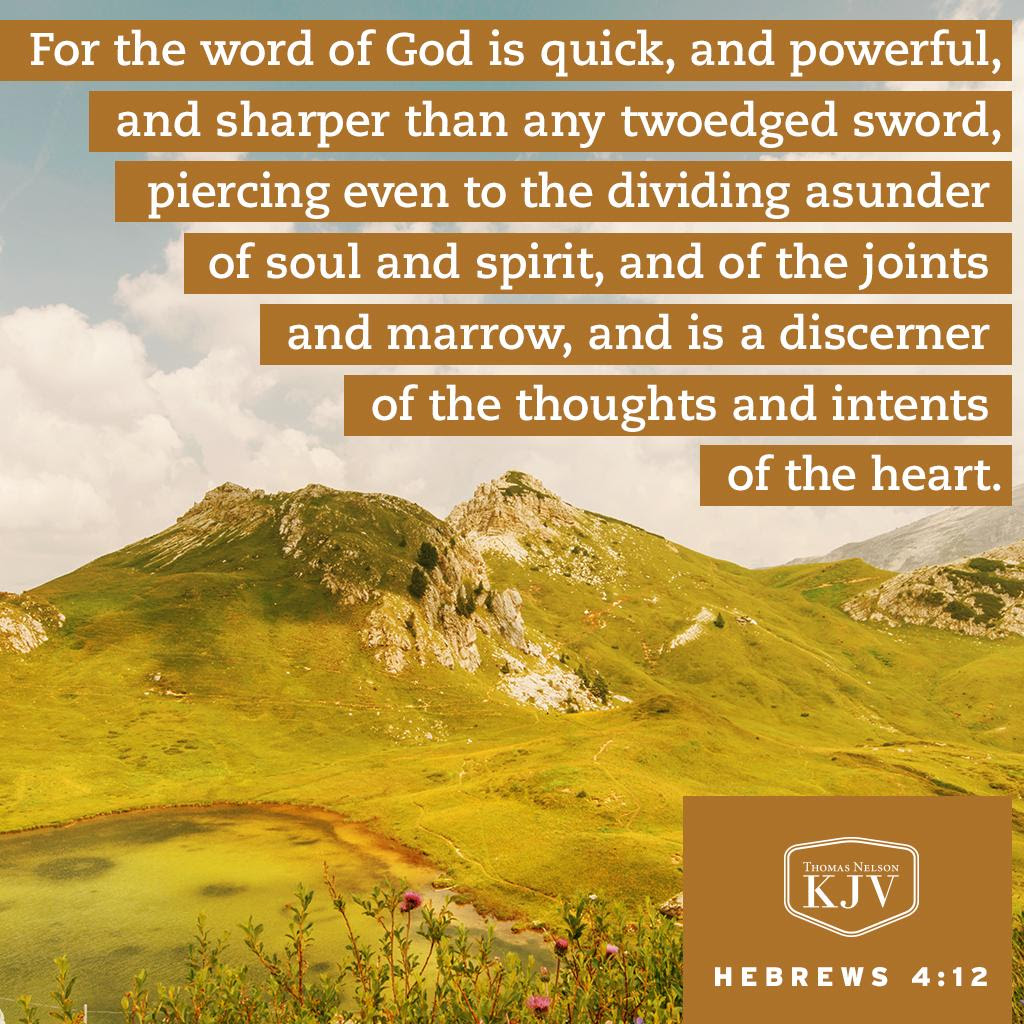
v.12 For the word of God is quick, and powerful, and is harper than any two-edged sword, piercing even to the dividing asunder of soul and spirit, and of the joints and marrow, and is a discerner of the thoughts and intents of the heart.
For the word of God: the efficacy of the word of God is a further enforcement of their studious labour to enter into God’s rest, for that calleth us thereunto; even the law and doctrine of the gospel brought by the incarnate Word from heaven, preached by him to the world, dictated and inspired into the holy penmen both of the Old and New Testament by the Holy Ghost, and written by them at his call and order, 2 Pet. 1:19–21; representing all those precepts and prohibitions, promises and threatenings, by which God will judge to whom this gospel hath been preached in that man whom he hath appointed: compare chap. 2:1, 2, and ver. 1, 2 of this. And this word was written by David, Psal. 95, even a word of exhortation, promise, and threatening, as opened before, and shows the perfection of this gospel law in its administration by Christ. Is quick; this word, like the incarnate Word, is ζω̄ν, not only a living word, but a quickening word, making dead sinners living Christians; souls dead in sins and trespasses, alive to God. This word, the breath of God, conveyeth spirit and life to them, 2 Tim. 3:16; 1 Pet. 1:23: so David experienced it, preserving the life it breathed into him, Psal. 119:50; and the members of the church, 1 Cor. 4:15; compare 2 Cor. 3:6, 17, 18; and as a rule it guideth and directeth them through Christ unto eternal life, John 6:68. And powerful; ἐνεργὴς· it is an active word, powerful in its effects, the very ministration of the Spirit, 2 Cor. 3:8, most efficacious and energetical for convincing, converting, comforting; and for condemning, killing: it acts like the power of God; so Rom. 1:16, 18. And sharper than any two-edged sword; τομώτερος signifieth a cutting sharpness, as becometh several uses, as searching, letting out corruption, or for killing; all which agree to this Divine word; sharper than any sword with two mouths. The Hebrews style the edge the mouth, that which bites, teareth, or woundeth; as Rev. 1:16, and 2:12. The word for spiritual execution upon souls is more sharp, and above every other sword; there is none so piercing for cutting the heart, or killing sin in it. So is it used, Eph. 6:17; compare Acts 2:37; 7:54. It is Christ’s weapon of offence and defence for his people, and it cuts without resistance; with it he is defending his truth, and smiting his enemies, Isa. 11:4; compare Rev. 19:13, 15, 21. Piercing even to the dividing asunder; διϊκνούμενος, piercing, or going through what is smitten with it; which way soever it is turned it forceth its way through all opposition, to a dividing into parts, and separating the most nearly united and closely joined things, laying open the very entrails, the most inward in a man; where the metaphors taken from the closest parts of the person are applied to the soul. Of soul: ψυχὴ may denote not so much the natural life and the faculties of that, but that which is styled the rational soul as unregenerate: see 1 Cor. 2:14. Such an animal, carnal soul as is purely human, 1 Cor. 3:3, which wants both a principle, light, and faculty to discern the things of God, as no natural eye can see a spirit, Rom. 8:5–8. And spirit; πνεύματος, the soul of man regenerate and spiritualized, called spirit, 1 Thess. 5:23. The soul enlightened, renewed, and governed by the Holy Ghost; not altered as to its substance, but as to its qualities; whose understanding, will, and affections are spiritualized, manifested in its actions, agreeable to the spiritual will of God, 1 Cor. 2:10, 12, 14, 15. These are both of them under the piercing power of the word, and the Spirit can reach them by it as he pleaseth. And of the joints and marrow: ἁρμω̄ν are not the members, but the nerves, membranes, muscles, whereby the members or limbs are joined one to another, so as not without incision to be discovered; and the marrow within the bones, there must be a breaking or perforating them to reach it. By which metaphors are set out the hardest, compactest, and most intimate parts of a sinner, the most secret hidden ones, which no natural reason can reach; yet the word of God pierceth them, to discover either the evil or good of them, and to inflict wrath, or communicate comfort, according to their conditions. And is a discerner of the thoughts and intents of the heart: the word of God is a most nice, exact, and critical judge, discerning the gravity and rectitude of them; it discovers and distinguisheth them as they are, or not, agreeable to itself, the fundamental truth; and is capable, as a judge, to charge or discharge, as its author will, by it, Rom. 2:12, 15, 16; compare 1 Cor. 14:24, 25. It discovers the most inward, close, secret, and constant motions, both speculative and practical, of the soul of man inseparably united to the heart; and one with another, whether they are opinions, conceptions, resolutions, or decrees, so subtile and so secret, as who can know them, but he who made the heart? Gen. 6:5; Jer. 17:9.
Matthew Poole, Annotations upon the Holy Bible, vol. 3 (New York: Robert Carter and Brothers, 1853), 825.
SERMON
DELIVERED ON THURSDAY EVENING, MAY 17, 1887,
BY C. H. SPURGEON,
AT THE METROPOLITAN TABERNACLE, NEWINGTON.
“For the word of God is quick, and powerful, and sharper than any two-edged sword, piercing even to the dividing asunder of soul and spirit, and of the joints and marrow, and is a discerner of the
thoughts and intents of the heart.”
Hebrews 4:12.
Discover more from Faithful Steward Ministries and FSM Women's Outreach
Subscribe to get the latest posts sent to your email.
 Faithful Steward Ministries and FSM Women's Outreach