
The First Commandment declares we are to worship God (Yahweh/Jehovah, the Holy Triune God of the Bible) alone. The Second Commandment proclaims how we are to worship Him.
Paul in Romans 1:18–32 tells us that fallen humanity’s tendency is not toward atheism but rather to idolatry. Having rejected the God who does exist, sinners are prone not to abandon worship altogether; rather, we make up all manner of other gods to “take the place” of the Creator of heaven and earth. 1
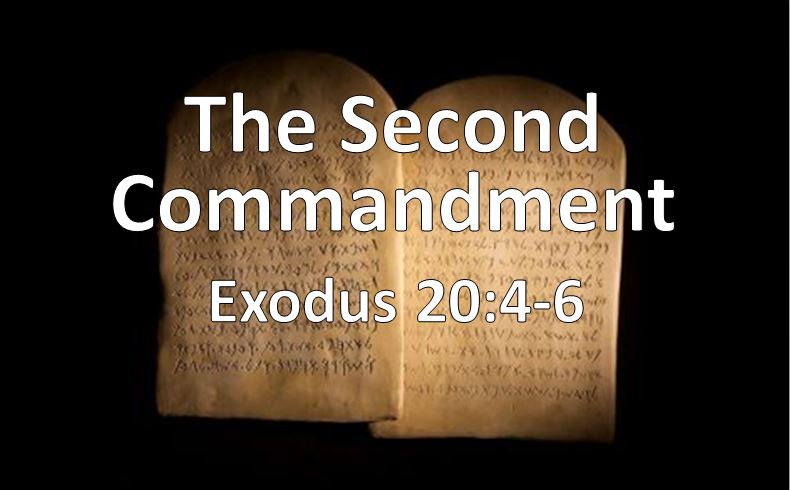
EXODUS 20:4 – 20:5 – 20:6
CONTEXT
CHAPTER TWENTY
Contents: Ten Commandments delivered to Moses at Sinai.
Characters: God, Moses.
Conclusion: A holy and righteous God has holy and righteous standards. Those who love God will constantly endeavor to live as He requires, enabled by the Holy Spirit.
Key Word: Commands, v. 6.
Strong Verses: 3–17.
Striking Facts: Law proposes life and righteousness as the end to be attained by keeping it, but proves at the outset that man is in a state of death (Rom. 5:20; 7:7, 13; 3:20). Life and righteousness cannot come by that which only curses, but only through the grace of God in Christ.
Keith Brooks, Summarized Bible: Complete Summary of the Old Testament (Bellingham, WA: Logos Bible Software, 2009), 20.
In-depth study of
20:4–6 Second Commandment. graven image. Idol; visible representation of a divine being. God is the Creator of heaven, earth, and the water, and must not be confused with His creations (Rom. 1:19–23). In the plagues, He demonstrated His mastery over the created world and humiliated the idols of Egypt. Therefore, though God blesses some visual arts (31:1–11), we must never make an image of God (including any person of the Trinity) or worship with a man-made image of anything before us. For He is a jealous God, not in a petty or unjust sense, but with a holy zeal for His glory (34:14). upon the children. Insofar as they also hate God (34:7).
Joel R. Beeke, Michael P. V. Barrett, and Gerald M. Bilkes, eds., The Reformation Heritage KJV Study Bible (Grand Rapids, MI: Reformation Heritage Books, 2014), 117.
In-depth study of v.4-6
4 Thou shalt not make unto thee any graven image, or any likeness of any thing that is in heaven above, or that is in the earth beneath, or that is in the water under the earth:
Thou shalt not make, either in thy mind, or with thy hand, Acts 17:29, or by thy command. Unto thee, i.e. for thy use, or for thee to worship; for otherwise they were not absolutely forbidden to make any images, but only to make them for worship, as may appear by comparing this place with Lev. 19:4; Deut. 4:15; and Amos 5:26, with Acts 7:43; and from Lev. 26:1, where the setting up of a pillar, or stone, is as absolutely forbidden as the making of an image. And therefore as the former is not forbidden to be done simply and universally, as appears from Josh. 24:20; 1 Sam. 7:12, but only to be done in order to worship, so also is the latter. Moreover there were cherubims and other images in the temple, and afterwards the brazen serpent, which because they were not made to be worshipped, neither were indeed, nor were ever esteemed to be, any contradictions to this law. Any graven image, or molten, or any other image, as is most evident from the nature and reason of the precept. Nor is any thing more common than such synecdochical expressions, wherein under one kind named all other things of the like nature are contained. But for more abundant caution, and to put all out of doubt, he adds a more general word, nor any likeness. Any thing that is in heaven; as of God, Deut. 4:15; Isa. 44:9, 20, angels, sun, moon, or stars, which the heathens worshipped, Deut. 4:19; 17:3. Or in the earth; as of men, and beasts, and creeping things, which the Egyptians and other Gentiles worshipped as gods. See Deut. 4:16, 17; Isa. 44:13; Ezek. 23:14. Or in the water; as of fishes, such as Dagon was; or serpents, crocodiles, and such other Egyptian deities. Under the earth: this is emphatically added, to note the singular care of Divine Providence in bringing the waters under the earth, which naturally are lighter and higher than it, and therefore might easily overwhelm it. Compare Psal. 104:6.
5 Thou shalt not bow down thyself to them, nor serve them: for I the LORD thy God am a jealous God, hvisiting the iniquity of the fathers upon the children unto the third and fourth generation of them that hate me;
Not only inward reverence is forbidden, but also all outward gestures that naturally or customarily express reverence, whether bowing down the body, as here; or bending the knee, as 1 Kings 19:18; or kissing the idol, or one’s hand towards it, as Job 31:27; Hos. 13:2; one gesture being by a synecdoche named for all. To them, nor before them; for to bow to them, and to bow before them, are expressions in Scripture of the same extent and use, as appears by comparing this place with Lev. 26:1; 2 Chron. 25:14; and 2 Sam. 7:22, with 1 Chron. 17:25; and Matt. 4:9, with Luke 4:7. Nor serve them; or, worship them, either inwardly in thy mind, or outwardly by any sensible mean or sign of worship given to them, as incense or sacrifice, vowing to them, or swearing by them, or the like. A jealous God, i.e. impatient of any partner in thy love and worship, and full of wrath against them that give my glory to images, Isa. 42:8; as jealousy is the rage of a man (Prov. 6:34) against the defiler of his marriage-bed. God is pleased to call and account himself the Husband of his church and people, Jer. 2:2; Hos. 2:19; and therefore idolatry is called adultery, Deut. 31:16; Jer. 3:3, 10; and God’s anger against idolaters’ jealousy. The word el properly signifies the strong God, and shows God’s ability to avenge himself, as the word jealous notes his readiness and resolution to do it. Visiting, i.e. remembering, inquiring into, or punishing, (as that word is commonly used, as hath been noted before,) the iniquity of the fathers upon the children. Quest. How can this be just? Answ. 1. All are born sinners, and are children of wrath, and therefore justly punishable for their own sins. Answ. 2. He speaks not here of eternal damnation, but of temporal punishments, in which there is no shadow of injustice; as appears, 1. Because the sins of parents are oft punished in their children, even in human courts, as is manifest in traitors, which practice being acknowledged to be just, it cannot with any sense be accounted unjust in God. 2. Because such external punishments have more good than evil in them, and are in many, and may be so in others, if themselves do not hinder it, instruments of the greatest good, exercises of their virtues and graces, and means of their eternal happiness. 3. Because children are a part and the possession of their parents, and therefore it is not unjust if they suffer with them, and for them. Answ. 3. This is to be understood with an exception of repentance, and penitent children, as appears from Ezek. 18. And if any such be temporally punished for their fathers’ sins, God will abundantly recompense it to them some other way. But if children tread in their fathers’ sinful steps, it is but just that they should partake of their plagues. Unto the third and fourth generation; and further too, as appears in the ten tribes, and afterwards in the two tribes, upon whom the iniquity of their fathers hath been visited now for many generations. But he mentions them in particular, partly, because a parent may live so long, and see the dreadful effects of his sin in his children’s children; partly, because so far the memory of a father may extend, and be matter of imitation to his children; and partly, to show the difference between his exercise of justice and mercy, as appears by comparing the next verse. Them that hate me. This word is opposed to the conceit that idolaters, at least many of them, have of themselves, that they love God more than others do, because they love, and honour, and worship the creatures for his sake, and for those excellencies that he hath wrought in them; but this will no more excuse their idolatry, than it will excuse him that commits adultery with his friend’s wife, that he did it for his friend’s sake, and from the love he had to his friend, and for his relations.
6 And shewing mercy unto thousands of them that love me, and keep my commandments.
Unto thousands, to wit, of their generations, i.e. for ever; whereas his punishment extended only to three or four of them: so far is God’s mercy exalted above his justice. Compare Psal. 103:17.
Them that love me, and keep my commandments: this conjunction is very observable, both against those that falsely and foolishly pretend or insinuate that the inward affection of love to God is not absolutely and always necessary to salvation; and also against them who, pretending inward love to God, live in the customary breach of God’s known commands.
Matthew Poole, Annotations upon the Holy Bible, vol. 1 (New York: Robert Carter and Brothers, 1853), 158–159.
STUDY
- Q. Which is the second commandment?
A. The second commandment is, “Thou shalt not make unto thee any graven image, or any likeness of any thing that is in heaven above, or that is in the earth beneath, or that is in the water under the earth: Thou shalt not bow down thyself to them, nor serve them: for I the Lord thy God am a jealous God, visiting the iniquity of the fathers upon the children unto the third and fourth generation of them that hate me; and shewing mercy unto thousands of them that love me, and keep my commandments.”
- Q. What is required in the second commandment?
A. The second commandment requires the receiving, observing (Deut. 32:46; Matt. 28:20), and keeping pure and entire all such religious worship and ordinances as God has appointed in his Word (Deut. 12:32).
- Q. What is forbidden in the second commandment?
A. The second commandment forbids the worshipping of God by images, (Deut. 4:15–16) or any other way not appointed in his Word (Col. 2:18).
C. H. Spurgeon, A Catechism, With Proofs (Bellingham, WA: Logos Bible Software, 2009), 18.
In-depth Study of Ten Commandments
DEVOTION
On Images (or Against Images)
by Colin Fast

We live in an image-obsessed culture – everything we do is captured in images: photographs, drawings, videos, and TikToks. Images and images and images and images. They help us think. They help us learn. They help us better understand ideas and concepts. ‘I’m just a visual person,’ some will suggest, ‘so I need to see things in pictures – and if I don’t, I’ll just imagine those images in my mind anyways.’
Given those cultural norms, the reasons for a proliferation of images of Christ might seem obvious as they increasingly appear in TV shows and movies, on book covers and in illustrations for kids books (and story Bibles), or hanging in museums and dining rooms and in churches. We assume these images of Christ aren’t a problem, since Jesus assumed a human nature – ‘these images are simply a representation of the incarnate Christ,’ we reason.
Discover more from Faithful Steward Ministries and FSM Women's Outreach
Subscribe to get the latest posts sent to your email.
 Faithful Steward Ministries and FSM Women's Outreach