
Continuation of our series, peeling back the layers of Jesus’s final teaching in His Olivet Discourse.
CONTEXT: See Part I
Today we will look at the first three verses of this final discourse.
31 When the Son of man shall come in his glory, and all the holy angels with him, then shall he sit upon the throne of his glory:
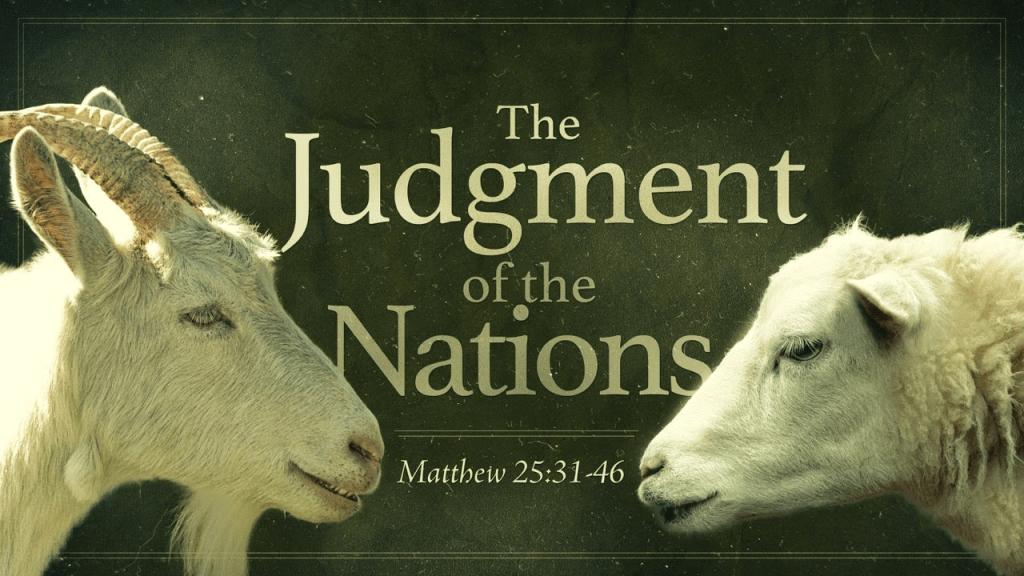
32 And before him shall be gathered all nations: and he shall separate them one from another, as a shepherd divideth his sheep from the goats:
33 And he shall set the sheep on his right hand, but the goats on the left.
The first thing that needs to be addressed when we look at Jesus’ words concerning His return, is His declaration that He will come in His Glory. Why is this significant you may ask? So far in His earthly ministry Jesus has declared He was here to Glorify (same Greek word) the Father. The Gospel of John spells this out more clearly than any other, John 12:28, 13:31, 14:13, and 17:1-4 are just a few examples. Jesus has in the previous two parables let His followers know they must be always ready and about kingdom works. Here He makes clear that His return will not be as the Son of Man (Jesus) but as the Glorified leader (Christ) of Hevean’s army and all the holy angels with him.
The second theological implication we find here is the gathering of all nations. There seem to be some differing opinions among Biblical scholars as to whether this means all believers (God’s elect) (Gill, Poole), all unbelievers (JFB), or everyone elect or not. I tend to think the latter and to agree with the J.C. Ryle’s assessment below:
All that have ever lived shall one day give account of themselves at the bar of Christ. All must obey the summons of the great King, arid come forward to receive their sentence. Those who would not come to worship Christ on earth, will find they must come to His great assize, when He returns to judge the world.
All that are judged will be divided into two great classes. There will no longer be any distinction between kings and subjects, or masters and servants, or dissenters and churchmen. There will be no mention of ranks and denominations, for the former things will have passed away. Grace, or no grace, conversion or unconversion, faith or no faith, will be the only distinctions at the last day. All that are found in Christ will be placed among the sheep at His right hand. All that are not found in Christ will be placed among the goats at His left. Well says Sherlock, “Our separations will avail us nothing, unless we take care to be found in the number of Christ’s sheep, when He comes to judgment.”
J. C. Ryle, Expository Thoughts on Matthew (New York: Robert Carter & Brothers, 1860), 342.
The final theological implication is what happens to this gathering of nations? We can see three things from v.32-33:
- Jesus will separate the nations
- Here we have the judgment of the nations (All peoples)
- Jesus is referred to or called a Shepherd.
- It is customary for a Good Shepherd to separate the His sheep from the Goats every night. The sheep, known for their white coats and fairly calm disposition here represent those elect who are to be welcomed into the Kingdom of God. The goats, known for their unruly behavior represent worldly people the unsaved.
- The manner or method of separating the nations.
- First, it needs to be noted that the Sheep and Goats co-exist in the same place. Some would teach that we must separate ourselves from ALL things of the world. They use Romans 12:2, Ephesians 2:10, 1 John 2:15-17 as the basis for this doctrine. The issue is total separation from the world allows no options to follow Jesus’ command in the Great Commission.
- Here Jesus separates those (Sheep) who have responded to the Holy Spirit and surrendered all to become sons and daughters of the Almighty God, to His right. This is a place of honor. Ephesians 1:20
- The Goats (all those who refused the Holy Spirit’s urging) will be separated to Jesus’ left. If the right side is considered a place of Honor the left side here can only mean a place of dishonor. Ecclesiastes 10:2
The message is clear Jesus will return, as Christ the King in all His glory to claim His body of believers. He will judge everyone, and separate His chosen from those of unbelief. Matthew Poole’s commentary sums it up better than I:
So the saints of God, who are like sheep for whiteness, gentleness, innocency, and feed in this world together with stinking and lascivious goats, the wicked of the world, compared to goats for the filthy qualities by which they resemble them; yet at the day of judgment Christ shall separate them. And he shall set the sheep on his right hand. The right hand is the place of honour and dignity, and the place for favourites: then Christ shall exalt his saints to great honour and dignity, and show them his favour. But the goats on the left; wicked men shall rise to shame and contempt. The right-hand men of the world shall be at the left hand of Christ. It shall be then seen, that because they are people of no understanding, he that formed them will show them no favour.
Matthew Poole, Annotations upon the Holy Bible, vol. 3 (New York: Robert Carter and Brothers, 1853), 120.
In the next installment, we will look at v.34-40, Jesus explains the reasoning for separating the faithful and their reward.
Discover more from Faithful Steward Ministries and FSM Women's Outreach
Subscribe to get the latest posts sent to your email.
 Faithful Steward Ministries and FSM Women's Outreach