

Endowment – 2. That which is given or bestowed on the person or mind by the creator; gift of nature; any quality or faculty bestowed by the creator. The natural activity of limbs is an endowment of the body; the natural vigor of intellect is an endowment of the mind. Chatham and Burke, in Great Britain, and Jan, Ellsworth, and Hamilton, in America, possessed uncommon endowments of mind.
“endowment.” Noah Webster’s 1828 American Dictionary of the English Language. 2024. https://1828.mshaffer.com/d/word/endowment (2 February 2024).
CONTEXT:
CHAPTER FOUR
Keith Brooks, Summarized Bible: Complete Summary of the New Testament (Bellingham, WA: Logos Bible Software, 2009), 60.
Contents: Walk and service of the believer in Christ. Ministry of gifts of Christ to His Body.
Characters: Christ, Holy Spirit, God, Paul.
Conclusion: Considering to what state and condition God has called us in Christ Jesus, let us approve ourselves good Christians, living up to our profession and calling. As members of His Body, the Holy Spirit will endue us with spiritual gifts for His service that we might confirm and build up others in the faith and that we might dispense the saving doctrines of His grace to the unsaved.
Key Word: Walk, v. 1.
Strong Verses: 1, 17, 22, 23, 24, 30, 32.
Striking Facts: v. 8. When Christ’s body was laid in the grave, His spirit descended into Hades (the abode of departed spirits), and proclaimed the victory of the cross. At His ascension to the Father after three days He delivered from Hades the spirits of the justified and took them to Paradise above, leaving the unsaved spirits in Hades. The spirit of the Christian at death now goes to be with Him above. Phil. 1:23; 2 Cor. 5:9.
.
Ver. 7. But unto every one of us is given grace, &c.] Which may refer to the saints in common, and may be interpreted of justifying, pardoning, adopting, sanctifying, and persevering grace, bestowed upon them all, freely and liberally, not grudgingly, nor niggardly, and without motive and condition in them; or to the ministers of the Gospel, and so design gifts fitting for the ministry, which every one has, though differing one from another, and all of free grace: according to the measure of the gift of Christ: either according to the gift of grace to Christ before the world began, and the measure of it, which he communicates to them in time, even grace for grace; or according to that measure of gifts which Christ received from men at his ascension: it may be observed that every member of Christ, and minister of his, receive more or less grace and gifts from him; and that what they receive is all of free grace, and in measure; and though they may have gifts differing one from another, yet all are useful; so that there is no room for pride, envy, and contempt, which would break in upon the unity of the spirit; for what is said from ver. 3 contains so many arguments to stir up the saints to endeavour to preserve that.
John Gill, An Exposition of the New Testament, vol. 3, The Baptist Commentary Series (London: Mathews and Leigh, 1809), 87.
This past Sunday’s Sermon and Devotional centered on Ephesians 4:3, with a theme of “Unity of the Spirit.” In leading up to today’s text Paul focuses on that which unites us in Ephesians 4:4-6 (see below1).
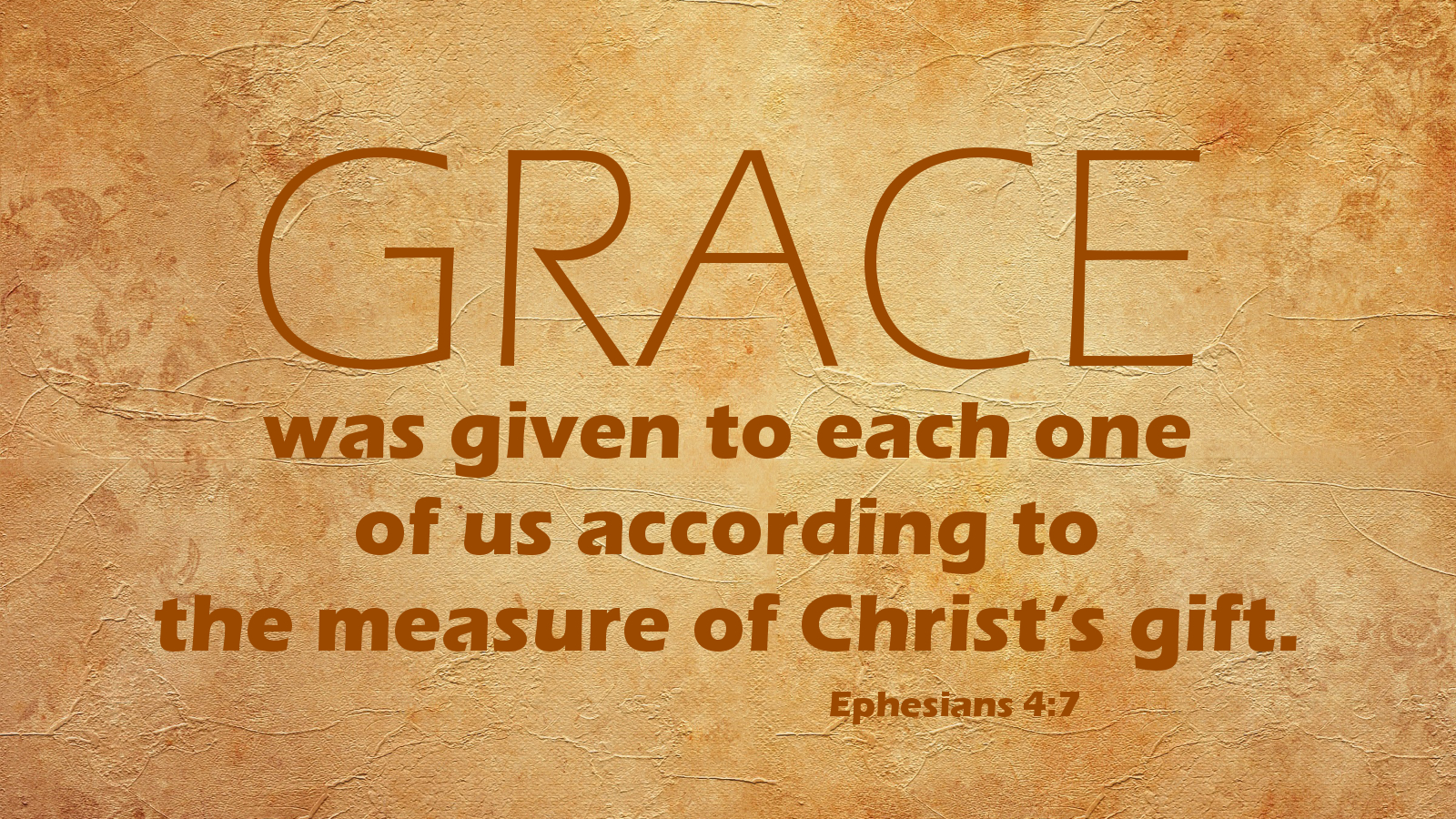
In today’s text v.7, Paul furthers this theme of the condition and state in which God has called us in Christ, by exclaiming all is by God’s Grace. Grace here not referring to personal salvation but to the differing gifts, I love the NLT version here: each one of us a special gift through the generosity of Christ. God Graciously bestows these “gifts” not for our benefit lest we boast. They are to be used exclusively for the benefit of the Glory of God and the advancement of His Kingdom.
Some Bible Cross References to look up:
Rom 12:3, Rom 12:6, 1 Cor 12:11, Eph 3:7, 1 Pet 4:10
The Heidelberg Catechism does an excellent job of expressing the need to preserve and utilize the Gift of Grace granted to us by Christ.
Question 55. What do you understand by “the communion of saints?”
Answer. First, that all and every one who believes, being members of Christ, are in common partakers of him, and of all his riches and gifts; secondly, that every one must know it to be his duty, readily and cheerfully to employ his gifts for the advantage and salvation of other members.
EXPOSITION
The articles of the Creed which we have yet to consider, treat of the benefits of Christ which have been, and shall be conferred upon the church by the Holy Ghost. The term communion expresses the relation between two or more persons, who have the same thing, or possession in common. The foundation or ground of this communion is the thing which is common. The term itself signifies the possessors, few or many, who have common fruition in one, or many things. The communion of saints, therefore, is an equal participation in all the promises of the gospel; or it is the common possession of Christ, and all his benefits; and the bestowment of the gifts which are given to each member for the salvation of the church. It signifies then, 1. The union of all the saints with Christ, as members with the head, which is effected by the Holy Ghost, who dwells in the head, and in the members, conforming and making them like unto their glorious Head, yet preserving a proper proportion between the head and the members; or, it is a union of the church with Christ, and of the members one with another; which union with Christ extends to his whole person, including both, his divine and human natures; for communion with the person of Christ is the foundation of communion in his benefits, according to what is said: “I am the vine; ye are the branches.” “Abide in me, and I in you.” “As the branch cannot bear fruit of itself, except it abide in the vine, no more can ye, except ye abide in me.” “For by one Spirit are we all baptized into one body.” “If any man have not the Spirit of Christ he is none of his.” “He that is joined unto the Lord is one Spirit.” “Hereby know we that we dwell in him, and he in us, because he hath given us of his Spirit.” (John 15:4, 5. 1 Cor. 12:13. Rom. 8:9. 1 Cor. 6:17. 1 John 4:13.) 2: A participation in all the benefits of Christ. The same reconciliation, redemption, justification, sanctification, life and salvation, belong to all the saints by and for the sake of Christ. They have in common all the benefits which are necessary for their salvation. “There is one body, and one Spirit, even as ye are called in one hope of your calling; one Lord, one faith, one baptism,” &c. (Eph. 4:4.) 3. The distribution of special gifts. These particular gifts which are bestowed upon some members of the church for the salvation of the whole body, for the gathering of the saints, for the work of the ministry, and for the edification of the church, are also common to the whole church: yet they are at the same time so distributed to all its members that some excel in one particular kind of gifts, whilst others again excel in other respects; for there are different gifts of the Spirit, and “to every one of us is given grace, according to the measure of the gift of Christ.” (Eph. 4:7.) 4. The obligation of all the members to devote all the gifts which have been conferred upon them to the glory of Christ, their Head, and to the salvation of the whole body, and of every member mutually.
From what has now been said, we may readily see how vain is the exposition of those, who make the communion of saints to consist in the subsistence of Christ’s body in and with our bodies. This opinion is refuted by the often-repeated comparison of the head and the members, which, although they are united in the closest manner, nevertheless, subsist without any mixture or confusion. From this we may also easily judge of the communion which we have in the sacraments; for they seal nothing different from what the word promises. The same error is also refuted by the consideration, that it is necessary that this communion should continue for ever. It is to this end that Christ communicates himself to us, that he may dwell, and remain in us. Hence the communion of Christ is such as his dwelling in us is, which being spiritual is to last for ever. Wherefore his communion must also be perpetual. This argument is conclusive, and has driven some to the notion of ubiquity, in order that they might overthrow it; for to maintain that other corporeal communion, they are constrained to affirm that Christ continually dwells bodily in the saints.
Believers are called saints in three respects: by the imputation of Christ’s righteousness; by the beginning of conformity to the law which is commenced in them; and by their separation from the rest of the human race, being called of God to the end that they may truly know and worship him.
Zacharias Ursinus and G. W. Williard, The Commentary of Dr. Zacharias Ursinus on the Heidelberg Catechism (Cincinnati, OH: Elm Street Printing Company, 1888), 303–305.
Hence we may now understand what we mean when we say, I believe in the communion of saints; viz, I believe that all the saints (to the company of whom I am firmly persuaded that I belong) are united to Christ, their head, by his Spirit, and that gifts are bestowed upon them from the head, including such as are the same in all and necessary for their salvation, as well as those which are diverse and variously bestowed upon every one, and which are requisite for the edification of the church.
- Ephesians 4:4-6 Stregth for Today Devotional ↩︎
Discover more from Faithful Steward Ministries and FSM Women's Outreach
Subscribe to get the latest posts sent to your email.

