
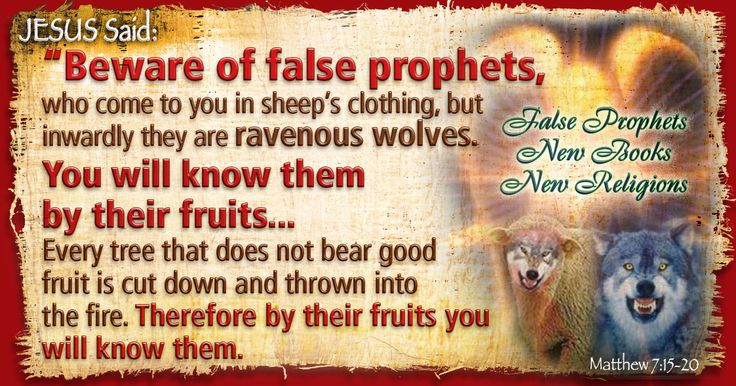
If you listen to “Christian” radio or TV programming you suspect this is going on with unbridled regularity today. Yet Jesus says “You {we} will know {for certain} who these false teachers are, how by their fruit.
This command from Jesus, is not written as a suggestion, demands we “Judge” others. Of course, modern society if they know no other bible verse knows Matthew 7:1, Judge not, that ye be not judged. So how are we to know {judge} folks if we can’t know/judge them? CONTEXT of course is everything.
Connect the Testaments DEVOTIONAL
October 9: Judgment: It’s Tricky Ezekiel 19:1–20:49; Revelation 9:1–21; Job 34:31–37
Judgment is both a curse and a blessing. If you judge others, you might be judged yourself—especially if you judge them incorrectly. Yet if you know how to judge right from wrong, you can discern truth from fiction.
Although judgment can be a wretched thing, there is a time for it: When God has confirmed something in your heart, and the Bible verifies your view, you must stand up for it. When Jesus tells us not to judge, He is not declaring that we should be passive (see Matt 7:1–6; see also Matt 7:15–23, where He condemns false prophets and false followers). Instead, Jesus is saying that we should be careful about what we say and do, for we could be the one at fault.
Ezekiel also deals with the very fine line of judgment. Yahweh says to him, “Will you judge them? Will you judge them, son of man?” (Ezek 20:4). This question implies the very point Jesus makes: Is Ezekiel capable of dealing out judgment? Certainly not, but with the power of Yahweh, he can speak the truth. Yahweh goes on, “Make known to them the detestable things of their ancestors” (Ezek 20:4). He follows this with a commentary on “the detestable things” accompanied by a comparison to how Yahweh has treated His people despite their disobedience (Ezek 20:5–8).
Judgment is tricky, but fear of “getting it wrong” should not keep us quiet in the midst of misdeeds and misconduct. Instead, we must speak up—let’s just be sure that we first pray and examine our thoughts in light of the Bible.
What have you previously been quiet about that you should speak up against?
John D. Barry and Rebecca Kruyswijk, Connect the Testaments: A One-Year Daily Devotional with Bible Reading Plan (Bellingham, WA: Lexham Press, 2012).
The following are comments and previous posts that are helpful on the subject:
IDENTIFYING A WOLF IN SHEEP’S CLOTHING. NIELS HEMMINGSEN: In this Gospel they are called wolves, but yet masking in sheep’s skins, that is to say, pretending themselves to be meek, whereas that notwithstanding, they like wolves leap privily into Christ’s fold, tearing and killing Christ’s sheep with false doctrine and counterfeit holiness. But what is the outward countenance of false teachers? They come (says Christ) in sheep’s clothing. The Lord in this place speaks not generally of all evil teachers, but only of one kind. For there are some who teach well and live amiss and some who teach amiss and live amiss, and other some who teach amiss and seem to live well. Of this third kind of prophets the Lord speaks here. For by them is greatest danger.
What is their desire? That does Christ set forth in a triune image when he terms them wolves. For as the desire of the wolf is first to scare the sheep from the fold; then to harry them into the woods; and third to devour them and destroy them. Even so the false prophets endeavor by these wiles to withdraw the sheep—that is to say, the godly and weak persons—from the true church and to drive them into the wilderness, where is no food of God’s word, to the intent they may get the master of them, and the length, murder not so much their bodies, as their souls.…
But you say, How can I who am a rude and ignorant person discern in this variety of opinions, who are the true teachers and who the false? To the intent we may discern and judge the shepherd from the wolf, Christ shows us the marks of the wolf and he draws out the false teachers in their proper colors. They come to you (says he) in sheep’s clothing. If someone looks but upon their outward visor, they would take them for most holy people or rather for angels of God. But if you pluck off their visors, you shall find them wolves; first for that their voice is not like Christ’s voice; yes, rather, with a strange noise they scare away Christ’s sheep from their sheepfold unto the wilderness, to the intent they may kill people’s consciences and destroy their souls. And this is one mark. Besides this, he adds another when he says, “You shall know them by their fruits.” Here you must be well advised that you take not the leaves for the fruit. An evil tree has now and then beautiful leaves; and again, a good tree often has plentiful fruit, but leaves not altogether so fair to see too. But what are the true fruits of prophets? They are three: worshiping, doctrine, and manners conformable to the doctrine. The true prophet has his manner of worshiping, his doctrine, and his manners according to the prescript word of God. The false prophet has a manner of worshiping devised by humans, a doctrine of human traditions, and manners to outward show honest, but savoring altogether of hypocrisy. A POSTIL, OR EXPOSITION OF THE GOSPELS.
DISCERNING BETWEEN TRUE AND FALSE PASTORS. THEODORE BEZA: Let this controversy therefore be first disputed before the question be made touching the form of ordination; and let these men leave off to boast of the apparel and outward show of pastors, when as inwardly they be ravening wolves. Verily Christ commands true pastors to be distinguished from false, not by laying on of hands, but by their fruits and by doctrine and manners.… [Moreover] miracles are not necessary to prove any holy, lawful vocation, either ordinary or extraordinary.… Now first it is manifest that the gift of miracles has always been free, that is, set in the power of God alone, who has given the same at certain times and to certain persons; therefore, we can make no rule of it. Next, seeing that not only Christ has foretold, but also the old and new stories witness, that this gift was common both to true and also to false prophets, what madness shall it argue to be desirous to have the false sending to be discerned from the true by miracles? A DISCOURSE OF THE TRUE AND VISIBLE MARKS OF THE CATHOLIC CHURCH.
Jason K. Lee, William M. Marsh, and Timothy George, eds., Matthew: New Testament, vol. I, Reformation Commentary on Scripture (Downers Grove, IL: IVP Academic: An Imprint of InterVarsity Press, 2021), 103–104.
Discover more from Faithful Steward Ministries and FSM Women's Outreach
Subscribe to get the latest posts sent to your email.

