
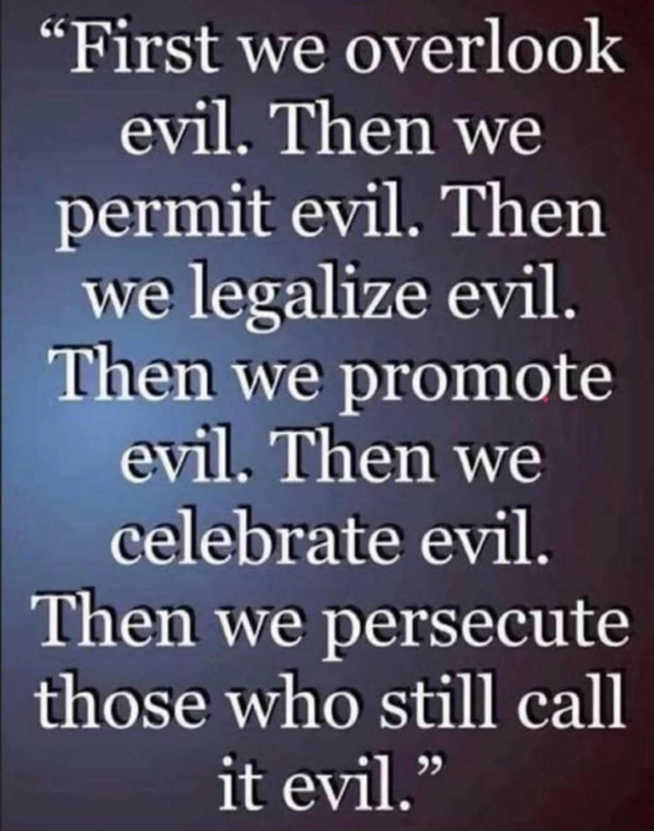
There are many scriptures that can be applied to this quote; the first one that came to my mind was Isaiah 5:20. Here is the Amplified version:
Woe (judgment is coming) to those who call evil good, and good evil; Who substitute darkness for light and light for darkness; Who substitute bitter for sweet and sweet for bitter!
Maybe it is just me, though I don’t think so, but I firmly believe we are living in a time that hits all six (6) points in the quote. Think on this for a moment;
- Evil in many forms has been overlooked for at least the last 60+ years.
- Evil (sin) has been permitted: Abortion, denial of school prayer, LGBTQ+
- Evil has been made legal: see above
- Evil has been promoted: check public education, view the LGBTQ+ in TV movies
- Evil has been celebrated: view any media awards ceremony
- Evil is used to persecute those (especially those who would share the Good News of Christ) who call it evil
There are many examples I could cite, but let me share one from personal experience. Years ago, I read an article in the Boston Globe about Plymouth Plantation (PP), in which the head of public relations stated unequivocally that the Pilgrims came to America primarily for economic gain. Not one to shy away from controversy, I shot an email off to the individual, with copies to the director of the PP and the Plymouth Historical Society. I used the quote below:
“For we must consider that we shall be as a City upon a Hill, the eyes of all people are upon us;… Beloved there is now set before us life, and good, death and evil in that we are commanded this day to love the Lord our God, and to love one another to walk in his ways and to keep his commandments and his ordinance, and his laws, and the Articles of our Covenant with him that we may live and be multiplied, and that the Lord our God may bless us in the land whether we go to possess it: But if our hearts shall turn away so that we will not obey, but shall be seduced and worship other gods, our pleasures, and profits, and serve them, it is propounded unto us this day, we shall surely perish out of the good Land whether we pass over this vast Sea to possess it.”
— John Winthrop (1588-1649), Puritan & First Governor of Massachusetts
I recommended they get a copy of Governor Winthrop’s journal and actually read it. Seriously, how could anyone, especially someone representing the Plantation, deny that the Pilgrims sailed primarily to escape religious persecution? Oh yes, they promote an alternative history. One that denies God and promotes evil.
I must make a note here. I looked up the PP website that I had saved years ago, and the link was disabled. So I searched and found that the plantation had been renamed Plimoth-Patuxet Museums. Obviously, some politically correct and forward-thinking attempt to be all-inclusive. The “good” news is that the site under Learn – Everyone – Faith & Spirituality, at least acknowledges that the Pilgrims’ search for personal religious freedom was the motivating factor behind Mayflower’s crossing in 1620.
STUDY
EVIL (Heb. ra’; Gk. kakos, ponēros, phaulos). Evil has a broader meaning than *SIN. The Heb. word comes from a root meaning ‘to spoil’, ‘to break in pieces’: being broken and so made worthless. It is essentially what is unpleasant, disagreeable, or offensive. The word binds together the evil deed and its consequences. In the NT kakos and ponēros mean respectively the quality of evil in its essential character, and its hurtful effects or influence. It is used in both physical and moral senses. While these aspects are different, there is frequently a close relationship between them. Much physical evil is due to moral evil: suffering and sin are not necessarily connected in individual cases, but human selfishness and sin explain much of the world’s ills. Though all evil must be punished, not all physical ill is a punishment of wrongdoing (Lk. 13:2, 4; Jn. 9:3; cf. Job).
I. Physical evil
The prophets regarded God as the ultimate Cause of evil, as expressed in pain, suffering or disaster. In his sovereignty he tolerates evil in the universe, though he overrules and uses it in his administration of the world. It is used to punish individual and national wickedness (Is. 45:7; La. 3:38; Am. 3:6). The world must be marked by regulation and order to be the scene of man’s moral life; otherwise there would be chaos. When men violate the basic laws of God they experience the repercussions of their actions, which may be in penal or retributive affliction (Mt. 9:2; 23:35; Jn. 5:14; Acts 5:5; 13:11). Divine ‘vengeance’ in the form of pain or sorrow does not imply evil passions in God. Pain may awaken an evil man to reality; till then ‘he is enclosed in illusion’ (C. S. Lewis, The Problem of Pain, p. 83). Nature’s present ‘vanity’ (profitlessness, Rom. 8:19–23) is its mark of evil, the earth being under a curse (Gn. 3:17–18). Christian suffering, whether trouble or persecution, is divinely permitted for purposes of spiritual blessing (Jas. 1:2–4; 1 Pet. 1:7; etc.). It is chastening, not penal; nor can it separate from the love of God (Rom. 8:38–39); it prepares for glory (Rom. 8:18; 2 Cor. 4:16–18; Eph. 3:13; Rev. 7:14). Suffering and sorrow create sympathy and kindness in men, bringing them into fellowship with God’s purpose to overcome evil.
II. Moral evil
God is separate from all evil and is in no way responsible for it. Moral evil arises from man’s sinful inclinations (Jas. 1:13–15). Israel repeatedly ‘did evil’ and suffered its consequences (Jdg. 2:11; 1 Ki. 11:6, etc.). Behind all history is a spiritual conflict with evil powers (Eph. 6:10–17; Rev. 12:7–12), ‘the evil one’ being the very embodiment of wickedness (Mt. 5:37; 6:13; 13:19, 38; Jn. 17:15; Eph 6:16; 2 Thes. 3:3; 1 Jn 2:13–14; 3:12; 5:18–19). Satan’s power is under divine control (cf. Jb. 1–2), and will finally be broken (Heb. 2:14; Rev. 12:9–11).
God is against evil, but its existence is often a stumbling-block to belief in a God of love. It can only be attributed to the abuse of free-will on the part of created beings, angelic and human. God’s whole saving activity is directed to deal with evil. In his life, Christ combated its manifestations of pain and sorrow (Mt. 8:16–17); but the cross is God’s final answer to the problem of evil. His love was supremely demonstrated there (Rom. 5:8; 8:32) in the identification of the Lord with the suffering world as the Sin-bearer. The moral change effected in men by the gospel is evidence of the reality of Christ’s triumph over all evil powers (Col. 2:15; 1 Jn. 3:8), and therefore of the final victory of God. Evil will be eliminated from the universe, and the creation will share redeemed man’s glorious destiny. Both physical and moral evil will be banished eternally (Rev. 21:1–8).
BIBLIOGRAPHY. C. S. Lewis, The Problem of Pain, 1940; C. E. M. Joad, God and Evil, 1943; J. S. Whale, The Christian Answer to the Problem of Evil, 1936; James Orr, The Christian View of God and the World, 1897; A. M. Farrer, Love Almighty and Ills Unlimited, 1962; O. F. Clarke, God and Suffering, 1964; J. Hick, Evil and the God of Love, 1966; J. W. Wenham, The Goodness of God, 1974; TDNT 3, pp. 469–484; 6, pp. 546–566; NIDNTT 1, pp. 561–567.
G. C. D. Howley, “Evil,” in New Bible Dictionary, ed. D. R. W. Wood et al. (Leicester, England; Downers Grove, IL: InterVarsity Press, 1996), 348–349.
Does the Bible Explain why God Allowed Evil?
The Bible doesn’t provide a single, comprehensive explanation for why God allows evil, but it addresses the question through multiple angles that together form a theological framework.
The Origin of Evil and Sin
Evil enters the world through human choice—the serpent deceives humanity, and Adam and Eve choose to eat from the forbidden tree despite God’s clear warning (Gen 3). God himself cannot be tempted by evil and tempts no one; rather, individuals are tempted when drawn by their own desires (James 1:13–15). Sin came into the world through human decision, and death followed as its consequence (Rom 5:12–19).
Evil also has a supernatural dimension. Satan, originally created blameless, became filled with lawlessness and violence, sinning through pride and corruption (Ezek 28:12–17). This deceiver of humanity was cast down to earth (Rev 12:7–9), where he continues to operate.
Why God Permits Rather Than Prevents Evil
The search results reveal that Christian theology distinguishes between God causing evil and God permitting it. God cannot produce or promote evil; He can only permit it. Nevertheless, since He is all-powerful, He can both defeat evil and bring about a greater good when He allows it1. God, being all-powerful, could have prevented evil actions through annihilation or diversion, yet He permits them2.
The Limits of Human Understanding
Importantly, the Bible acknowledges that God’s reasoning transcends human comprehension. God’s judgments are unfathomable and His ways are untraceable (Rom 11:33–36). While God sets before humanity both life and death, blessing and curse, inviting people to choose life (Deut 30:15–19), the ultimate purpose behind permitting evil remains partially mysterious.
God desires all people to be saved and to know the truth, and He is extraordinarily patient, not wishing that anyone should perish (1 Tim 2:3–4; 2 Pet 3:9).
- 1Norman L. Geisler, Systematic Theology, Volume Three: Sin, Salvation (Minneapolis, MN: Bethany House Publishers, 2004), 80–81.
- 2Paul Helm, The Providence of God, ed. Gerald Bray, Contours of Christian Theology (Downers Grove, IL: InterVarsity Press, 1993), 172.
Discover more from Faithful Steward Ministries and FSM Women's Outreach
Subscribe to get the latest posts sent to your email.

