
COMMENTS
As 2025 comes to a close, I think it is a good reminder to reflect on our failures as men and women to do good consistently. This is not a condemnation, a judgment, but an observation that holds true for me as well as for the rest of mankind.
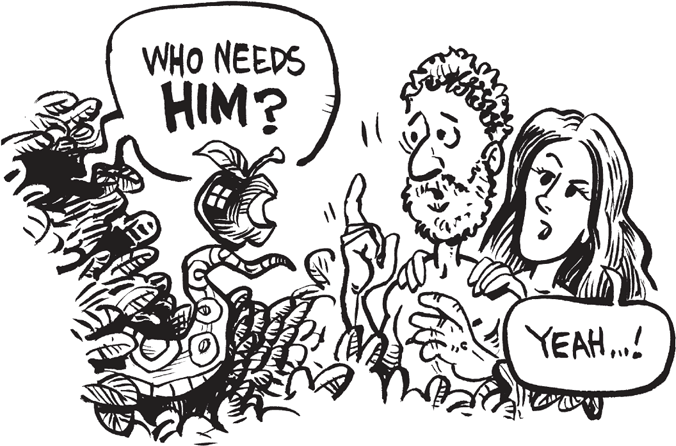
To understand today’s study properly, we need to examine events that occurred centuries apart. In the beginning, when God created Adam and Eve, He placed them in the Garden of Eden with only one restriction. Do not eat the fruit from the forbidden tree (Gen 2:17). The consequence of eating from this tree was death. Since all generations of mankind flow from Adam and Eve, so too their curse, the penalty for eating the forbidden fruit (Gen 3:16-19), flowed to all their descendants.
Fast forward a few millennia to Paul and Romans 3. Here, the Apostle clearly points out that although the Jews have an inherent advantage v.1-4, they have squandered it many times. In verses 5-8, Paul answers the question of why sin is condemned by God. I suggest a study of John 3:16-21 also. In verses 9-25, we get to the key text for our study today. Here, Paul explains why sin is universal among humankind (Romans 3:23) and how the Old Covenant/Testament reveals our sins. In v. 25-31, Paul points out that man is justified by faith alone in Christ alone.
As far back as I can remember, since my true conversion, I have heard the arguments against man’s depravity. I understand, people want to believe they are inherently good. Unfortunately, this is totally false. Can people do good things? Yes. Does that make them good? No. The only standard of Good is God’s Holy Word apart from God, redemption in Christ, and the indwelling Holy Spirit; man can do Nothing Truly Good, see the verse list below. Here are two quotes that I find quite appropriate for today’s study:
Be yourself is about the worst advice you could give some people.
—Anonymous
Bible Truth Behind the Quote:
“None is righteous, no, not one” (Romans 3:10).
Beware of no man more than of yourself; we carry our worst enemies within us.
—Charles Spurgeon (1834-1892), pastor, New Park Street Chapel, London
Bible Truth Behind the Quote:
Paul said, “I do not understand my own actions. For I do not do what I want, but I do the very thing I hate” (Romans 7:15).
Ron Rhodes, 1001 Unforgettable Quotes About God, Faith, and the Bible (Eugene, OR: Harvest House Publishers, 2011).
COMMENTARY/DEFINITIONS
The fall resulted in a curse upon creation, that it would not be subservient to human needs and demands, and that it would be subject to disaster and destruction, groaning for its own redemption.
Along with the disordering of humanity, the fall also resulted in the frustration of the created order itself and its falling into disorder. Strikingly, the first curse upon man after his fall is not a curse upon him but upon “the ground,” the natural world itself (Gen 3:17–19). The natural world was made for man, but because of man’s sin, the creation itself became a disordered and self-destructive realm, resistant to human demands, and a source of danger to human beings.
Scripture makes clear that the disorder resident in creation is a result of man’s fall. The creation narrative and the description of the garden of Eden show an environment for man in which everything is subservient to him and lends itself to his sustenance and use. All of it is good, and he may eat of almost every tree of the garden. The animals are subject to his naming and ruling.
All this was broken and marred through the fall. The fall itself consists in a disturbing of the order of relation between man and the animals. While the serpent is a vehicle of Satan, it nevertheless reflects disorder for man and woman to follow the advice of a snake rather than the command of God. The enmity that God creates between the serpent and the woman has prophetic significance, but it also reflects the simple fact of a disruption of harmony between man and the animals. Likewise, the sustenance humans need from plants and from the ground is disrupted. Natural disasters will become prevalent. Nature becomes “red in tooth and claw” and groans for redemption. The creation has been disordered in many ways by the fall, but most especially in its relation to human beings.
The deficiencies of the created and fallen natural order is most clearly revealed in prophecies of the new earth. There, the fear that exists between animals and humans is undone; dangerous carnivores will abide with their prey, in harmony with human beings, and even little children (Isa 11:6–9). This new order is not simply for the good of the animals or the planet but for the good of human beings. In fact, the renovation of the earth is dependent on the salvation of human beings. The redemption for which creation longs will come only when redemption comes for human beings (Rom 8:22–23). The creation will be made new because human beings, saved by Jesus Christ, are being prepared a place by their Lord and Savior.
Joel B. Carini, “The Effects of the Fall on Creation,” in Lexham Survey of Theology, ed. Mark Ward et al. (Bellingham, WA: Lexham Press, 2018).
Are humans inherently good or evil according to scripture?
Scripture presents human nature as fundamentally corrupted by sin rather than inherently good. The apostle Paul declares that no one is righteous and all have turned aside to become unprofitable, with no one doing what is right (Rom 3:10–12). The human heart is described as deceitful, perverse, corrupt, and mortally sick (Jer 17:9)—a condition that extends to our deepest motivations. God observed that human wickedness was great and that every intention of human thinking was only evil continually (Gen 6:5).
This sinful disposition isn’t acquired through individual choices alone but inherited. The psalmist confesses being brought forth in iniquity, with sin present from conception (Ps 51:5), and sin entered the world through one man, spreading to all humanity because all sinned (Rom 5:12). Evil thoughts, sexual immorality, theft, murder, and countless other vices emerge from within human hearts, making people unclean (Mark 7:21–23).
However, this biblical pessimism about fallen human nature doesn’t mean humans are essentially evil. Augustine emphasized that creation—including human nature—is fundamentally good because God created it, with evil being only a perversion of that goodness1. The standard Christian view holds that humanity is essentially good but existentially estranged through misuse of freedom, contrary to the misconception that Christian teaching condemns human nature itself1. Scripture teaches that both the physical and spiritual nature of humankind was originally good2, though the fallen condition means people-as-they-currently-exist are sinful, “de-natured” men and women3.
The paradox resolves through recognizing three dimensions: humans were created good, are now fallen and sinful, but can be redeemed through Christ, who offers full freedom from sin’s pain and penalties to those who follow him3.
Biblical passages on human sinfulness: Romans 3:23 affirms that all have sinned and fall short of God’s glory, while Ecclesiastes 7:20 observes that no righteous person exists who does good and never sins.
- 1Roger E. Olson, The Mosaic of Christian Belief: Twenty Centuries of Unity and Diversity (Downers Grove, IL: IVP Academic, 2016), 207.
- 2Got Questions Ministries, Got Questions? Bible Questions Answered (Bellingham, WA: Logos Bible Software, 2002–2013). [See here.]
- 3Edward Hadas, Counsels of Imperfection: Thinking through Catholic Social Teaching (Washington, DC: The Catholic University of America Press, 2021), 17–18.
original sin. The reality of a broken relationship with God was imputed to all humanity as a result of the first *sin of Adam and Eve as representatives of humanity. While debate exists within the Reformed tradition regarding the precise nature and effects of original sin, such as the extent to which it destroys the *image of God, there is general agreement that it affects every person in their entirety (e.g., reason, will, affections, body) and that the guilt of original sin can only be removed through the work of Christ received by *faith, and not simply through *baptism. While *Calvin emphasized the *imputation of original sin from Adam and Eve, *Luther highlighted the personal nature of original sin as involving not just alien guilt but an active proclivity to *sin, which continues to influence but does not control believers with wills freed to love Christ.
Depravity, total depravity. Depravity refers both to the damaged relationship between God and humans and to the corruption of human nature such that there is within every human an ongoing tendency toward sin. Total depravity refers to the extent and comprehensiveness of the effects of sin on all humans such that all are unable to do anything to obtain salvation. Total depravity, therefore, does not mean that humans are thoroughly sinful but rather that they are totally incapable of saving themselves. The term suggests as well that the effects of the Fall extend to every dimension of human existence, so that we dare not trust any ability (such as reason) that we remain capable of exercising in our fallen state.
Stanley Grenz, David Guretzki, and Cherith Fee Nordling, Pocket Dictionary of Theological Terms (Downers Grove, IL: IVP Academic, 1999), 37.
STUDY
Calvin is well-known for talking about the effects of sin as “total depravity.” Human sin, in his view, creates a condition whose effects are “diffused into all parts of the soul.” The “total” in “total depravity” means that there is no part of the human personality that is free from sin and its impact. Why would Calvin want to make such a claim? For one thing, to counter the idea that, somewhere within them, humans have some area of their life that is sin free, and that from that area, they can derive the resources to heal themselves of what ails them. We have no such resources, Calvin says. As his prayer of confession puts it, “We are poor sinners, conceived and born in iniquity and corruption, prone to do evil, incapable of any good, and in our depravity we transgress [God’s] holy commandments without end or ceasing.”
The consequences of sin are many. They involve our ability to discern certain things, such as God. Sin explains why humans so easily fall into idolatry rather than worshiping the true God. And they involve our will. Calvin claims that sinful human beings have a will (still). But is it a free will? Yes, in a certain sense. It is free in the sense that the choices we make are genuinely our choices. No one outside of myself forces me to choose in the way I do. But it is not free in that we cannot choose not to sin. Original sin has resulted in a binding (or enslavement) of our will, a bondage to sin. We can choose many things. We can choose how we will sin. But we cannot determine to do what is good and succeed in doing what is good.
The claim that human beings lack free will is a controversial one. Luther and Erasmus had carried on a vehement public argument over the issue in 1524–1526. As a humanist, Erasmus wanted to preserve the idea that humans are able, on their own, to respond to God; they can improve morally and they can work to better their societies. Calvin engaged in a brief debate (in 1542–1543) with a Catholic opponent, Albertus Pighius, who feared that an attack on human freedom would compromise both the idea of God’s goodness and the Catholic emphasis on the need for us to strive for holiness. For both Luther and Calvin, to speak of humans as free, free to do what is good and capable of moral progress, was simply to indulge in self-flattery. Free will is a fiction, they claimed. The effects of primal human sinfulness are too strong for us to claim the capacity to do good apart from God.
Christopher Elwood, Calvin for Armchair Theologians, Armchair Theologians Series (Louisville, KY: Westminster John Knox Press, 2002), 66.
ADDITIONAL RESOURCES
What is the sin nature? – GotQuestions.org
Discover more from Faithful Steward Ministries and FSM Women's Outreach
Subscribe to get the latest posts sent to your email.
 Faithful Steward Ministries and FSM Women's Outreach