
No one acts apart from the sovereign plan of God. Every choice, every act, every decision made by every human in the world, including the most evil, heinous behavior against the truth and against the Lord, God overrules and fits into His plan for His own ends and His own glory. There’s not one rebellious molecule in the universe that operates independently of His purpose.
John MacArthur – Table Talk on Trouble and Triumph, Part 1. The sermon originally appeared at: (https://www.gty.org/library/sermons-library/42-270/table-talk-on-trouble-and-triumph-part-1) at http://www.gty.org. © 1969-2008. Grace to You. All rights reserved. Used by Permission.
COMMENT
About a decade ago, Grace to You Ministries published one of John MacArthur’s sermons in a series entitled “Frequently Abused Verses.” Our verse for today was the basis for one of them under the title “For What “Good?” Is God Working All Things Together?
Why, or how, is this verse misused? It seems straightforward enough, God who loves me is going to do everything good to benefit me, right? WRONG! This interpretation is what you will find in groups spouting “name it and claim it” theology and easy believism. It is all about them and how God (lowercase, intentional) works for them.
In the quotation above, John MacArthur, citing Romans 8:28, begins by pointing out one of the fundamental tenets of the Christian faith: God is Sovereign. Is anyone else like God? Of course not. Can any of us, ourselves included, make a claim that God should do good for us? Absolutely Not. In Romans 8:28, there is a threefold requirement for good. First, we must love God; this is the Agape love, not superficial, the all-in love, no matter the circumstance, between a slave to sin and his redeemer. Romans 8:12-17. Second, we must be called. This good occurs only for those called by God before the foundations of the earth were formed, Romans 8:29-30. Lastly, it is all done for God’s glory, or as the text reads, according to his purpose.
Everything that God does is for His own ends and His own glory. How arrogant and foolish to think it is about us.
COMMANTARY/STUDY
Divine sovereignty establishes God as the absolute and sole Ruler of the universe.1 More specifically, God holds ultimate, final, and complete authority over everything and everyone, with all events stemming from his decisions and control.2 Though God accomplishes his purposes through various means, he maintains complete control over his world, with nothing escaping his notice or falling outside his jurisdiction.1
The concept extends beyond mere power and knowledge. Divine sovereignty encompasses more than absolute power and complete knowledge, though these attributes are included within it.1 God’s sovereignty includes his freedom to determine and execute whatever he deems best.1 Importantly, God’s only limitation is himself—he cannot violate his own character or act contrary to his purposes.1
Different theological traditions understand sovereignty’s implications differently. Calvinist theologians hold a strong notion of divine sovereignty2, while some evangelical critics object based on their commitment to libertarian free will, as espoused by traditional Arminians and proponents of the open view of God.2 Some theologians argue that God maintains general control over all things while respecting human freedom, operating within general purposes rather than controlling every detail, and leaving open various avenues for achieving his goals.2
Biblically, divine sovereignty functions as a central biblical theme, with God delegating authority, establishing kingdoms, and bringing ruin to those refusing submission to his authority.3 In the New Testament, God’s sovereignty is revealed through Christ, who ushers in the kingdom and exercises divine authority over all creation.3
- 1Robert P. Lightner, The God of the Bible and Other Gods: Is the Christian God Unique among World Religions? (Grand Rapids, MI: Kregel Publications, 1998), 99.
- 2John S. Feinberg, No One Like Him: The Doctrine of God, The Foundations of Evangelical Theology (Wheaton, IL: Crossway Books, 2001), 294–295.
- 3Joshua A. Crutchfield, “Divine Sovereignty,” in Lexham Theological Wordbook, ed. Douglas Mangum et al. (Bellingham, WA: Lexham Press, 2014). [See here, here.]
ROMANS 8:28:
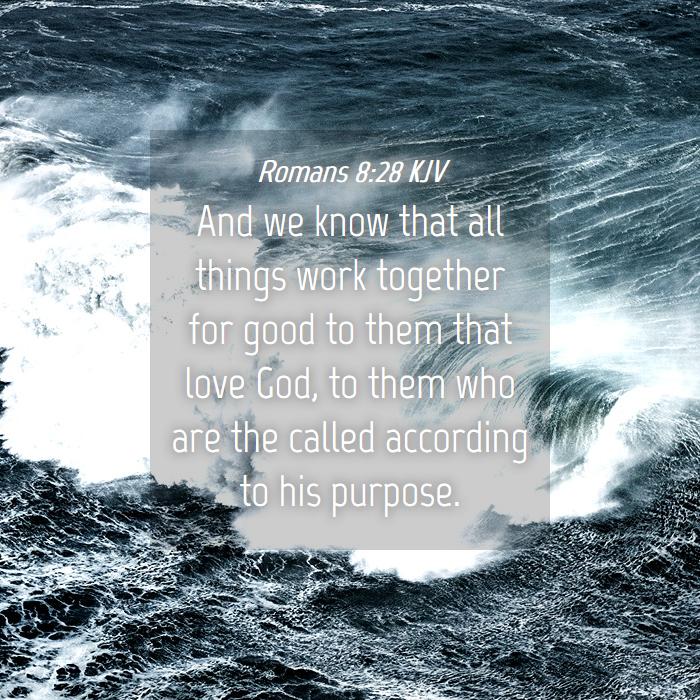
And we know that in all things God works for the good of those who love him, who have been called according to his purpose (verse 28). This verse is so rich in comfort and substantive in meaning that it is frequently memorised by itself. But if we take this particular verse out of the context in which it is written, we could distort the meaning. There are three elements that require specific attention.
The first element is the meaning of the phrase, ‘in all things’. One natural conclusion from such a statement is that every single thing which happens to us, by us, with us or for us, in this world, is added together by the sovereign God and brought to a great and wonderful conclusion. Well, I am not denying that God does that. But in the context of this verse, the use of the phrase ‘all things’ does not refer to each and every thing that happens.
Rather Paul is using this phrase ‘all things’ in the same way he uses it throughout his writings, as a summary statement to capture the essence of what he has just said. So if we are going to understand what he is saying here, we have to apply the ‘all things’, not to a universal sense of all things, but to the ‘all things’ that he has just described.
Obviously what the apostle has in view is the infirmities and the sufferings of the people of God. These sufferings that we endure in this world are not worthy to be compared with the glory that God has laid up for us in the future. These present sufferings are the ‘things’ that Paul has in mind. They are actually in a sense blessings in disguise, because the sufferings in this world are used by God for our ultimate good and for our ultimate benefit.
This does not mean that everything which happens to us is good in and of itself. Suffering is a tragic, physical evil. I am not supposed to say to another believer who is suffering, ‘Rejoice, this is a wonderful benefit that you are experiencing here, because it is working together for your good.’ We are not to praise God for the presence of suffering, particularly in the case of others, because that would lead us to the same smug attitude that is so destructively manifest in Job’s friends. Rather if I see another suffering, I must do everything in my power to alleviate that suffering.
Now that would seem to be working against this wonderful benefit God has given him. But Paul is saying that God uses these things, triumphs over them, brings victory out of them and adds them together for our greater glory. In other words, God redeems the evil that befalls us.
So we should be comforted and consoled by the fact that our suffering is neither futile nor ultimately tragic. It may be very painful and difficult to endure for the moment. But God stands sovereign over our suffering.
The second thing we need to note is that there is a restriction here. God is not promising to bring goodness out of all suffering for everybody. Rather he says, that in all things God works for the good of those who love him (verse 28b). It is not in the final analysis a matter of mental assent but of affection for God. Obedience, discipleship and living the Christian life are a consequence of loving God. If you love me, Jesus said, keep my commandments (John 14:15). Our obedience is based upon a prior love. The love of God is the motivating force for living a Christian life. It is not the desire to merit one’s own salvation, nor even an altruistic beneficent attitude towards our fellow men. The ultimate motivator for Christian service, Christian ministry and Christian obedience, is a personal affection for God.
The whole point of studying Scripture is that we might love God more. The better we know him, the easier it is for our hearts to be inflamed with affection for him. It is difficult, nay impossible, to love an unknown quantity. Love involves a personal relationship. Love is something that takes place between subjects, not objects, and is the personal quality on which Christianity is based. So those who love God have the promise that all of their suffering and all of their difficulties are being worked together for their good by the very God that they love. The bottom line of what we are trying to develop in our Christian growth is a deeper affection for God. That’s what worship is all about.
The third aspect of this verse to be noted is a second distinction that makes it a passage of particular rather than universal application: who have been called according to his purpose (verse 28c). When the Bible speaks of God’s call, it never means simply the external call whereby the invitation to fellowship with God is given. Those who are called by God experience, what we call in theology, effectual calling (see comments on 1:1).
The last clause does not refer to a different group from the clause preceding. All those whom God calls according to his purpose love him, and all those who love God have been called according to his purpose.
R. C. Sproul, The Gospel of God: An Exposition of Romans (Great Britain: Christian Focus Publications, 1994), 146–148.
DEVOTION
ADDITIONAL RESOURCES
Why All Things Work for Good – Romans 8:28 BY THOMAS WATSON
The Difficult Doctrine of the Love of God by D.A. Carson
What does it mean that all things work together for good (Romans 8:28)?
Discover more from Faithful Steward Ministries and FSM Women's Outreach
Subscribe to get the latest posts sent to your email.
 Faithful Steward Ministries and FSM Women's Outreach