
TOPIC/THEME
Forgetting Our Sins For HIS Glory
COMMENT/CONTEXT
Our main text today continues yesterday’s reading in Isaiah 43. We skip ahead to verse 25. The most common theme I found for this verse is not the one I listed above; they are more like expounding upon God’s mercy, love, and Grace. While these, too, are important themes, I believe the whole verse needs to be taken in context. The final phrase, for mine own sake, is the answer to why God would forgive sins. God must eliminate sin; it goes against all of God’s character. God can eliminate sin by destroying or forgiving it, all for His Glory.
v.25 What a verse of mercy, grace, and goodness is here! One might justly have been led to expect, after what the Lord had said in the preceding paragraph, that for such baseness and ingratitude, punishment and correction would have followed. But God’s ways are not our ways; nor our thoughts his thoughts: truly, as the apostle hath said, Where sin aboundeth, grace doth much more abound, Romans, 5:20; and all the ways of grace are of this kind, and constrain every soul that is made a rich partaker of it, to cry out, with the Prophet, Who is a God like unto thee, that pardoneth iniquity, and passeth by the transgression of the remnant of his heritage? Micah, 7:18, 19.
Robert Hawker, Poor Man’s Old Testament Commentary: Proverbs–Lamentations, vol. 5 (Bellingham, WA: Logos Bible Software, 2013), 413.
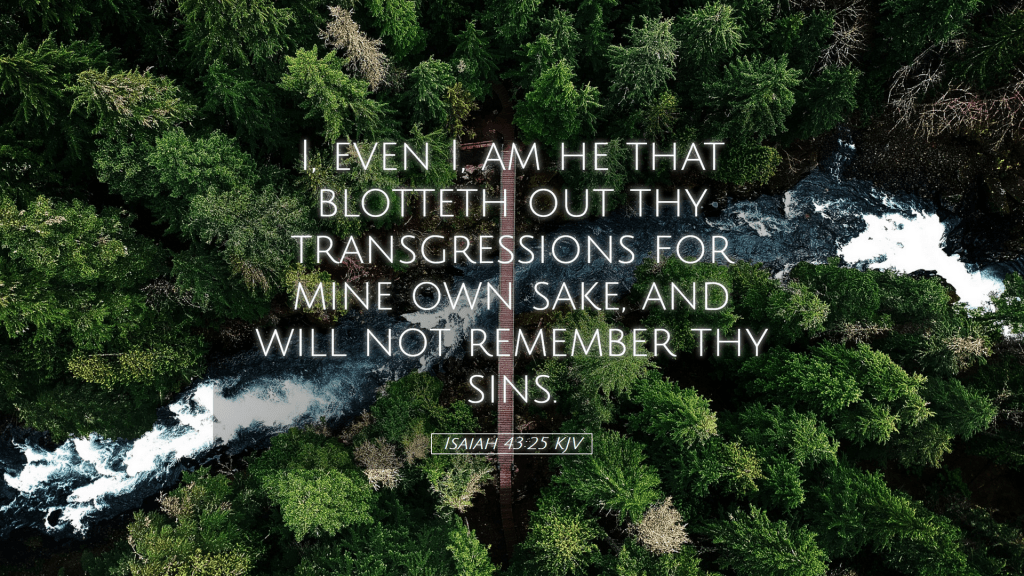
v.25 I, even I, am he that blotteth out thy transgressions for mine own sake, and will not remember thy sins.
I, even I; I whom thou hast thus despised, and wearied, and provoked to destroy thee. That blotteth out thy transgressions out of my book, in which they were all written, and to be read unto thee and charged upon thee another day. See Jer. 17:1; Rev. 20:12. Sins are oft compared to debts, Matt. 6:12, 14, &c., which are written in the creditor’s book, and crossed or blotted out when they are paid. For mine own sake; being moved thereunto not by thy merits, but by my own mere goodness and free mercy. Will not remember thy sins; so as to punish them, and destroy thee for them, as thou deservest.
Matthew Poole, Annotations upon the Holy Bible, vol. 2 (New York: Robert Carter and Brothers, 1853), 424.
DEVOTION

Forgetting Our Sins
Julie and her husband felt sadness and regret when they learned that their daughter had been shoplifting. But with God’s help, when she came to them weighed down with sorrow, they forgave her—and they helped her make restitution and receive counseling. Some months after the revelation, when their daughter made an offhand comment about how they might not trust her anymore, Julie wondered, What does she mean? She didn’t immediately think about her daughter’s offense because God had removed the sting of it from her mind. She had decided not to dwell in the past but had asked God to help her forgive.
In that moment, God gave Julie a taste of His goodness and grace as she experienced the love He extends to His people. God told His people not to “dwell on the past” because He was “doing a new thing” (Isaiah 43:18-19). He also made the beautiful declaration, “I, even I, am he who blots out your transgressions, for my own sake, and remembers your sins no more” (v. 25). God could choose to hold our sins against us, but because of His love and mercy, He doesn’t. When we repent, He wipes our record clean.
Although our forgiven wrongdoing may have a negative impact on our lives and that of others, God will never hold that offense against us. He will enfold us in His mercy and grace.
By Amy Boucher Pye
REFLECT & PRAY
When have you experienced the surprising love of God? How does His grace change and transform you?
Forgiving Father, thank You for running toward me with love. Please help me to turn from my sinful ways and return to You.
Discover more from Faithful Steward Ministries and FSM Women's Outreach
Subscribe to get the latest posts sent to your email.
 Faithful Steward Ministries and FSM Women's Outreach