
Planted by grace, and owing all to our heavenly Father’s care, we may defy the hurricane, and laugh at the fear of drought, for none that trust in him shall ever be left unwatered.
C. H. Spurgeon
CONTEXT
GENERAL, REMARKS. Here we have one of the loftiest and longest sustained flights of the inspired muse. The psalm gives an interpretation to the many voices of nature, and sings sweetly both of creation and providence. The poem contains a complete cosmos sea and land, cloud and sunlight, plant and animal, light and darkness, life and death, are all proved to be expressive of the presence of the Lord. Traces of the six days of creation are very evident, and though the creation of man, which was the crowning work of the sixth day, is not mentioned, this is accounted for from the fact that man is himself the singer: some have ever, discerned marks of the divine rest upon the seventh day in Ps 104:31. It is a poet’s version of Genesis. Nor is it alone the present condition of the earth which is here the subject of song; but a hint is given of those holier times when we shall see “a new earth wherein dwelleth righteousness, “out of which the sinner shall be consumed, Ps 104:35. The spirit of ardent praise to God runs through the whole, and with it a distinct realization of the divine Being as a personal existence, loved and trusted as well as adored.
We have no information as to the author, but the Septuagint assigns it to David, and we see no reason for ascribing it to any one else. His spirit, style, and manner of writing are very manifest therein, and if the psalm must be ascribed to another, it must be to a mind remarkably similar, and we could only suggest the wise son of David—Solomon, the poet preacher, to whose notes upon natural history in the Proverbs some of the verses bear a striking likeness. Whoever the human penman may have been, the exceeding glory and perfection of the Holy Spirit’s own divine authorship are plain to every spiritual mind.
DIVISION. After ascribing blessedness to the Lord the devout psalmist sings of the light and the firmament, which were the work of the first and second days Ps 104:1-6. By an easy transition he describes the separation of the waters from the dry land, the formation of rain, brooks and rivers, and the uprising of green herbs, which were the produce of the third day Ps 104:7-18. Then the appointment of the sun and moon to be the guardians of day and night commands the poet’s admiration Ps 104:19-23, and so he sings the work of the fourth day. Having already alluded to many varieties of living creatures, the psalmist proceeds from Ps 104:24-30 to sing of the life with which the Lord was pleased to fill the air, the sea, and the land; these forms of existence were the peculiar produce of the fifth and sixth days. We may regard the closing verses Ps 104:31-35 as a Sabbath meditation, hymn, and prayer. The whole lies before us as a panorama of the universe viewed by the eye of devotion. O for grace to render due praise unto the Lord while reading it.
The Treasury of David, C.H. Spurgeon, https://archive.spurgeon.org/treasury/ps104.php
Verse 16. The watering of the hills not only produces the grass and the cultivated herbs, but also the nobler species of vegetation, which come not within the range of human culture:
“Their veins with genial moisture fed,
Jehovah’s forests lift the head:
Nor other than his fostering hand
Thy cedars, Lebanon, demand.”
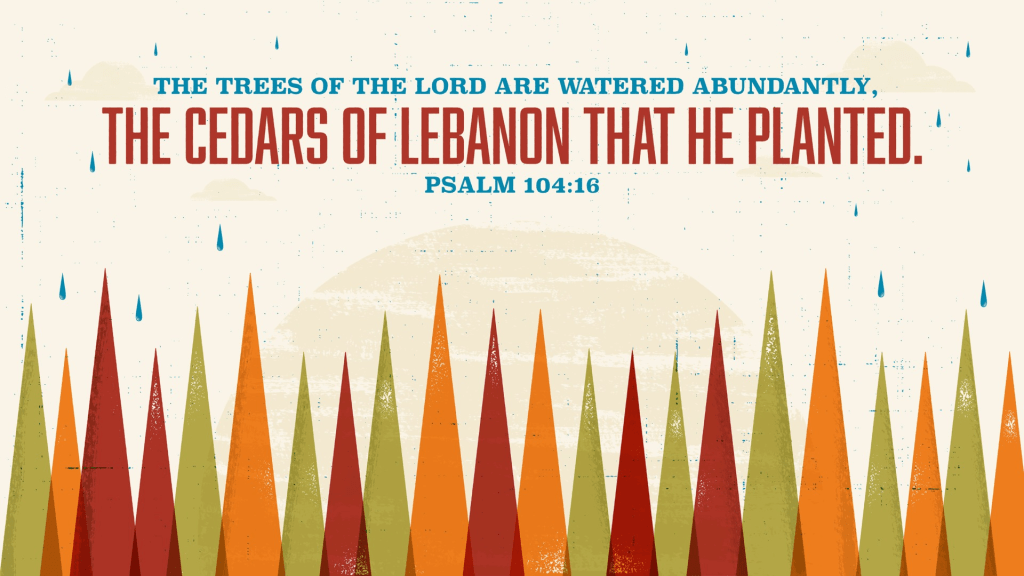
The trees of the Lord—the greatest, noblest, and most royal of trees; those too which are unowned of man, and untouched by his hand. Are full of sap, or are full, well supplied, richly watered, so that they become, as the cedars, full of resin, flowing with life, and verdant all the year round. The cedars of Lebanon, which he hath planted. They grow where none ever thought of planting them, where for ages they were unobserved, and where at this moment they are too gigantic for man to prune them. What would our psalmist have said to some of the trees in the Yosemite valley? Truly these are worthy to be called the trees of the Lord, for towering stature and enormous girth. Thus is the care of God seen to be effectual and all sufficient. If trees uncared for by man are yet so full of sap, we may rest assured that the people of God who by faith live upon the Lord alone shall be equally well sustained. Planted by grace, and owing all to our heavenly Father’s care, we may defy the hurricane, and laugh at the fear of drought, for none that trust in him shall ever be left unwatered.
ibid
Verse 16. The trees of the Lord, etc. The cedars are indeed the trees of the Lord. They are especially his planting. There is a sense in which, above all other trees, they belong to him, and shadow forth in a higher degree his glory. The peculiar expression of the text, however, must not be limited to one particular species of cedar… Encouraged by this Scripture usage, I shall use the word in a somewhat wider sense than the conventional one, to denote three remarkable examples which may be selected from the coniferae to show the power and wisdom of God as displayed in the trees of the forest. These are, the cedar of Lebanon, the cedar of the Himalayas, and the cedar of the Sierra Nevada. The epithet which the psalmist applies to one, may most appropriately be applied to all of them; and there are various reasons why the Lord may be said to have a special interest and property in each of them, to a few of which our attention may now be profitably directed.
1. They are “trees of the Lord” on account of the peculiarities of their structure. In common with all the pine tribe, they are exceptional in their organization. They reveal a new idea of the creative mind.
2. The cedars are “the trees of the Lord” on account of the antiquity of their type it was of this class of trees that the pre Adamite forests were principally composed.
3. The cedars are the “trees of the Lord, “on account of the majesty of their appearance. It is the tree, par excellence, of the Bible—the type of all forest vegetation.
—Condensed from Hugh Macmillan’s “Bible Teachings in Nature, “1868.
STUDY
Question: What are the cedars of Lebanon the Bible mentions?
Answer: In ancient times, cedar wood was especially desirable for its aromatic qualities as well as its resistance to decay and bugs. Lebanon was known for its magnificent cedars and was once heavily forested with them. Cedar was a major export and source of wealth, although, in more recent years, Lebanon has faced deforestation. Even today, the image of a cedar tree is found on the Lebanese national flag.
In Ezekiel 31, Assyria is compared to a cedar of Lebanon and described thus: “Beautiful branches overshadowing the forest; it towered on high, its top above the thick foliage. The waters nourished it, deep springs made it grow tall; their streams flowed all around its base and sent their channels to all the trees of the field. So it towered higher than all the trees of the field; its boughs increased and its branches grew long, spreading because of abundant waters. All the birds of the sky nested in its boughs, all the animals of the wild gave birth under its branches; all the great nations lived in its shade. It was majestic in beauty, with its spreading boughs, for its roots went down to abundant waters” (verses 3–7). The symbolism of the cedar points to the former greatness of Assyria, as it towered magnificently over the other nations of the earth.
Cedar is mentioned throughout the Old Testament as an item of luxury and wealth. David used cedar wood in building his palace (2 Samuel 5:11; 7:2), and it was also used in building the temple (1 Kings 5:6; 2 Kings 19:23), which was almost completely paneled with cedar (1 Kings 6:6, 16, 18, 20, 36). Solomon used it in his Palace of the Forest of Lebanon, with cedar columns, beams, and roof (1 Kings 7:2). It was also used in the construction of the second temple (Ezra 3:7). The abundance of cedar was seen as a sign of prosperity (1 Kings 10:27; 2 Chronicles 1:15.) David and Solomon acquired their cedar from Hiram, king of Tyre, a city in Lebanon (1 Chronicles 14:1; 2 Chronicles 2:3, 8) where the best cedar was to be found.
The fact that God planted the cedars in Lebanon was a sign of His power and goodness (Psalm 29:5; 104:16). His ability to break or burn them is a sign of His power to judge (Zechariah 11:1; Isaiah 2:3; 14:8). Jeremiah warned the king of Judah that, although he rested in a house of cedar—figuratively calling his residence “Lebanon”—he would not escape judgment (Jeremiah 22:14–15, 23).
The cedars of Lebanon were a gift from God and a source of wealth for Lebanon, the cities of Tyre and Sidon especially benefitting from their export (1 Chronicles 17:1, 6; 22:4). Although Tyre and Sidon were on friendly terms with Israel under David and Solomon, in later years they became enemies, and Tyre rejoiced over the fall of Judah. Therefore, God promised judgment (Ezekiel 26).
The cedars of Lebanon should remind us that every good gift comes from God, but when we focus on the gift without thanking and worshiping the One who gave it, we too will face judgment.
Got Questions Ministries, Got Questions? Bible Questions Answered, vol. 2 (Bellingham, WA: Faithlife, 2014–2021).
CEDAR TREE. The cedar tree of Lebanon, forms an interesting object in holy Scripture, and merits attention. The tree itself seems, for majesty and beauty, to take place of every other among the trees of the forest. Its branches are wide and spreading. They begin to form themselves nearly from the ground, and stretch forth on each side. The tree itself is an evergreen, and sheds forth a gummy substance, which is said to contain many salutary qualities. The wood of it formed a part in the service of the cleansing of the leper. (See Lev. 14:4.) One of the kings of Israel called himself by the name of the Cedar of Lebanon, 2 Kings 14:9. The church, or Christ for the church, when celebrating the beauties and glories of their habitation, compares the beams of it to cedar. (Song, 1:17.) And the state of individual believers in the church is more than once spoken of, as resembled by the flourishing nature of the cedar of Lebanon. (Ps. 92:12–15; 104:16.) The Hebrews called it Tashur, which the Septuagint rendered cedar. There is somewhat very interesting in such representations of the Lord’s inheritance, when by figure and similitude we are sent, by God the Holy Ghost, to the loveliest objects in nature to form our views of the Lord’s pleasure and delight, which he taketh in his people. Taught by such an infallible Teacher methinks I would never read of the Cedar of Lebanon, without connecting with it some sweet resemblance to be discovered in his people, which he saith himself are the branch of his planting, and which are so, that they might be called trees of righteousness “the planting of the Lord, that he might be glorified.” (Isa. 60:21. 61:3.) And if Jesus himself, be in the view of JEHOVAH, and in his church’s view, “the plant of renown,” (Ezek. 34:29.) surely, it is blessed to know, that the church is in Jesus’s view, the Cedar of Lebanon. And in how many ways do they bear resemblance to the glory of Lebanon, when made comely, from the comliness Jesus puts upon them! Is there any tree of the wood so graceful, or so lovely, as the Cedar of Lebanon? Neither is there any lily among the thorns so fair, and white, and fragrant, as Jesus’s love is among the daughters. (Song 2:2.) Do any trees out-top the Cedar of Lebanon, spread wider, or cast their branches with more luxuriancy farther than this fair one? Neither do any grow more upright, extend their usefulness in equal direction for general good, as the disciples of the Lord. For though they are poor and mean in man’s opinion, yet do they stand high in the esteem of Christ Jesus; and in the grace of the Lord, like the branches of the cedar, they spread forth, by faith, in every direction, and by rich experience in the divine life, manifest forth the loveliness of their high calling all around. And as the Cedar of Lebanon is deep-rooted, evergreen, and ever-fragrant, so believers in Christ are deep-rooted in him, always flourishing in him, however unprofitable in themselves; and as the prophet describes the church, “their branches shall spread, and their beauty be as the olive tree, and their smell like Lebanon.” (Hos. 14:6.) Such, and many more of the like nature, open to our view, while considering the church in Jesus’s esteem, as the Cedar of Lebanon. (See a lovely account of this, Ps. 92:13–15.)
Robert Hawker, The Poor Man’s Concordance and Dictionary to the Sacred Scriptures (London: Ebenezer Palmer, 1828), 143–145.
DEVOTIONAL
Discover more from Faithful Steward Ministries and FSM Women's Outreach
Subscribe to get the latest posts sent to your email.
 Faithful Steward Ministries and FSM Women's Outreach