
Liberalism (theological). Movement in Protestant theology since the nineteenth century that is dominated by the goal of modifying Christianity so as to make it consistent with modern culture and science. Liberalism rejects the traditional view of Scripture as an authoritative propositional revelation from God in favor of a view that sees revelation as a record of the evolving religious experiences of humankind. It sees Jesus more as ethical teacher and model rather than as divine atoner and redeemer.
C. Stephen Evans, Pocket Dictionary of Apologetics & Philosophy of Religion (Downers Grove, IL: InterVarsity Press, 2002), 68–69.
Liberalism in the “church” is the great demon of the watered-down Gospel message. It denies the reality of Hell, that Jesus was the most dogmatic man to ever live (“I am the…John 14:5-7), and that faith without works is dead. This fairly modern (19th century) approach to religion is anything but true Christianity.
CONTEXT:
Truthful or deceitful (vv. 17, 19, 22)
Commending truth and condemning lies occurs frequently in PROVERBS, teaching us how precious truth is to God but how common lying is among us.
Verse 17 is basic, bringing out the essential difference between the two. Superficially it appears to state the obvious, but there is more here than meets the eye. It establishes two big principles.
(a) What we say expresses what we are. Literally it reads ‘he who breathes truthfulness’, showing that truth comes from within (Matt. 15:18, 12:34). By nature our ‘heart is deceitful’ (Jer. 17:9), taught by ‘the father of lies’ (John 8:44) who deceived our first parents into lying to God. But God who ‘desires truth in the inner parts’ (Ps. 51:6) can deliver us from this false evil being and fill us with ‘the Spirit of truth’ (John 14:17) so that henceforth we ‘speak the truth’ (Eph. 4:15, 25).(b) Love of truth is inseparable from love of justice: gives honest testimony is literally ‘reveals justice’. This takes us into the law court where truth and falsehood can be a matter of life and death, and which is the setting of the ninth commandment on which this saying is based. Here one witness speaks the truth because his sole concern is for justice—that the defendant be condemned if guilty and acquitted if innocent. The false witness has other motives, such as fear or self-interest, and tells lies, literally ‘reveals deceit’—that is, he shows the falseness of his heart, from which, as Jesus said, ‘come evil thoughts … false testimony’ (Matt. 15:19). He whose nature is not right will not be concerned for righteousness or for truth.
Verse 19 commends truth for its enduring nature—it ‘stands firm’ (NEB) for ever. ‘What is true will always be true’ (Henry)—it cannot change. How it is received makes no difference to its intrinsic Tightness. This will one day be acknowledged, although perhaps not until eternity: ‘Heaven and earth shall pass away but my words will not pass away’ (Matt. 24:35).
In contrast, lies have only a short life-span—literally ‘lasts only while I wink’, the briefest measurement of time in the ancient world (cf. 1 Cor. 15:52). At its lowest this means lies are often exposed very quickly, as David predicted of those who falsely accused him (Ps. 52:1–5); as Gehazi found to his cost (2 Kings 5:25–27) and even more drastically Ananias and Sapphira (Acts 5:3–10). In a scrape we tend to resort to the lie, but it is a very short term solution. ‘Truth will out.’ ‘Lies have no feet.’
What applies to the words applies to their speaker. He who has truthful lips ‘stands firm’ for ever. Even if denounced as a liar now, he will like Job be vindicated ‘in the end’ (Job 19:23–27). Truth and life go together, being inseparably bound in him who is ‘the way, the truth and the life’. Those who have the truth have eternal life because they stand on him whose words ‘are the words of eternal life’ (John 6:68). But the one with the lying tongue builds his life on what will crumble away and take him with it.
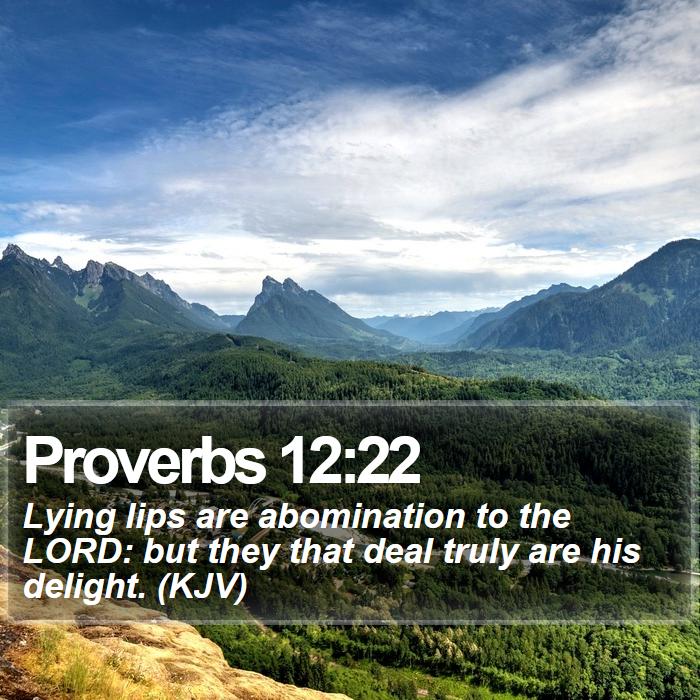
Verse 22 reveals what lies behind these proverbs—God’s personal approval or otherwise. The language is strong: detests and delights represent opposite poles of God’s reaction to our words, our deeds and ultimately ourselves. Various things are said to arouse God’s detestation (see 6:16–19 where lying comes at the top of the list and features twice). Nothing reminds God of the devil and the first sin more than this. The devil ‘is a liar and the father of lies’—and of liars too, for in this way they show they ‘belong to (their) father the devil’ (John 8:44). Lies not only produced the first sin but disrupt society more than anything else. Paul tells us to ‘put off falsehood and speak truthfully … for we are all members of one body’ (Eph. 4:25), here not the body ecclesiastical but the body politic. Society can only function where there is trust, and there can only be trust where there is truth.
Conversely, nothing more delights him than truth. He is the God of truth and his Son is the truth, so that those who are truthful are objects of his love. He sees the stamp of his own image on them. Literally it reads ‘who act truthfully’. Truth is not just factual accuracy (there are times when this is impossible) but the way we live. Paul even used truth as a verb in Ephesians 4:15 which literally reads ‘truthing it in love’. It is possible to be a George Washington and not be what John calls ‘walking in the truth’ (2 John 4, 3 John 3–4). This requires believing him who is the truth and living in him, on which depends our eternal destiny (Rev. 21:8).
Eric Lane, Proverbs: Everyday Wisdom for Everyone, Focus on the Bible Commentary (Great Britain: Christian Focus Publications, 2000), 129–131.
DEVOTIONAL:

A New and Rising Liberalism
There’s a new liberalism making its way through our churches and transforming our denominations. No, this liberalism doesn’t deny the virgin birth or the historicity of Jesus’ resurrection. This liberalism is steeped in biblical exegesis and historic-reformed categories. Today’s liberalism attempts to use the common creeds and confessions we know and love, and it emphasizes the importance of using scripture to defend our ideas. This liberalism has a foothold in virtually every major Reformed seminary and denominational group. Like the liberalism that Machen fought, this liberalism isn’t simply an aberration away from biblical Christianity; it’s an entirely different religion. Using the same language, borrowing from the same history, and often preached side by side with orthodoxy, this liberalism poses no less a serious threat to orthodox Christianity than did the liberalism of the early 20th century.
RELATED:

Discover more from Faithful Steward Ministries and FSM Women's Outreach
Subscribe to get the latest posts sent to your email.
 Faithful Steward Ministries and FSM Women's Outreach