
Over the next few posts, I plan on peeling back the layers of Jesus’s final teaching in His Olivet Discourse.
CONTEXT:
CHAPTER TWENTY-FIVE – Parables of the wise and foolish virgins. Testing of the servants in the Lord’s absence. Future testing of the Gentile nations at the Lord’s return.
Characters: God, Jesus, disciples.
Conclusion: The hour of our Lord’s second coming is very uncertain which is good reason why we should live not only in a state of habitual preparation but actual diligence in present service for Him, and engaged in works of charity for men. Those who have so lived will in that day receive the grandest degree in the universe, the “well-done” of Jesus Christ.
Key Word: Christ’s return, vv. 6, 19, 31.
Strong Verses: 13, 29, 31, 32, 34, 40.
Striking Facts: vv. 1–13. The strict application is Jewish and refers to the “Revelation” when Christ comes “with His saints” to set up His Kingdom and punish the nations. Virgins are attendants of a bride. “Bridegroom” in some translations is “bride and groom” and “marriage” in v. 10 is “marriage-feast.” The virgins are professing Jewish disciples (Rev. 14:4; Psa. 45:14). In the midst of the great Tribulation, the mid-night cry will be raised. As applied to Christians the parable is a warning of the “Rapture” which precedes the “Revelation.” The lamp is a type of God’s Word and the oil of the Holy Spirit. The two classes distinguish between Possessors of Christianity and Professors of it.
Keith Brooks, Summarized Bible: Complete Summary of the New Testament (Bellingham, WA: Logos Bible Software, 2009), 14.
.
Chapter Overview: To punctuate his themes of the need for readiness for his coming and the judgment to follow, Jesus provides two related parables. In the Reformation commentaries, the details of the ten virgins receive varied levels of attention. Where some reformers see implications with each detail of the story, others focus on a primary point: Christian vigilance until Christ returns. Martin Bucer discourages a complex investigation of the elements of the parable because the thrust of the parable is perceived easily. Other reformers see needed faith as being represented by either the readiness of the wise virgins or their oil specifically.
In the second parable, Jesus provides further insight into the type of behavior that results from genuine readiness. All three of the servants entrusted with talents in the parable expect the master to return and to have to give account for the master’s gifts. However, the commentators note that the ways in which they act in anticipation of the master’s return show the true nature of their readiness.
The humble Son of Man, who has been a main feature of Matthew’s narratives, provides a spectacular contrast with the royal figure who now pronounces judgment over all the nations. Moreover, even in this regal setting, the Son of Man associates himself with his humble past by referring to those who were hungry, thirsty, outcast, sick, and in prison. Drawing again on Daniel, Jesus concludes by delineating that his judgment is final in that the outcome is eternal punishment or eternal life. The Reformation commentators explain that the judgment scene at the end of the sermon prompts fear that can lead to faith in the Son of Man.
Jason K. Lee, William M. Marsh, and Timothy George, eds., Matthew: New Testament, vol. I, Reformation Commentary on Scripture (Downers Grove, IL: IVP Academic: An Imprint of InterVarsity Press, 2021), 321.
v.25:31–46 This teaching of Jesus on the sheep and the goats appears only in Matthew. He was not teaching salvation by works in these verses. The compassion shown by the sheep shows their salvation (7:15–27). That both the sheep and the goats are surprised at their “qualifications” indicates that neither was working for salvation. Those who were punished for their failure to minister to others were so blinded by their preoccupation with themselves that they showed no compassion. The parable shows that mere profession of one’s belief that does not lead to love and concern for people is useless.
Alan Hultberg, “Matthew,” in CSB Apologetics Study Bible, ed. Ted Cabal (Nashville, TN: Holman Bible Publishers, 2017), 1209.
.
J.C. Ryle Commentary of Matthew 25:31-46
INTRODUCTION
31 When the Son of man shall come in his glory, and all the holy angels with him, then shall he sit upon the throne of his glory:
32 And before him shall be gathered all nations: and he shall separate them one from another, as a shepherd divideth his sheep from the goats:
33 And he shall set the sheep on his right hand, but the goats on the left.
.
34 Then shall the King say unto them on his right hand, Come, ye blessed of my Father, inherit the kingdom prepared for you from the foundation of the world:
35 For I was an hungred, and ye gave me meat: I was thirsty, and ye gave me drink: I was a stranger, and ye took me in:
36 Naked, and ye clothed me: I was sick, and ye visited me: I was in prison, and ye came unto me.
37 Then shall the righteous answer him, saying, Lord, when saw we thee an hungred, and fed thee? or thirsty, and gave thee drink?
38 When saw we thee a stranger, and took thee in? or naked, and clothed thee?
39 Or when saw we thee sick, or in prison, and came unto thee?
40 And the King shall answer and say unto them, Verily I say unto you, Inasmuch as ye have done it unto one of the least of these my brethren, ye have done it unto me.
.
41 Then shall he say also unto them on the left hand, Depart from me, ye cursed, into everlasting fire, prepared for the devil and his angels:
42 For I was an hungred, and ye gave me no meat: I was thirsty, and ye gave me no drink:
43 I was a stranger, and ye took me not in: naked, and ye clothed me not: sick, and in prison, and ye visited me not.
44 Then shall they also answer him, saying, Lord, when saw we thee an hungred, or athirst, or a stranger, or naked, or sick, or in prison, and did not minister unto thee?
45 Then shall he answer them, saying, Verily I say unto you, Inasmuch as ye did it not to one of the least of these, ye did it not to me.
.
46 And these shall go away into everlasting punishment: but the righteous into life eternal.
Matthew 25:31-46 KJV
Depending on which modern version of the Bible or commentary you may have it likely has a heading for these texts like, “Final Judgement,” The Sheep and Goats,” or something very similar. The above text from the Amplified Bible for instance titles this section “The Judgement.” In these texts we find the Lord Christ explaining Eschatology, or end times. Please note as I have mentioned many times I do not consider myself an expert in Eschatology, so this series will be limited in that specific discussion. What we will look at is how Jesus uses this text to show that His followers must be ready at all times.
It should be noted that only Matthew records this final parable of our text today.
Chapter 25 consists of three parables or teachings:
- v.1-13, Parable of the Virgins. Here Jesus uses the example of ten virgins, half of whom are carefree, unconcerned, worldly, and the other half who are conscientious and obediently well prepared.
- v.14-30, Parable of Talents. Here Jesus describes the need to be faithful and use the things God provides (everything we have is from Him) for His glory and the kingdom.
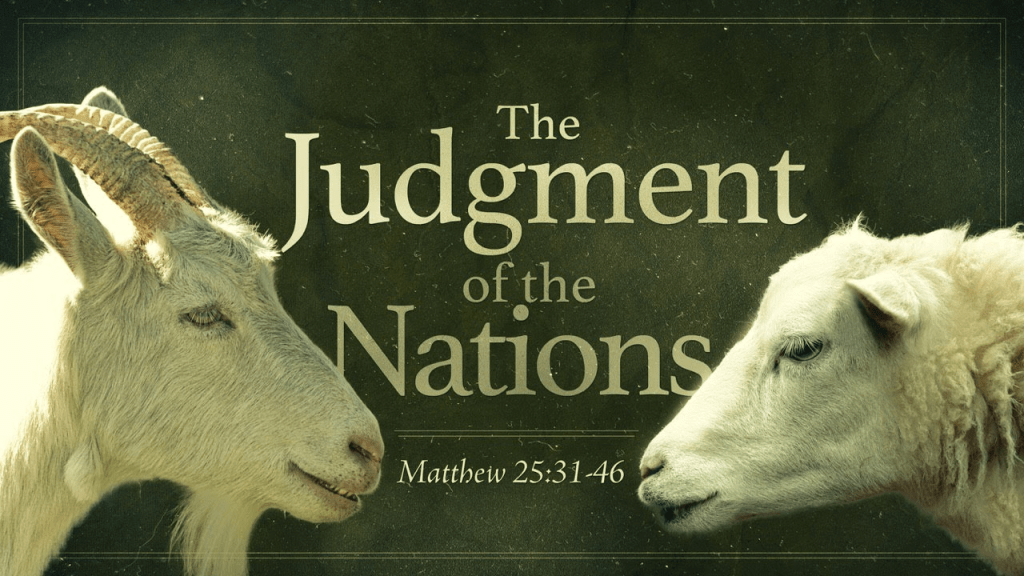
- v.31-46, Judgment of Nations/Sheep or Goats. Here Jesus teaches the great contrast between His elect and those who are forever outside the Kingdom of God.
The first two of these (we will not be digging into here) support the last. In the first two, He describes the need to be prepared for His return. In the last (our text) He describes what will happen upon His return.
Christ in the Text (Christology):
• Son of Man (v. 31)
• Shepherd (v. 32)
• King (v. 34, 40)
• Lord (vv. 37, 44).
Over the next four installments, we will look at v.31-46, the Judgements of Nations or the Separation of Sheep and Goats as you prefer, breaking it down as follows:
- v.31-33
- v.34-40
- v.41-45
- v.46
Discover more from Faithful Steward Ministries and FSM Women's Outreach
Subscribe to get the latest posts sent to your email.
 Faithful Steward Ministries and FSM Women's Outreach
One thought on “Devotional Thought – “Final Glory and Judgement” -Part I – 03/12/2024”