
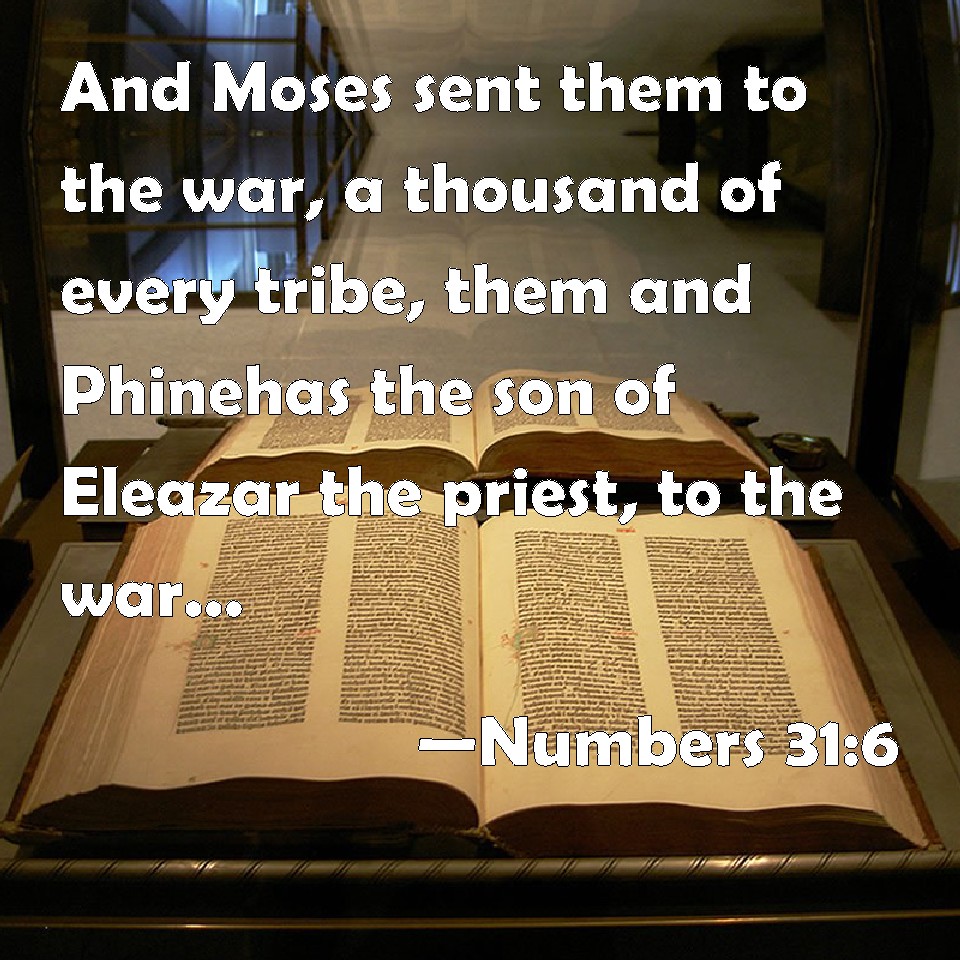
War sucks, one need only look at the nightly news and see the horrible images coming from the Gaza Strip to know that this is true. I know of no soldier/service member who wants war except the deranged. However, as is the case with Israel if you must go to war ensure it is a Holy or righteous war.
The book of numbers is often overlooked or skimmed through as boring. But a careful study can bring a wealth of solid biblical knowledge. Here in Chapter 31, there are four themes that we will look at:
1. Righteous justice – It is hard for folks to read (and in our limited thinking understand) that God commanded the nation of Israel to wipe out a “peoples group” the Midianites. Yet the command is justified 1The Midianites were the posterity of Abraham by Ketuarah, Gen. 25:2. Some of them settled south of Canaan, among whom Jethro lived, and they retained the worship of the true God; but these were settled east of Canaan, and had fallen into idolatry, neighbors to, and in confederacy with, the Moabites. Their land was not designed to be given to Israel, nor would Israel have meddled with them if they had not made themselves obnoxious to their resentment by sending their bad women among them to draw them to whoredom and idolatry. This was the provocation, this was the quarrel. For this (says God) avenge Israel of the Midianites, v. 2.
Man has always and will always apart from Christ fight the sovereignty of God. We mistakenly think that we know better or that our ways are justified when the truth is only God has cause to seek righteous vengeance against sinful creation.
2. Obedience to God’s commands – Sort of, as usual, the men of Israel twist the command of God to their own liking (sounds like many modern-day “Christians”) when they refuse to eliminate all the Midianites.
3. War and its consequence – The “Holy” War as it is called in many commentaries is not a war like that of the period between 1095 and 1291 in and around Jerusalem. In many ways, they were anything but Holy. No, this war was commanded by God, righteous in that God is just punishing those who sin against Him. 2This must disturb any rational, thinking person because the fact is we are all guilty of sin against God. We all deserve the kind of destruction the Midianites received, and yet we are offered mercy. If we refuse that mercy and refuse to surrender our lives to God, then we will face His justice and the judgment for rejecting His free gift of life. “For the wages of sin is death” (Rom. 6:23). But our great hope, our only hope, is Jesus. He was the perfect sacrifice, and as John tells us, “whoever believes in Him should not perish but have everlasting life” (John 3:16). And even though the wages of sin are death, “the gift of God is eternal life in Christ Jesus our Lord” (Rom. 6:23). All we have to do is come to Him, believe in Him, and throw ourselves on His grace.
4. Ritual purification – War even one commanded by God is a dirty business. Here Moses instructs the soldiers to purify after coming into contact with the dead. While no such law/rule applies today many returning soldiers suffer from PTSD and other issues because they have no time to purify from unholy, unjustified wars. 3They were obliged to purify themselves, according to the ceremony of the law, and to abide without the camp for seven days, till their purification was accomplished. For, 1. They had imbrued their hands in blood, by which though they had not contracted any moral guilt, the war being just and lawful, yet they were brought under a ceremonial uncleanness, which rendered them unfit to come near the tabernacle till they were purified. Thus God would preserve in their minds a dread and detestation of murder. David must not build the temple because he had been a man of war, and had shed blood, 1 Chr. 28:3. 2. They could not but have touched dead bodies, by which they were polluted, and that required they should be purified with the water of separation, v. 19, 20, 24.
Chapter SUMMARY: Numbers 31 presents a stark portrait of war and its aftermath in ancient times. The stringent observance of God’s commandments, the intense purification rituals, and the careful division of spoils highlight the Israelites’ commitment to obeying God in every situation. Amidst the challenging narrative, the chapter challenges us to reflect on the nature of obedience, divine justice, and our response to God’s commands in our lives.
Topic CONTEXT 31:6–12: The model for holy war has the priest Phinehas accompanying the army of twelve thousand into battle, taking the sanctuary vessels for purification rites and the trumpets for sounding the battle alerts (10:1–10). Centuries later, the Dead Sea scroll document, styled “The War of the Sons of Light and the Sons of Darkness,” replicates this model. The passage presents a terse summary of the battle in a typical OT narrative fashion with an expansion of detail regarding the proper disposition of spoils of war. The section emphasizes how the purity of the congregation is maintained and how the goods are distributed proportionately among the twelve tribes and the priests and Levites.
31:13–24 The purpose of holy war was the eradication of impure elements, whether persons or property, from a given geographic region. This passage harks back to the idolatrous activity of Baal-peor (chap. 25) and sets the stage for the instructions in 33:50–56 for occupying the promised land by dispossessing the Canaanites and eradicating the marks of their false religion. Hence it is integral to the main theme developed in the book of Numbers: the dangers of rebellion and idolatry. Critics, who suggest this holy-war mentality was a crude feature of ancient cultures and not in keeping with God’s purpose for humanity, have ignored the fact that these instructions were applicable at this critical point in the formation of the theocracy of Israel. Their very survival as the holy community of faith was at stake. Chapter 31 is consistent with the directives given in other pentateuchal passages, including Dt 7:5, 24–25; 12:1–12; 20:16–20 (purging of idolatry); and Dt 21:10–14 (female captives). However, the law of Christ, the law of love, supersedes the instructions for Israel in the era of Moses and Joshua. While God still abhors every kind of evil in society, and the people of God must diligently oppose its every expression, “holy war” of the kind recorded here is not the proper response.
R. Dennis Cole, “Numbers,” in CSB Apologetics Study Bible, ed. Ted Cabal (Nashville, TN: Holman Bible Publishers, 2017), 204.
.

or Text 838255
.
.

.
Discover more from Faithful Steward Ministries and FSM Women's Outreach
Subscribe to get the latest posts sent to your email.
 Faithful Steward Ministries and FSM Women's Outreach