

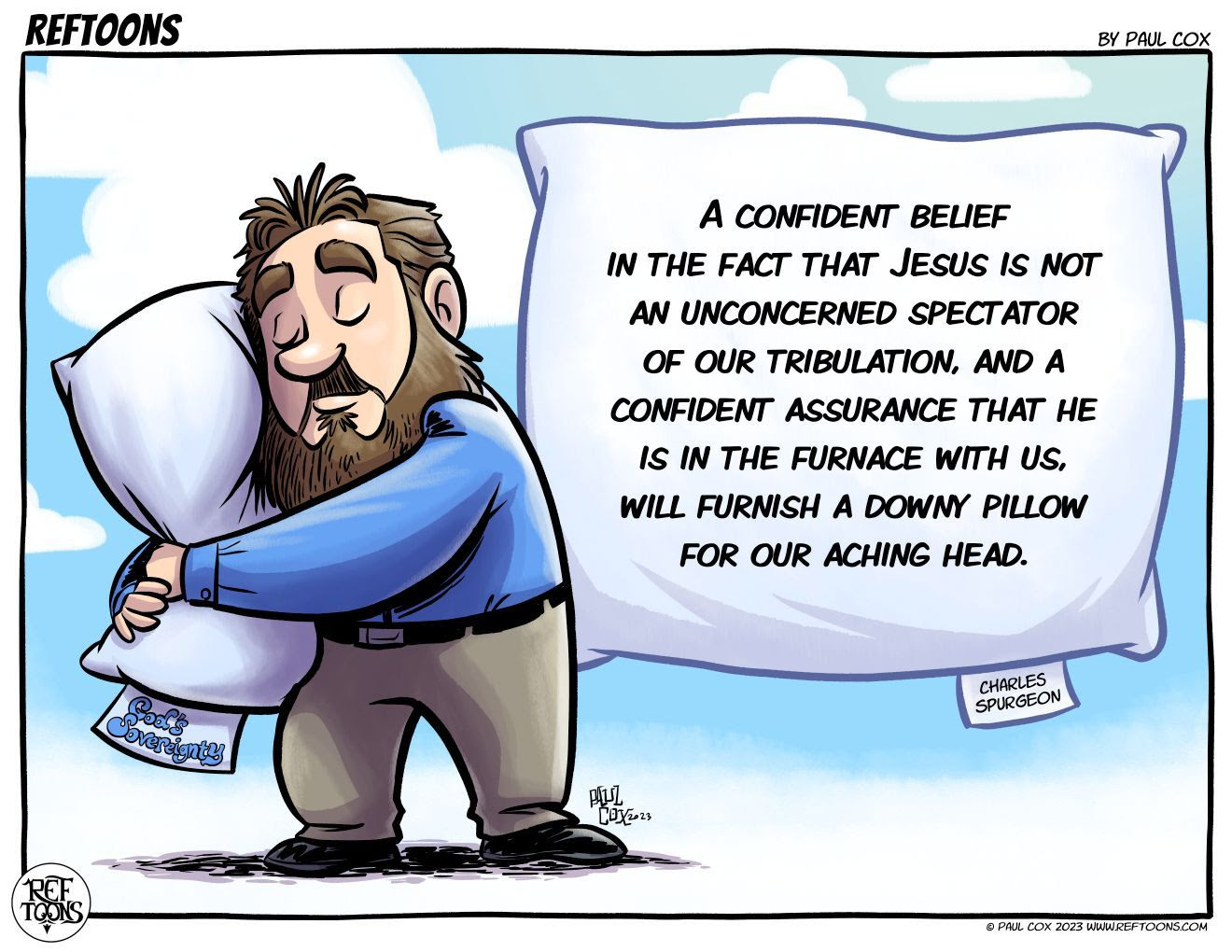
God’s Sovereignty is a fundamental principle of the Christian faith. If God is not in control, if He is just some bystander waiting to see how things play out, why worship Him? How could that make Him worthy of such glory, honor, and praise?
Only the God of the Bible, Father, Son (Jesus), and Holy Spirit can meet the attributes of a Sovereign God. The sort of God that allows us to rest our heads easy at night even in a world seemingly gone mad.
SOVEREIGNTY—of God, his absolute right to do all things according to his own good pleasure (Dan. 4:25, 35; Rom. 9:15–23; 1 Tim. 6:15; Rev. 4:11).
M. G. Easton, Illustrated Bible Dictionary and Treasury of Biblical History, Biography, Geography, Doctrine, and Literature (New York: Harper & Brothers, 1893), 641.
sovereignty of God. God’s authority and power to accomplish his will as the supreme Ruler of all things. God expresses his sovereignty through his *decrees and actions, which are planned in complete independence from anything outside himself and enacted throughout *redemptive history. The Reformed tradition recognizes God’s sovereignty over all creation and particularly in his acts of *predestination, *effectual calling, *justification and *glorification of his people. This sovereignty is linked paradoxically and inseparably with human responsibility in a way that resists merely mechanical determinism, although Reformed theologians differ on the nature of human *free will. God’s sovereignty serves as a source of great comfort to Christians, whose hope rests in a God who controls all things for the good of his people and creation.
Kelly M. Kapic and Wesley Vander Lugt, Pocket Dictionary of the Reformed Tradition, The IVP Pocket Reference Series (Downers Grove, IL: IVP Academic, 2013), 112–113.
.
Discover more from Faithful Steward Ministries and FSM Women's Outreach
Subscribe to get the latest posts sent to your email.
 Faithful Steward Ministries and FSM Women's Outreach