
COMMENTS and COMMENTARIES
I have often written on this doctrine because I am convinced discernment should be a part of every Christians daily life. It is how we make judgments based upon our Biblical worldview. Look at the progression of Webster’s dictionary below. Note that no negative connotation (discrimination) was attached to this until the 1913 revision. (continued below)
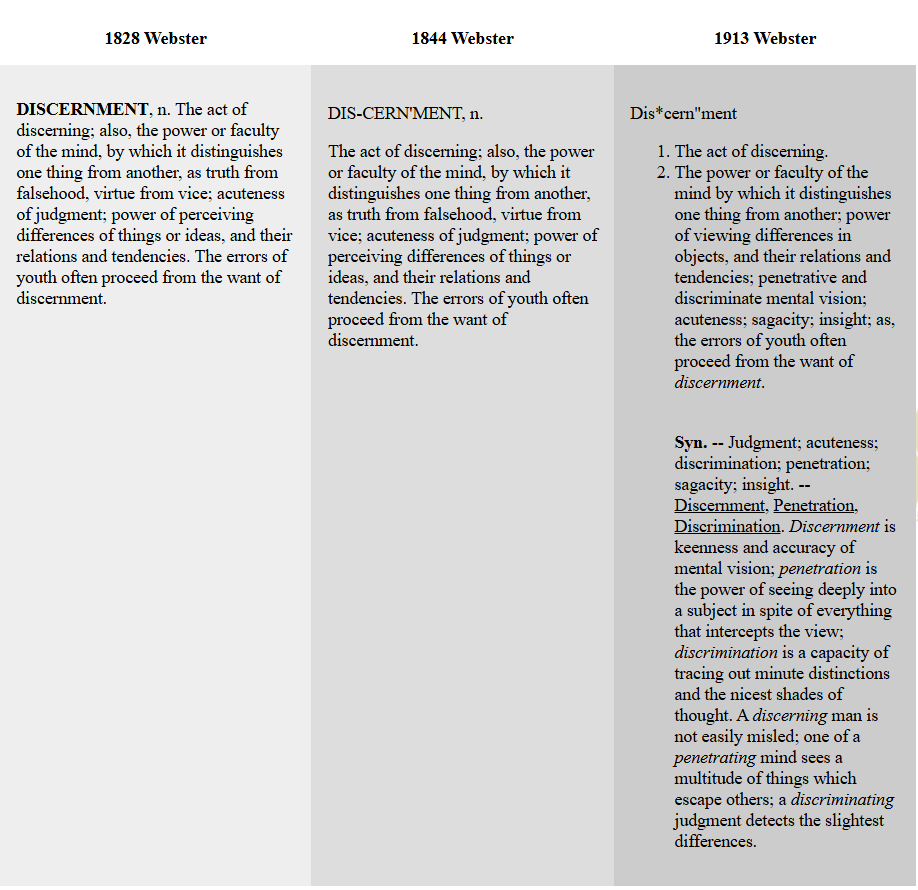
The latest version can be summarized (AI) as: “discernment,” according to Merriam-Webster, is the power or faculty of the mind by which it distinguishes one thing from another, such as truth from falsehood or virtue from vice. It emphasizes accuracy in judgment and the ability to perceive differences in things or ideas. Additionally, it can refer to the act of discerning and the acuteness of judgment. The key to discernment and what Matthew 7:1 is pointing out about judging others is clearly stated: the faculty of the mind by which it distinguishes one thing from another, such as truth from falsehood or virtue from vice, discernment is not condemnation, it is recognition.
1 John 4 Summary Testing the Spirits
Verses 1–3 – Test the Spirits
John warns believers not to accept every spiritual claim at face value. Instead, they must “test the spirits” to see whether the message comes from God. The sure test: a genuine spirit confesses that Jesus Christ has come in the flesh. Any spirit that denies this is of the antichrist.
Verses 4–6 – Victory Over Falsehood
Believers have already overcome the deceivers because “the One who is in you is greater than the one who is in the world.” False teachers speak from the world’s viewpoint and the world listens to them. Those who know God will heed the apostolic testimony, revealing the clear line between the Spirit of truth and the spirit of error.
Verses 7–12 – Love Comes from God
Love originates in God’s own nature. Everyone who truly loves shows evidence of being born of God. God’s love was made visible when He sent His only Son to atone for sin. If God has loved us like this, we must love one another; through such love, God’s unseen presence becomes tangible.
Verses 13–16 – Assurance Through the Spirit
The indwelling Spirit provides the believer’s confidence that God remains in him. The apostles testify that the Father sent the Son to be Savior of the world. Confessing Jesus as the Son of God brings mutual abiding: God in the believer and the believer in God. Because God is love, remaining in love is the same as remaining in God.
Verses 17–19 – Perfect Love and Fear
When love is brought to maturity, it produces boldness for the coming day of judgment, for “in this world we are just like Him.” Perfect love drives out fear, since fear is tied to punishment. We love because He loved us first.
Verses 20–21 – The Command to Love One Another
Claiming to love God while hating a brother is impossible; such a claim is a lie. Visible love toward fellow believers is the proof of invisible love toward God. The command is direct: whoever loves God must also love his brother.
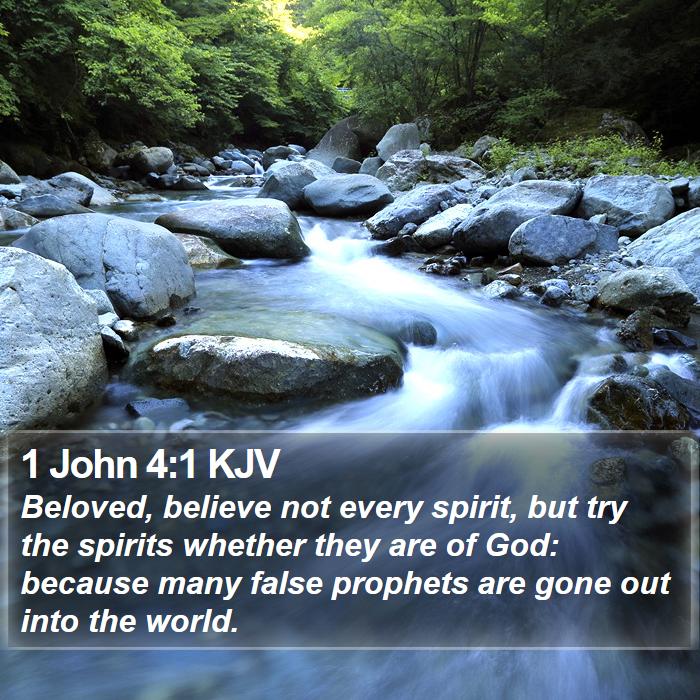
v.1 do not believe every spirit A simpleton believes every word that he hears, but “the wise man can see where he is walking” (Eccl 2:14). He examines what he sees and hears, and does not blindly accept whatever may be told to him.
test the spirits to determine if they are from God “Consider how you listen” (Luke 8:18), and consider what you listen to; we should not entrust ourselves to every person who professes to be a spiritual instructor. I will give you one good test: see whether they search and probe you. Rest assured that the Lord has not sent those that speak smooth words and never trouble your conscience or make you search yourselves. “If you utter what is precious and not what is worthless, you will be as my mouth” (Jer 15:19), says the Lord to His prophets, but not otherwise.
many false prophets have gone out into the world It was so in John’s day; it is so in these days. If there were only one false prophet, we should have need to be on our guard, but “many false prophets have gone out into the world.” If false prophets were all shut up in a cage and we had to go to seek them, there might be some danger from them, but there is so much more danger now.
Charles Spurgeon, Spurgeon Commentary: 1 John, ed. Elliot Ritzema, Spurgeon Commentary Series (Bellingham, WA: Lexham Press, 2014), 1 Jn 4:1.
Here are three verses that clearly show the need for a discerning spirit:
Hosea 14:9 – Who is wise, that he may understand these things? Prudent, that he may know them? For the ways of the Lord are right and the [uncompromisingly] just shall walk in them, but transgressors shall stumble and fall in them. [Ps. 107:43; Isa. 26:7; Jer. 9:12; Dan. 12:10.]
Philippians 1:9–10 – And this I pray: that your love may abound yet more and more and extend to its fullest development in knowledge and all keen insight [that your love may display itself in greater depth of acquaintance and more comprehensive discernment], 10 So that you may surely learn to sense what is vital, and approve and prize what is excellent and of real value [recognizing the highest and the best, and distinguishing the moral differences], and that you may be untainted and pure and unerring and blameless [so that with hearts sincere and certain and unsullied, you may approach] the day of Christ [not stumbling nor causing others to stumble].
Hebrews 5:14 – But solid food is for full-grown men, for those whose senses and mental faculties are trained by practice to discriminate and distinguish between what is morally good and noble and what is evil and contrary either to divine or human law.
The Amplified Bible (La Habra, CA: The Lockman Foundation, 1987), Ho 14:9–Heb 5:14.
Discernment, Spiritual. In 1 Corinthians 12:10 it is written that the Holy Spirit gives to some individuals the discerning of spirits: the wisdom in making keen judgments, the ability to discriminate and perceive with insight, and to recognize or identify good and evil in a separate and distinct way. Spiritual discernment is a subjective and experiential ability to understand and interpret a religious experience and spiritual condition. The seeker of God, in humility and love, desires to be led by the Spirit in all ways (Gal. 5:18; Rom. 8:14). This religious experience strengthens the awareness of believers as “the children of God” (Rom. 8:14–17), forming a dependency and interactive communication with God through prayer and action.
Closely connected to spiritual discernment, especially when the community and its life are involved, is the spirit of prophecy. The Christian community is warned in 1 Thessalonians 5:19–22 to take care not to quench the Spirit or despise prophesyings. In all matters, refraining from all evil and testing or proving of everything to ensure that it is good (i.e., of God) is essential. When individuals depend on their own fallible knowledge and abilities, failing to recognize that all power comes from God, they are led into falsehood, temptation, false pride, and a breach in communication with God and divine will. Only constant reliance upon God can make possible the understanding of good and evil, should God choose to imbue an individual with such a gift or experience. Slipping on the rocks of pride and independence from God, even momentarily, caused one as devout as Moses to lose his spiritual balance and to forfeit entering the promised land with his people. Peter, momentarily taking his eyes off of Jesus and focusing instead on the boisterous wind and his fear of slipping, lost his footing in the water and began to sink. Only when he once again looked to Jesus was he connected to the divine and able to discern the good (strong faith in God) and evil (doubting God’s salvific grace; Matt. 14:27–31).
Although the Old Testament does not speak of spiritual discernment in that terminology, it describes the intervention of prophetic interpretation and the presence of God in directing the Jewish community and its daily life. Guidelines were set by which people might judge the validity of what prophets spoke (Deut. 18:21–23).
Discriminating between the Spirit of God and a counterfeit, evil spirit involves a judgment by discerners of their fruits or what their actions bring about. Where the true Spirit is present, the spiritual discerner has taken much care, through the help of God, to be pure, moral, a devout believer, trustworthy, loving of others, generous, loyal, temperate, and peace-loving. For the Christian, acknowledging Jesus Christ as Lord and Savior comes from the teaching and guidance of the Spirit (1 Cor. 3:3). Then, choosing to live in the Spirit and to follow the leading of the Spirit, certain individuals are able to discern the direction in which the Spirit guides. Paul, speaking of the transforming power of the Spirit to renew the mind so that the person might discern the will of God, what is good, pleasing, and perfect (Rom. 12:2), describes the development of a Christian into a spiritual person who is then able to judge all things. In this way people who are given the gift or awareness by the Spirit are allowed to share in God’s wisdom on some matters. Extreme humility is required, since in no way is the created ever to equate ability to discern with being equal to the Creator. This was the grievous sin of Lucifer.
Discernment of evil could come about through sincere prayer, a dedicated spiritual life, and a strong desire to stay close to God and under divine protection from evil. Focusing so much on the good and thus on God allows the individual to see the contrast of good and evil. However, where there is sin and self-seeking, there will be distortion of purpose and thinking. Satan will be able to deceive, making the ungodly appear acceptable and attractive to the superficially righteous.
A possible serious error that some religious leaders may make concerns not only correctly discerning spiritual gifts of other believers, including spiritual discernment, but also encouraging such gifts and their sharing and not envying those with keen insight in detecting good from evil. Scripture tells us that in the last days women and children will prophesy and that, if God’s people do not bear witness for Christ as Savior, the very rocks would speak out for him. Such prophesying and witnessing require spiritual discernment of good and evil and of the sacred and the secular. The survival of the community of believers depends on at least some of its members remaining in close relationship with God to discern and instruct others in the divine life and holy goals.
C. A. Rayburn, “Discernment, Spiritual,” in Baker Encyclopedia of Psychology & Counseling, ed. David G. Benner and Peter C. Hill, Baker Reference Library (Grand Rapids, MI: Baker Books, 1999), 353.
DEVOTION/STUDY

Why Christians are more frustrated than ever and desperately need discernment
CONCLUSION and RELATED ARTICLES
I hope that everyone understands the greatest fear we should have as believers comes not from unbelievers; their lies are pretty easy to spot. No, as 1 John 4 makes clear, these false preachers and teachers have gon out from among us. Claiming to be doing the will of God, they are spirit-led but not Holy Spirit-led. It is against these soothsayers that one must practice Biblical discernment daily. It is the duty of all children of God to challenge their preachers/teachers, as the Bereans (Acts 17:11), and devote time to the study of God’s Word that we may become approved workers (2 Timothy 2:15) of the Kingdom
Discover more from Faithful Steward Ministries and FSM Women's Outreach
Subscribe to get the latest posts sent to your email.
 Faithful Steward Ministries and FSM Women's Outreach