
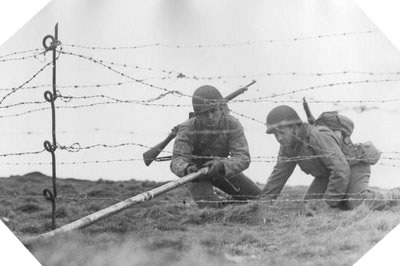
Maybe it is just me but the first thing that comes to mind when I hear the word Breech or Breecher is a scene from the movie D-Day where the soldiers were trying to lace together Bangalore torpedoes to Breech the German coastal defenses.
CONTEXT
Israel’s hypocritical fasting (58:1–12). When God ordered His messenger to rebuke the people for their rebellion, they seemed surprised. They publicly affirmed they were “eager for God to come near them,” and they “fasted” and “humbled” themselves (perhaps through the wearing of sackcloth and through public prayer; see 2 Chron. 7:14; Joel 1:13–14; Jon. 3:5–9). But God saw their hearts and knew they were insincere. As they fasted, they continued to exploit their workers, and their fasts would often end in physical violence (“striking each other with wicked fists”). But change could be brought about by a true fast. Injustice, oppression, and the lack of care for the poor would disappear. “Then you will call, and the LORD will answer.”
Israel’s hypocritical Sabbath-keeping (58:13–14). Isaiah introduced a second illustration to show the insincerity of the people. Evidently the people chafed under God’s Sabbath regulations and failed to follow His command. They were doing as they pleased and “going [their] own way.” But if they would keep the Sabbath, they could then “feast on the inheritance” promised to their forefather Jacob.
Israel’s violence and injustice (59:1–8). Israel’s problems were not caused by God’s inability to rescue them. His arm was not “too short” to reach out to them, nor were His ears “too dull” to hear their cries of distress. If God was not the problem, then who was? Isaiah answered in 59:2 with a scathing accusation against the people. One can almost feel the tip of his finger pressed against the people’s chest as he pointed to them and said, in effect, the problem is you! Verses 2–3 repeatedly use the words “you” and “your.” It was their sins that separated them from God and kept Him from responding to their pleas for help. With hands full of blood and mouths full of lies, “their thoughts are evil thoughts; ruin and destruction mark their way.” In Romans 3:15–17 the apostle Paul quoted from this passage to stress God’s condemnation of all humanity because of sin.
Charles Dyer et al., Nelson’s Old Testament Survey: Discover the Background, Theology and Meaning of Every Book in the Old Testament (Nashville, TN: Word, 2001), 578–579.
v.12 And they that shall be of thee shall build the old waste places: thou shalt raise up the foundations of many generations; and thou shalt be called, The repairer of the breach, The restorer of paths to dwell in.
They that shall be of thee, i.e. either, 1. A remnant of thee among the captivity, that shall be as persons raised from the dead; or, 2. Thy posterity, expressed thus, because they sprang or proceeded from them. The old waste places, Heb. wastes of eternity, i.e. which have lain long waste; for holam doth not always signify what is bounded by no time, but what respects a long time, looking either forward, as Gen. 13:15; Exod. 21:6, or backward, as here, viz. the space of seventy years, and so may truly be rendered the wastes of an age. By waste places he means the city and temple, with cities and places adjacent, turned as it were all into a waste, or wilderness, void and untilled, and which was done not only by Nebuchadnezzar king of Babylon, but by Sennacherib also, and the other kings of Assyria. They had lain so long desolate, that the foxes inhabited them instead of men, Lam. 5:18. And it was turned so much into a desert, that they were forced to fight with the beasts that possessed it to get their food, Lam. 5:9. The foundations of many generations; either the foundations that were laid many generations ago, as those of Jerusalem, which was not only built, but was the head of a kingdom, in the days of Melchizedek, who was king thereof in the days of Abraham, as appears, Gen. 14:18; if that Salem were Jerusalem, as is generally agreed, and Josephus writes, lib. 1. Antiquit. cap. 10; who was born about the three hundredth year after the flood: the superstructures were now destroyed, viz. of Jerusalem, and divers other cities. Or, that shall continue for many generations yet to come.
Thou shalt be called; thou shalt be honoured with this title, as we use to say the father of our country, i.e. deservedly so called, because thou art so; the like phrase chap. 48:8. The repairer of the breach: breach is put here collectively for breaches, which were made by God’s judgment breaking in upon them in suffering the walls of their towns and cities to be demolished, and their state broken, chap. 5:5. The restorer of paths; such a one was Moses, Psal. 106:23. And this tends to the same sense with the former expression, because men were wont to make paths over those breaches, to go the nearest way. Or it may more particularly point at the recovering of the ancient paths, and bringing them into their wonted course, which were either those chief streets through the gates of the cities, or other lanes out of those streets, which were now forgotten and lost, partly by being covered with rubbish, and partly by those shorter paths that were trod and made over the breaches; such a restorer of paths was Nehemiah, Neh. 6:1. And we read of the several repairers he made use of, Neh. 3. Or those paths that led from city to city, which being now laid desolate, and uninhabited, were grown over with grass and weeds, for want of travellers, or safety of travelling, (of something a like case we read in the time of the judges, Judg. 5:6, 7,) and so lost as in a wilderness, wherein there is no way; and by building up those cities again the several paths leading to them would be restored. To dwell in; these accommodations being all recovered, their ancient cities might be fit to be reinhabited.
Matthew Poole, Annotations upon the Holy Bible, vol. 2 (New York: Robert Carter and Brothers, 1853), 463.
DEVOTION
Morning, August 24
“The breaker is come up before them.” —Micah 2:13
Inasmuch as Jesus has gone before us, things remain not as they would have been had he never passed that way. He has conquered every foe that obstructed the way. Cheer up now thou faint-hearted warrior. Not only has Christ travelled the road, but he has slain thine enemies. Dost thou dread sin? He has nailed it to his cross. Dost thou fear death? He has been the death of Death. Art thou afraid of hell? He has barred it against the advent of any of his children; they shall never see the gulf of perdition. Whatever foes may be before the Christian, they are all overcome. There are lions, but their teeth are broken; there are serpents, but their fangs are extracted; there are rivers, but they are bridged or fordable; there are flames, but we wear that matchless garment which renders us invulnerable to fire. The sword that has been forged against us is already blunted; the instruments of war which the enemy is preparing have already lost their point. God has taken away in the person of Christ all the power that anything can have to hurt us. Well then, the army may safely march on, and you may go joyously along your journey, for all your enemies are conquered beforehand. What shall you do but march on to take the prey? They are beaten, they are vanquished; all you have to do is to divide the spoil. You shall, it is true, often engage in combat; but your fight shall be with a vanquished foe. His head is broken; he may attempt to injure you, but his strength shall not be sufficient for his malicious design. Your victory shall be easy, and your treasure shall be beyond all count.
“Proclaim aloud the Saviour’s fame,
Who bears the Breaker’s wond’rous name;
Sweet name; and it becomes him well,
Who breaks down earth, sin, death, and hell.”
C. H. Spurgeon, Morning and Evening: Daily Readings (London: Passmore & Alabaster, 1896).
Discover more from Faithful Steward Ministries and FSM Women's Outreach
Subscribe to get the latest posts sent to your email.
 Faithful Steward Ministries and FSM Women's Outreach