
[Christ] can make the dry, parched ground of my soul to become a ‘pool,’ and my thirsty, barren heart as ‘springs of water.’
Yes, He can make this ‘habitation of dragons’—this heart, so full of abominable lusts and fiery temptations—to be a place for ‘grass’ and fruit to Himself (Isa 35:7).”
– – John Owen – The Mortification of Sin
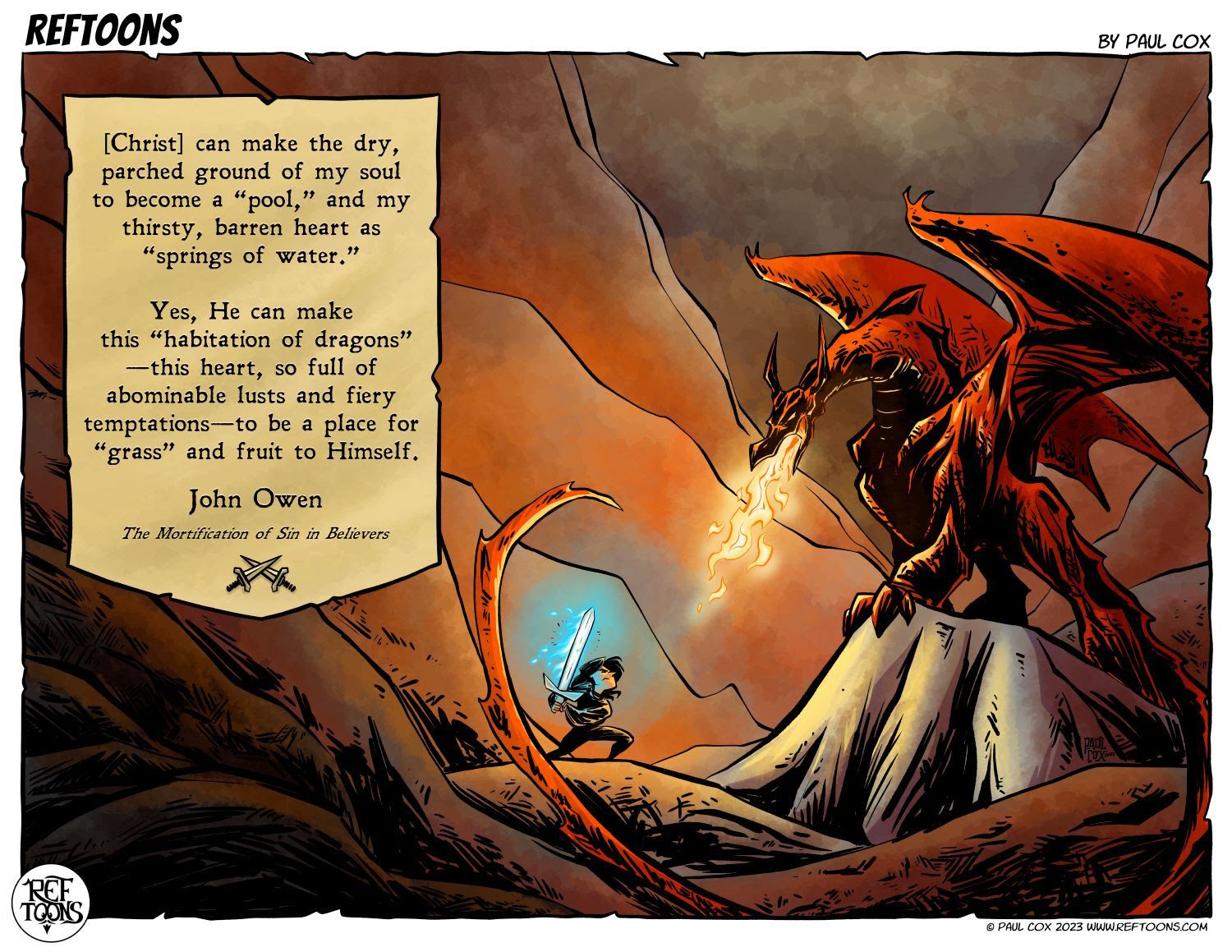
Everyone, Christian or not goes through periods in their lives of barren parched desert-like conditions. It is how we pass through these that matters as believers. Do we become disgruntled, complain to God, and even lose Faith? Or do we hold fast to the promises of God for the greater glory that awaits His chosen?
DEVOTIONAL
Isaiah 35 Waters in the Wilderness
It is fitting that the last oracle of the first section of Isaiah should be one which rejoices in God’s salvation. In the preceding chapters we have frequently noted the certainty of judgement, which included the deportation of many of the survivors to Mesopotamia, the seat of the great world-powers of Assyria and Babylon. Such was the vision of Isaiah that he looked beyond the period of chastisement to the time when God would fulfil His gracious purposes to His people, in their own land. This inevitably involved the return from captivity, and it is this which is depicted so movingly in ch. 35. This future event would be as great a miracle as the Exodus from Egypt in the time of Moses, when God led, protected and supplied the needs of those whom He had redeemed. The route from the Tigris-Euphrates basin involved traversing some desolate, arid areas, but these would be transformed and the journey of the returned exiles would be a march of triumph. Those who were weak and crippled in spirit or tongue-tied because of despair would be encouraged and liberated as the Lord opened up His way before them (3–9). Once more there was the prospect of worshipping the Lord in Jerusalem in an atmosphere of radiant joy which banished for ever the shadows of the past (10).
The writer was ‘introduced’ to this lovely psalm by a fellow officer on H.M.S. Indefatigable during the war years of 1944/45. A Christian, with a glowing testimony to a living Christ, he revelled in this passage. Our ‘desert’ was not one of sand but a waste of sea, at action stations, with danger and privation in close attendance and so many of the normal amenities of life removed. But God, we realized, was able to transform the most desolate situation, and the small Christian group on board enjoyed ‘waters in the wilderness’ and ‘streams in the desert’ (6). Situations vary from year to year and from individual to individual, but God never changes. He remains the God of the impossible, there is nothing too hard for Him. The ‘desert’ through which you are passing today, or may be called to pass through in the future, can ‘rejoice and blossom abundantly’ (2) and you too may see His glory and majesty in His work of deliverance (2, 4).
Arthur E. Cundall, Psalms–Malachi, vol. 2, Daily Devotional Bible Commentary (Nashville, TN: A. J. Holman Company, 1974), 225.
RESOURCES
Chapter CONTEXT From MHCC: As after a prediction of God’s judgments upon the world (ch. 24) follows a promise of great mercy to be had in store for his church (ch. 25), so here after a black and dreadful scene of confusion in the foregoing chapter we have, in this, a bright and pleasant one, which, though it foretel the flourishing estate of Hezekiah’s kingdom in the latter part of his reign, yet surely looks as far beyond that as the prophecy in the foregoing chapter does beyond the destruction of the Edomites; both were typical, and it concerns us most to look at those things which they were typical of, the kingdom of Christ and the kingdom of heaven. When the world, which lies in wickedness, shall be laid in ruins, and the Jewish church, which persisted in infidelity, shall become a desolation, then the gospel church shall be set up and made to flourish. I. The Gentiles shall be brought into it (v. 1, 2, 7). II. The well-wishers to it, who were weak and timorous, shall be encouraged (v. 3, 4). III. Miracles shall be wrought both on the souls and on the bodies of men (v. 5, 6). IV. The gospel church shall be conducted in the way of holiness (v. 8, 9). V. It shall be brought at last to endless joys (v. 10). Thus do we find more of Christ and heaven in this chapter than one would have expected in the Old Testament.
35:1–10 Commentary: A shift of scene occurs here. The desert that Edom had become (34:8–15) was no longer in view; this passage was a poetic image of the Wilderness of Judah coming to life again, with the return of “the redeemed of the LORD” to Zion (v. 10). Jerusalem did not fall during Isaiah’s time, so a “return” did not occur then; therefore, many interpreters consider that, in this passage, Isaiah was looking ahead to the time of the Jews’ return from exile in Babylon more than a century and a half later. Some commentators consider this passage the work of an inspired, but unnamed, disciple of Isaiah (his disciples were mentioned in 8:16) who wrote during the exile, though there is nothing here that specifically points to a later date of composition. Other interpreters view this passage as a picture of the time when God will establish his kingdom (2:2–4), and his people “will see the glory of the LORD” (35:2). The promise that “God himself will be with them” (Rv 21:3) and “they will see his face” (Rv 22:4) is reinforced at the end of the NT; the same writer also affirms that, in Christ, “we observed his glory” (Jn 1:14).
Gary Smith, “Isaiah,” in CSB Apologetics Study Bible, ed. Ted Cabal (Nashville, TN: Holman Bible Publishers, 2017), 850.
LOCALIZED AND WORLDWIDE JUDGMENT AND REDEMPTION (31:1–35:10)
The last two oracles in chapters 28–33 have the same pattern of judgment followed by restoration, but the restoration section in both is greatly expanded. Zion will be ruled by a righteous and just king who will govern over a restored nation that not only seeks justice and righteousness but also will be a place of peace and safety. This section reaches a climax with oracles of judgment (chap. 34) and restoration (chap. 35). God will arise and punish the wicked, but will also bring great restoration, blessing, peace, and joy to his people in Zion.
Douglas Mangum, ed., Lexham Context Commentary: Old Testament, Lexham Context Commentary (Bellingham, WA: Lexham Press, 2020), Is 31:1–35:10.
v.7–10. Commentary: See how the blessings of redemption, in the gifts of the Holy Ghost, are beautifully set forth, under the similitude of rivers and streams of water. And when that Holy Spirit came down, agreeably to our Lord’s own blessed promise, on the day of Pentecost; and ever since, when he comes down on the souls of his people, is not the Spirit poured out from on high, which makes every plant in the garden of Jesus to flourish? What is that river, the streams whereof make glad the city of God, but God in his threefold character of persons; Father, Son, and Holy Ghost; from whom, as from an ocean, all the streams of spiritual life, grace, comfort, and consolation, flow? I pray the Reader to consult some of the numberless scriptures where these truths abound; Psalm, 46:4. John, 7:37–39. Isaiah, 55:1. John, 4:10–14. Rev. 22:1, 2. Reader! do not fail to remark, how full of blessings this chapter is, in promises to the redeemed. The close of the chapter forms indeed a short, but comprehensive description of the safety and felicity of the Church, until grace is consummated in glory. There shall be a way for the redeemed to come; and this shall be an highway; a way not to be mistaken: in which there shall be no lion nor ravenous beast. Every redeemed soul shall travel it; the unclean shall not pass it; but the wayfaring man shall not err in finding it, however weak in other things his understanding may be. And the whole ransomed shall pass it, and sing the song of redemption, with everlasting joy, when sorrow and sighing is done away for ever. And who doth not see in all this, the whole outlines of redemption plainly marked? Jesus is the way, and the truth, and the life. And as none cometh to the Father but by him; so all and every one that doth come, he will in no wise cast out, John, 14:6. and 6:37. And Jesus is the highway, and the way of holiness; for the holiness of his redeemed is in him, and by him. And what is an highway, but a way open to travellers? Every poor traveller to Zion can go no other way; neither will the king of it, even Jesus, suffer such as are asking the way to Zion, with their faces thitherward, to err in the way. Saw ye him whom my soul loveth? They shall hear a voice behind them, saying, This is the way, walk ye in it, when ye turn to the right hand and when ye turn to the left. Neither shall that roving lion, the devil, overcome, nor even exercise the travellers in this way unnecessarily. Jesus hath conquered him for them; and will finally conquer him in them. One perpetual song belongs to the redeemed; and, saith this scripture, they shall sing it in their coming and return. Reader, by way of confirmation, turn to those scriptures, Jerem. 50:4, 5. Song, 3:3. Isaiah, 30:21. 1 Cor. 10:13. Rev. 7:9 to the end.
Robert Hawker, Poor Man’s Old Testament Commentary: Proverbs–Lamentations, vol. 5 (Bellingham, WA: Logos Bible Software, 2013), 379–380.
Ver. 7. Commentary: And the parched ground shall become a pool, and the thirsty land springs of water, &c.] Such persons who have been like the parched earth, barren and unfruitful, or like the earth scorched with the sun, filled with a sense of divine wrath, and thirsting, like the dry earth, after the grace of God, Christ, and his righteousness, shall be comforted and refreshed, and filled with the grace of God: or such who have been scorched and parched with the heat of persecution, from the antichristian party, and have been thirsting after deliverance from it, shall now enjoy peace and prosperity: in the habitation of dragons, where each lay; in kingdoms, cities, and towns, inhabited by men, comparable to dragons for their poison and cruelty; where the great red dragon Satan had his seat; and the Pagan emperors, and Papal powers, who have exercised the authority, power, and cruelty of the dragon, dwell; see Rev. 12:3, 4, 9, 15, 17 and 13:2, 11, 12; shall be grass, with reeds and rushes; persons shall spring up, partakers of the grace of God, who, for their number and flourishing estate, shall be like the green grass; and others, still more eminent for their gifts and usefulness, like reeds, or canes and rushes; see Isa. 44:3; Rev. 9:4.
John Gill, An Exposition of the Old Testament, vol. 5, The Baptist Commentary Series (London: Mathews and Leigh, 1810), 199.
v.7 Commentary: The dry place shall be changed into a pool. He confirms the former statement, that Christ will come in order to enrich his people with all abundance of blessings; for waters shall flow out of “dry places.” We must keep in remembrance what we mentioned a little before, that the Prophet delineates to us what may be called a picture of a happy life; for although this change was not openly visible at the coming of Christ, yet with good reason does the Prophet affirm that, during his reign, the whole earth shall be fruitful; for he had formerly said that without Christ all things are cursed to us. In the habitation of dragons. The whole world, therefore, shall resemble a parched wilderness, in which lions, “dragons,” and other wild beasts prowl, till the kingdom of Christ shall be set up; and, on the other hand, when he is established on his throne, the godly shall lack nothing. An instance of this was given, when the Lord delivered his people and brought them out of Babylon; but the accomplishment of this prophecy must be looked for in Christ, through whom their ruinous condition is amended and restored; for that deliverance was but a feeble representation of it. And yet the full accomplishment of this promise ought not to be expected in the present life; for as it is through hope that we are blessed, (Rom. 8:24,) so our happiness, which is now in some respects concealed, must be an object of hope till the last day; and it is enough that some taste of it be enjoyed in this world, that we may more ardently long for that perfect happiness.
John Calvin and William Pringle, Commentary on the Book of the Prophet Isaiah, vol. 3 (Bellingham, WA: Logos Bible Software, 2010), 68–69.
Discover more from Faithful Steward Ministries and FSM Women's Outreach
Subscribe to get the latest posts sent to your email.
 Faithful Steward Ministries and FSM Women's Outreach