Chapter CONTEXT from MHCC: There are two excellent books which the great God has published for the instruction and edification of the children of men; this psalm treats of them both, and recommends them both to our diligent study. I. The book of the creatures, in which we may easily read the power and godhead of the Creator (v. 1-6). II. The book of the scriptures, which makes known to us the will of God concerning our duty. He shows the excellency and usefulness of that book (v. 7-11) and then teaches us how to improve it (v. 12-14).
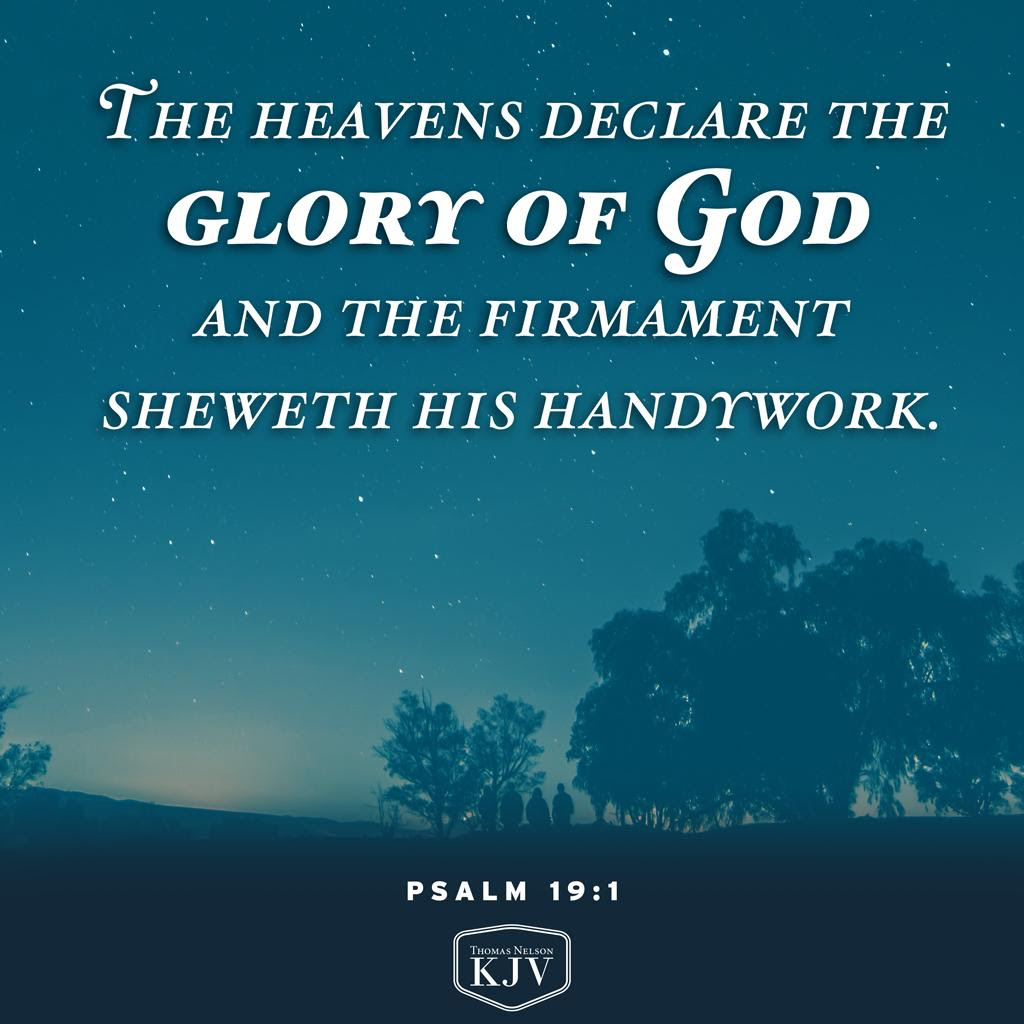
Whenever you run into someone who is a non-believer in God, I am not talking about Christ or Christianity here, we are talking baby steps with an ardent anti-god type individual, you can begin by sharing this verse. Who created the heavens if not God? Here is a rather extensive list of cross-references to these verses from LOGOS and The Treasury of Scripture Knowledge
Ro 1:19 | Because that which may be known of God is manifest in them; for God hath shewed it unto them. Ps 50:6 | And the heavens shall declare his righteousness: For God is judge himself. Selah. Ro 1:20 | For the invisible things of him from the creation of the world are clearly seen, being understood by the things that are made, even his eternal power and Godhead; so that they are without excuse: Ge 1:6 | And God said, Let there be a firmament in the midst of the waters, and let it divide the waters from the waters. Is 40:22 | It is he that sitteth upon the circle of the earth, And the inhabitants thereof are as grasshoppers; That stretcheth out the heavens as a curtain, And spreadeth them out as a tent to dwell in: Ge 1:6–8; Ps 4:2; 8:1, 6; 50:6; 74:16; 89:5; 97:6; 103:22; 139:12; 148:3; Is 6:3; 40:22; Ro 1:18-31
Psalm 19: David describes God’s communication through both His creation and His Word and then his communication with God through prayer.
19:1 heavens. Highest part of God’s creation, representing all creation. declare. Recount. the glory of God. God’s perfections or attributes (Rom. 1:20). firmament. The sky, including the atmosphere and the stars above it (Gen. 1:6–8, 14–17, 20). his handywork. The work of His hands. The universe glorifies God because it reveals its Creator.
19:2 Day unto day uttereth speech. Literally, “[One] day bubbles or gushes forth news or information to [the next] day.” The communication is ceaseless, going on day and night.
Joel R. Beeke, Michael P. V. Barrett, and Gerald M. Bilkes, eds., The Reformation Heritage KJV Study Bible (Grand Rapids, MI: Reformation Heritage Books, 2014), 776.
Thoughts for Personal/Family Worship: Psalm 19
God graciously reveals Himself. This is grace to us, for our knowledge of Him is completely dependent on what He chooses to reveal. God constantly reveals to all mankind His being and basic attributes through the natural revelation of what He created. No one has any excuse for not worshiping the Lord. Yet nature conveys no saving message: it justly condemns man for refusing to glorify God but it does not point to the remedy. God’s special revelation of His Word is the means of grace that reveals the wonderful remedy to condemnation. The Scripture is more precious than gold and sweeter than honey. Nowhere else do we learn of the Lord as the Redeemer of sinners—God in Christ reconciling the world to Himself (2 Cor. 5:19). Praise God for His creation and the Bible which are both means of revelation. Are you taking time each day to read what God has caused to be written?
Significantly, David communes with God in response to God’s communication. There is always a link between God’s Word and prayer. It is a link that we should use daily. While creation should fill us with awe toward God, only the Bible can teach us how to draw near to God as a forgiven and transformed people in acceptable worship. How can we use each benefit of Scripture (vv. 7–11) as a means of guiding our prayers?
Lest anyone think I am cutting short this wonderful song a joy and praise here are two further things that the beleiver should gleen from this Pslam.
THE MEANS OF GRACE The apostle Paul declares, “By grace are ye saved through faith, and that not of yourselves: it is the gift of God: not of works, lest any man should boast” (Eph. 2:8–9). Where does this faith come from? How is this gift of God imparted? The answer of historic Christianity is that it comes from God and by the means of grace that Christ has appointed in His church. All the ordinances, or things commanded by Christ (Matt. 28:20), are in view in this answer, but the primary means is the Word of God, the Holy Scriptures, “which are able to make thee wise unto salvation” (2 Tim. 3:15). David extols the saving power of the Word, declaring that “the law of the LORD is perfect, converting the soul” (Ps 19:7). There is no conflict between faith in the sovereignty of God and use of His appointed means to obtain what He promises to us. As God, the Holy Spirit is free to work when, where, and how He pleases, with or without the use of means. Nevertheless, the means of grace are commended to us by the very fact that the sovereign God commands us to use them. A distinction must be made between the kindness of God shown to all creatures, by which He showers good gifts upon all mankind, just and unjust alike, and that special or saving grace imparted only to God’s elect. The Bible affirms, “The LORD is good to all: and his tender mercies are over all his works” (Ps. 145:9). However, “he sheweth his word unto Jacob, his statutes and his judgments unto Israel. He hath not dealt so with any nation: and as for his judgments, they have not known them” (Ps. 147:19–20). Scripture’s uniqueness as a means of grace lies in its very nature: “The word of God is quick, and powerful, and sharper than any twoedged sword … a discerner of the thoughts and intents of the heart” (Heb. 4:12). However, because of the unbelief, ignorance, and darkness of our fallen, corrupted hearts, the Holy Spirit alone makes the reading and preaching of the Word effectual as a means of grace, using the Word to enlighten our darkness, working faith in our hearts, and enabling us to receive Christ as Savior and to serve Him as Lord. Other means of grace are subordinate to God’s Word. Holy baptism and the Lord’s Supper are the Word of God made visible to confirm the truth of God’s promises to us. Prayer is a means by which those promises are invoked by believers, to “obtain mercy, and find grace to help in time of need” (Heb. 4:16). Praise is a means by which God’s grace, the Word of Christ dwelling in our hearts, is poured forth in thanksgiving to God as we sing the “psalms and hymns and spiritual songs” included in the canon of Scripture at the direction of the Holy Spirit (Eph. 5:18–21; Col. 3:16). We must never attribute efficacy to the means themselves and the bare use of them. The water of baptism cannot wash away sins. The bread and wine of the Lord’s Supper are not and cannot become the life-giving flesh and blood of Christ. A man’s Christianity is not to be measured by the number of sermons he has heard or prayers he has recited. It is possible to do all the right things without a believing heart: “Whatsoever is not of faith is sin” (Rom. 14:23). Even so, those who believe that God has instituted these means of grace make diligent use of them. The church must give first place to the sound preaching of the Word. Her members should hear such preaching with faith and submission, desiring to know, believe, and obey the will of God revealed therein. The sacraments should be administered only in conjunction with such preaching, and must be received in faith by all who would profit from them. To pray effectively, our minds must be filled with the truth of God’s Word. To praise acceptably, our hearts must be filled with the Word of Christ and with the Holy Spirit.
Joel R. Beeke, Michael P. V. Barrett, and Gerald M. Bilkes, eds., The Reformation Heritage KJV Study Bible (Grand Rapids, MI: Reformation Heritage Books, 2014), 776–778.
Discover more from Faithful Steward Ministries and FSM Women's Outreach
Subscribe to get the latest posts sent to your email.

 Faithful Steward Ministries and FSM Women's Outreach